1. Standard Definition and Analysis
1.1 Official Definition and System Positioning
GS1 AI 8006 (Individual Trade Item Piece, ITIP) is an application identifier within the global GS1 standard system, designed to uniquely identify individual components of a trade item. Its official definition is a coding mechanism that assigns unique identifiers to each physically separated component making up a complete trade item, applicable to scenarios where a single sales unit consists of multiple independent physical parts.
Within the GS1 identification system, AI 8006 is positioned at the item-level component identification layer. It fills the technical gap where traditional GTIN (Global Trade Item Number) can only identify complete trade items and cannot distinguish individual components within a set. This identifier allows brand owners to assign independent component numbers to multiple physical components under the same GTIN, maintaining the commercial integrity of the product while enabling component-level traceability and management.
1.2 Technical Parameters of Coding Structure
According to official GS1 specifications, the coding format of AI 8006 is N4 + N14 + N2 + N2, with the detailed structure shown in the table below:
| Field | Length | Character Type | Description |
|---|---|---|---|
| AI Prefix | 4 digits | Numeric only | Fixed value “8006”, indicating an ITIP data segment |
| GTIN-14 | 14 digits | Numeric only | Global Trade Item Number of the complete trade item |
| Piece Number | 2 digits | Numeric only | Sequence number of the current component in the set (01–99) |
| Total Pieces | 2 digits | Numeric only | Total number of components in the trade item (01–99) |
Regular expression validation rule: (\d{14})(\d{4})
The AI is followed by exactly 18 numeric characters: the first 14 digits are the GTIN-14, and the last 4 digits combine the 2-digit piece number and the 2-digit total piece count. The entire data segment (excluding the AI) is fixed at 18 numeric characters with no variable-length portion, occupying 18 bytes in ASCII encoding.
Coding constraints:
- All characters are limited to digits 0–9; letters and special symbols are not supported.
- Both piece number and total piece count are expressed in two digits, padded with a leading zero when necessary.
- The piece number must not exceed the total piece count.
- The total piece count ranges from 01 to 99; 00 is not allowed.
1.3 FNC1 Character Usage Specification
AI 8006 mandates the use of the FNC1 (Function 1) character as a data separator. In GS1-128 barcodes, FNC1 is placed after the start character and before the AI code to indicate that the barcode complies with GS1 application identifier standards.
Position specifications:
- Within the barcode symbol: FNC1 sits between the start character and the first AI.
- Within the data string: When additional variable-length AIs follow AI 8006, FNC1 is used as a field separator.
- In plain-text data exchange: FNC1 is typically represented as ASCII 29 (GS, Group Separator).
1.4 Check Digit Algorithm and Calculation Example
The GTIN-14 field within AI 8006 uses the standard GS1 modulo 10 weighting algorithm to calculate the check digit, with alternating weights of 3 and 1.
Mathematical formula:
Check digit = (10 - (weighted sum mod 10)) mod 10Step-by-step calculation process:
- Weight assignment: Working from right to left (excluding the check digit), alternate multiplying by weights 3 and 1, with the rightmost digit weighted by 3.
- Calculate weighted sum: Sum the product of each digit and its corresponding weight.
- Modulo operation: Take the weighted sum modulo 10.
- Derive check digit: Subtract the remainder from 10, then take the result modulo 10.
Complete calculation example:
Given the first 13 digits of a GTIN: 0950600013435, calculate the 14th check digit.
| Left-to-right position | 1 | 2 | 3 | 4 | 5 | 6 | 7 | 8 | 9 | 10 | 11 | 12 | 13 |
|---|---|---|---|---|---|---|---|---|---|---|---|---|---|
| Digit | 0 | 9 | 5 | 0 | 6 | 0 | 0 | 0 | 1 | 3 | 4 | 3 | 5 |
| Right-to-left position | 13 | 12 | 11 | 10 | 9 | 8 | 7 | 6 | 5 | 4 | 3 | 2 | 1 |
| Weight | 3 | 1 | 3 | 1 | 3 | 1 | 3 | 1 | 3 | 1 | 3 | 1 | 3 |
| Product | 0 | 9 | 15 | 0 | 18 | 0 | 0 | 0 | 3 | 3 | 12 | 3 | 15 |
Weighted sum = 0 + 9 + 15 + 0 + 18 + 0 + 0 + 0 + 3 + 3 + 12 + 3 + 15 = 78
Check digit = (10 – (78 mod 10)) mod 10 = (10 – 8) mod 10 = 2
Complete GTIN-14: 09506000134352
Verification method: Substitute the full 14-digit number including the check digit back into the algorithm. The final weighted sum should be an integer multiple of 10.
2. Core Technical Functions
2.1 Technical Positioning and Supply Chain Value
The core technical value of AI 8006 lies in enabling fine-grained component-level management of set products without consuming additional GTIN coding resources. Under the traditional model, identifying each component in a set separately requires assigning an independent GTIN to each component, which doubles coding resource consumption and breaks the commercial integrity of the product.
Technical advantages are reflected in three dimensions:
- Coding efficiency: A product set occupies only one GTIN resource. The 4-digit component extension enables unique identification of up to 99 components, significantly improving coding efficiency.
- Commercial consistency: All components share the same GTIN master data attributes (product name, price, brand, etc.), maintaining integrity in ordering, settlement and pricing processes.
- Traceability granularity: Supports component-level traceability across production, logistics and after-sales processes, enabling precise root-cause analysis for individual components within a set.
2.2 Association Mechanism with Other GS1 Application Identifiers
Invalid pairing rules: AI 8006 must not be used together with AI 01 (GTIN) or AI 37 (Count). This is because ITIP already embeds the GTIN-14 internally; repeating AI 01 causes data redundancy and semantic conflict. AI 37 indicates the quantity of trade items within a logistic unit, which operates at a different semantic level from component identification.
Association constraints in barcode scenarios:
Under barcode data content rules, AI (22) must be attached to AI (01). AI 22 (Consumer product variant) is not an independent product identifier by itself; it only expresses variant attributes of a product (such as color and size). In the structured data of a barcode, it must exist as an attribute dependent on the primary key AI 01 (GTIN) and cannot appear as an independent data segment.
Synergy mechanisms:
- AI 21 (Serial number): Can be used as a key qualifier combined with ITIP to assign a unique serial number to each component, enabling full-lifecycle traceability at the individual item level.
- AI 10 (Batch / lot number): Identifies the production batch of a component, supporting batch-level quality tracking and recall management.
- AI 22 (Consumer product variant): Must be attached to AI 01 in barcode scenarios, but can directly serve as a qualifier for ITIP in Digital Link URI scenarios (see Chapter 3 for details).
- AI 17 (Expiry date): Can be attached as a data attribute, applicable to set product components with shelf-life requirements.
3. Application of GS1 Digital Link
3.1 URI Construction Rules and Resolution Mechanism
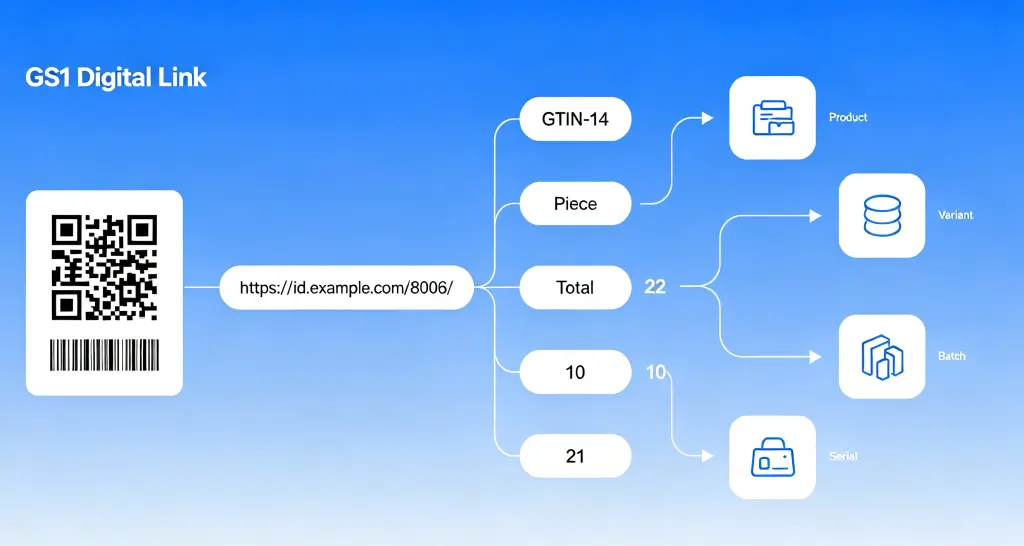
GS1 Digital Link integrates the GS1 identification system with Web URI standards, giving every identified object a unique web address accessible via the Internet. As a primary key identifier in GS1 Digital Link, AI 8006 can directly serve as the core identification element in the URI path.
Standard URI structure:
https://id.example.com/8006/{gtin14}{piece}{total}Path segmentation rules:
- Domain part: Enterprise resolution service domain name (uniformly using id.example.com)
- Primary key segment:
/8006/indicates the primary key type is ITIP - Identification value: 18-digit numeric string = 14-digit GTIN-14 + 2-digit piece number + 2-digit total piece count
- Key qualifiers: Appended as path segments in the fixed order: 22 → 10 → 21
Resolution mechanism:
- The client scans the barcode or enters the URI and initiates an HTTP GET request.
- The resolution server receives the request and extracts the AI identifier and data value.
- Routes to the corresponding brand resolution endpoint based on the GS1 company prefix.
- Returns structured data (JSON-LD) or redirects to the product information page.
- Supports content negotiation, returning data in different formats according to the Accept header.
3.2 Technical Comparison: Digital Link vs. Traditional Barcodes
| Technical Dimension | Traditional GS1-128 Barcode | GS1 Digital Link | Improvement |
|---|---|---|---|
| Data capacity | Approx. 100–200 characters | No theoretical upper limit | Order-of-magnitude increase |
| Information type | Structured coded data only | Rich media + dynamic data | Multi-dimensional expansion |
| Update capability | Immutable after printing | Real-time cloud updates | Dynamically configurable |
| Interaction mode | One-way reading | Two-way interaction | Supports active user queries |
| Traceability depth | Node-based data | Full-chain transparency | End-to-end visibility |
| Consumer reach | No direct access | Scan to product page | New direct-to-consumer channel |
3.3 System Architecture for Full-Chain Traceability
System architecture layers:
- Identification layer: Assigns a unique Digital Link identifier to each component based on AI 8006, printed on component packaging or labels.
- Acquisition layer: Collects identification data via multiple terminals such as industrial scanners, handheld PDAs and consumer smartphones.
- Transport layer: Supports multiple protocols including HTTP/HTTPS and MQTT for uploading identification data to the cloud.
- Resolution layer: GS1 resolution service handles identifier routing and format conversion, returning standardized link targets.
- Application layer: Business applications including supply chain traceability, quality management, consumer services and compliance reporting.
- Data layer: Distributed storage of full-lifecycle component data, with support for blockchain attestation.
Data flow description:
Codes are assigned to each component and associated with production data during production → scanned at warehousing and location-recorded → transport nodes scanned and status updated during logistics → consumers scan codes to obtain product information at retail → component sources are located and recall or repair processes initiated in after-sales.
3.4 Complete Digital Link Example
Basic ITIP Digital Link example:
https://id.example.com/8006/095060001343520102Field breakdown:
8006: Application identifier, indicating ITIP type09506000134352: GTIN-14 (14 digits, check digit = 2)01: Piece number, representing the 1st component in the set02: Total pieces, representing 2 components in total in the trade item
Full example with key qualifiers:
https://id.example.com/8006/095060001343520102/22/BLACK/10/LOT20260701/21/SN88765432Qualifier description:
22/BLACK: Consumer product variant – black version10/LOT20260701: Production batch number – LOT2026070121/SN88765432: Component serial number – SN88765432
Access method: Enter the URI directly in a browser, or scan the QR code with a GS1 Digital Link-compatible scanning application. The system will automatically resolve and return the detailed information page for the corresponding component.
3.5 Association Rules and Qualifier Usage Specifications
Mandatory constraint rules:
- Invalid pairing constraint: Within the same GS1 element string, AI 8006 must not appear together with AI 01 (GTIN) or AI 37 (Count). Quantity information should be implicitly expressed through the total piece count field.
- Dual-scenario rule difference for AI 22:
- Barcode rule (data content): AI (22) must be attached to AI (01). Since (22) is not an independent product identifier by itself, it must depend on the GTIN primary key in the linear data structure of a barcode.
- URI rule (link syntax): AI (22) can serve as a qualifier for AI (8006). Since (8006) is an independent primary key, (22) naturally acts as “supplementary information” in the URI syntax structure and can directly supplement attributes to the ITIP primary key without depending on AI 01.
- Key qualifier combination rule: In GS1 Digital Link, the key qualifier combination for AI 8006 is 22 AND 10 AND 21, meaning the three qualifiers must exist in descending hierarchical order. AI 21 cannot be used alone without AI 10. This design ensures consistency in data granularity.
- Order specification: In the URI path, qualifiers must follow the fixed order of 22 → 10 → 21 and cannot be rearranged.
Compliant vs. non-compliant examples:
✅ Compliant: /8006/.../22/RED/10/BATCH001/21/SER123
✅ Compliant: /8006/.../22/RED/10/BATCH001
❌ Non-compliant: /8006/.../21/SER123/10/BATCH001 (incorrect order)
❌ Non-compliant: Barcode data containing both AI 8006 and AI 22 without AI 01 (violates barcode scenario constraints)
4. Industry Application Practices
4.1 Retail Industry: Omnichannel Management of Apparel Sets
Case background: A well-known menswear brand sells business suit sets consisting of a jacket and trousers. Under the traditional model, separate GTINs led to complex inventory management and mismatched returns and exchanges.
System integration architecture:
- Hardware layer: Fixed scanners on production lines, handheld PDAs in stores, consumer smartphones
- Software layer: ERP system integrated with ITIP coding module, WMS, omnichannel middle platform
- Network topology: Production workshop intranet → enterprise data center → cloud resolution service → public network access
Data acquisition process:
- During cutting and sewing, AI 8006 identifiers are generated for each suit. Jacket and trousers are marked as 01/02 and 02/02 respectively.
- Upon finished goods receipt, scanning the set code automatically associates inventory locations of both components.
- At store sales, scanning any component retrieves full product information and supports separate returns of individual components.
- Consumers can scan the code to view fabric composition, washing instructions and styling recommendations.
Implementation effect evaluation:
- Inventory accuracy improved to 99.7%, component mismatch rate reduced by 87%
- Return and exchange processing efficiency increased by 62%, average handling time reduced from 12 minutes to 4.5 minutes
- GTIN resource consumption reduced by 50%, annual coding maintenance cost reduced by approximately 180,000 RMB
- Payback period of approximately 14 months, three-year ROI estimated at 215%
4.2 Logistics Industry: Multi-Parcel Traceability for Knock-Down Furniture
Case background: A panel furniture brand ships wardrobe products in 3 separate cartons. Traditional methods made it difficult to track the logistics status of each box, resulting in high customer complaint rates.
System integration architecture:
- Hardware layer: Barcodes printed on cartons, logistics sorting scanning equipment, delivery staff handheld terminals
- Software layer: TMS, last-mile delivery APP, customer self-service query platform
- Data flow: Factory coding → outbound scanning → transit sorting → last-mile delivery → customer sign-off
Data acquisition process:
- During packaging, GS1-128 labels with AI 8006 are printed on each outer carton, marked “1/3”, “2/3”, “3/3”.
- Scanning the master carton at outbound automatically verifies that all three pieces are present.
- Scanning any carton at logistics nodes retrieves the full order logistics information.
- Consumers can check real-time delivery progress of each component via the Digital Link URI.
Implementation effect evaluation:
- Missing piece rate reduced from 3.2% to 0.4%, a drop of 87.5%
- Customer query response time reduced from an average of 8 hours to real-time self-service
- Logistics exception handling efficiency improved by 55%, lost-item localization time reduced from 2 days to 4 hours
- Customer satisfaction increased by 28 percentage points, logistics-related complaints reduced by 64%
4.3 Healthcare Industry: Component Traceability for Implantable Devices
Case background: An orthopedic implant manufacturer produces artificial hip sets containing multiple components (femoral stem, acetabular cup, liner, femoral head) and must comply with Unique Device Identification (UDI) regulatory requirements.
System integration architecture:
- Hardware layer: Laser coding on sterile packaging, operating room scanning terminals, hospital HIS system interfaces
- Software layer: UDI management platform, quality traceability system, adverse event reporting module
- Security mechanisms: Encrypted data transmission, operation audit logs, hierarchical permission control
Data acquisition process:
- In clean rooms, each component is laser-engraved with an AI 8006 QR code readable through sterile packaging.
- Scanning records are created at sterilization, outbound and warehousing stages, forming a complete supply chain trail.
- Before surgery, scanning verifies product information and expiry date, and automatically associates with patient medical records.
- In the event of an adverse event, precise traceability down to specific component batches and production details is possible.
Implementation effect evaluation:
- Fully compliant with National Medical Products Administration UDI requirements, passed unannounced inspections
- Pre-operative product verification time reduced from an average of 5 minutes to 45 seconds
- Adverse event traceability precision upgraded from batch level to individual component level
- Recall scope reduced by over 60%, significantly lowering recall costs and brand risk
4.4 Manufacturing Industry: Kit Management for Electronic Devices
Case background: A tablet manufacturer sells product sets containing three independent components (main unit, keyboard, stylus). After-sales repair requires accurate identification of warranty status for individual components.
System integration architecture:
- Hardware layer: SMT line coding equipment, assembly line scanning stations, after-sales repair terminals
- Software layer: MES, CRM customer service system, warranty management module
- Integration interfaces: Bidirectional data synchronization with SAP ERP and after-sales service cloud platform
Data acquisition process:
- ITIP codes are assigned to each component during production and written into the product SN association table.
- Finished sets are scanned to verify component completeness and bound as a unified sales unit.
- Consumer registration via code scanning automatically activates warranty for all components.
- Scanning the component code during after-sales repair retrieves warranty status and repair history.
Implementation effect evaluation:
- Component misassembly rate reduced by 92%, factory QC efficiency improved by 40%
- After-sales warranty determination accuracy reaches 100%, eliminating warranty fraud
- Repair spare parts management precision improved, inventory turnover days reduced by 22%
- Average repair cycle shortened from 7 days to 4.5 days, service satisfaction increased by 31%
Summary: As a component-level identification standard, GS1 AI 8006 effectively solves the fine-grained management problem of multi-component set products through its lightweight design extending component numbers on top of GTIN. Combined with GS1 Digital Link technology, it enables seamless connection from physical identification to digital identity, while accommodating differentiated rules between barcode and URI scenarios. It provides a standardized technical path for full-chain supply chain traceability, upgraded consumer services and compliance management. With the advancement of regulations such as the EU Digital Product Passport (DPP), ITIP identification will play an increasingly core supporting role in component-level lifecycle management across more industries.