Barcode Knowledge
Preface
This article is fully compiled in accordance with the GS1 Digital Link v1.2 standard and the national standard GB/T 33993-2024 QR Codes for Commodities. It corrects all compliance defects in previous examples, including GTIN check digits, URI path structures, layered Key-Qualifier rules, and the obsolete /gs1/ prefix. Standard code examples ready for direct use in label printing systems are provided herein.
I. Two Standard Formats of GS1 QR Codes
A GS1 QR Code refers to a QR code compliant with the global GS1 identification system, split into two distinct variants: Traditional GS1 Element String QR Code and GS1 Digital Link QR Code. The two differ completely in intended use, encoding rules, and device compatibility.
1. Traditional GS1 Element String QR Code (Offline Supply Chain Scanning Only)
- Encoding Rule: The first character of the QR code carries an invisible control character FNC1, followed by a continuous concatenation of AI element strings. No webpage redirection capability is supported.
- Device Compatibility: Industrial scanners, supermarket POS terminals, and warehouse handheld devices can automatically parse GTIN, batch numbers, serial numbers, etc. Standard smartphone cameras only display plain text strings upon scanning and cannot open webpages.
- Limitations: Unable to deliver digital consumer services; cannot serve as a carrier for Digital Links.
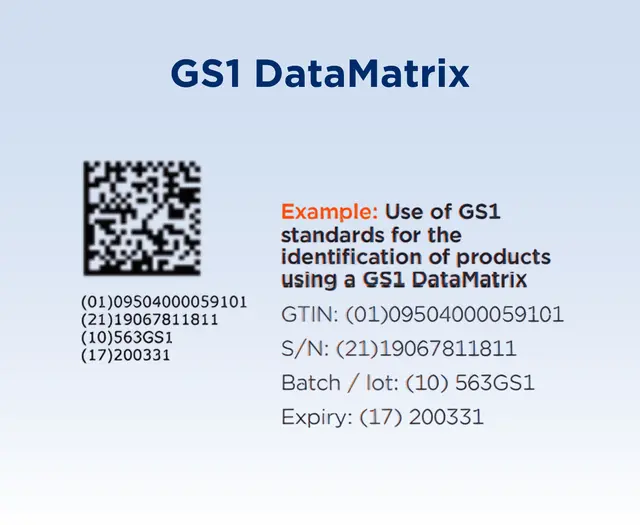
- Standard Element String Example (Valid Check Digit)
(01)06900000000007(10)LOT202607(17)271231(21)SN000123
Raw content stored inside the QR code (with implicit FNC1): [FNC1]010690000000000710LOT2026071727123121SN000123

2. GS1 Digital Link QR Code (Primary New Standard Carrier)
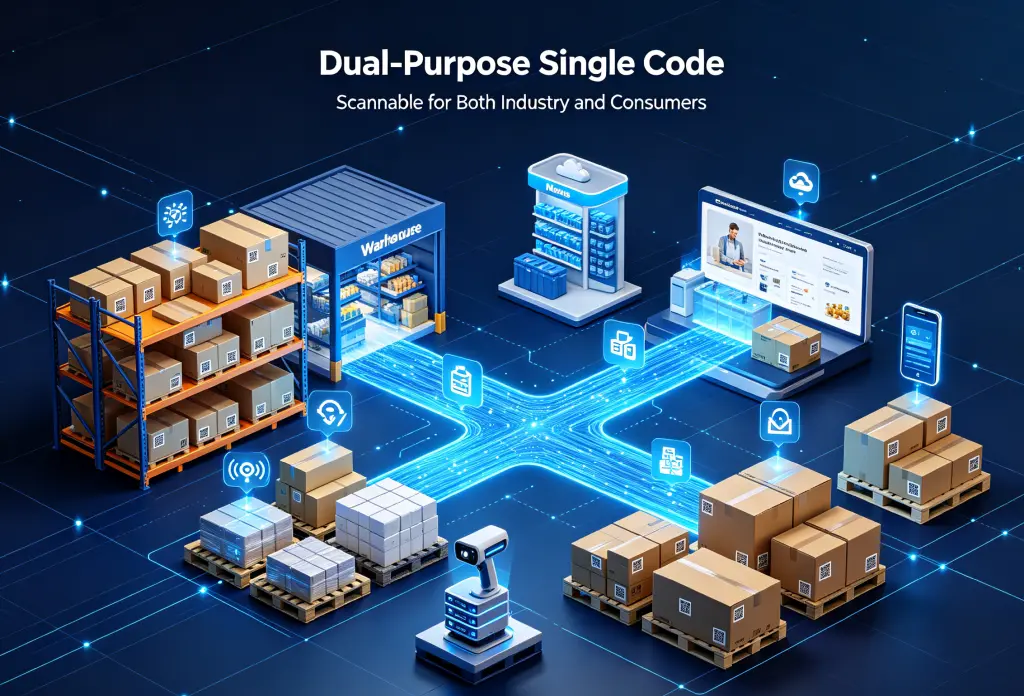
The globally promoted GS1 replacement for linear barcodes, a unified QR code compatible with both supply chain and consumer scenarios, encoded as standardized URIs to enable dual-purpose single codes:
- B-end Industrial Devices: Scanners automatically extract primary identifiers and qualifier AIs within the path, functioning identically to linear barcodes and compatible with existing ERP, WMS, and cash register systems.
- C-end Native Smartphone Cameras: Directly access resolution servers and auto-redirect to product traceability, electronic label, and compliance disclosure pages.
- Core Basis: GS1 AI JSON-LD differentiates Primary Keys, Key Qualifiers, and general attribute parameters via layered classification to eliminate the error
The AIs in the path are not a valid key-qualifier sequence.
II. Core URI Layering Rules Based on GS1 AI JSON-LD
1. Three Classifications of AI Data
| Category | JSON-LD Identifier | Storage Location | Common Associated AIs | Mandatory Constraints |
|---|---|---|---|---|
| Primary Key | gs1DigitalLinkPrimaryKey: true | First path segment of the URI | 01 (GTIN), 00 (SSCC), 414 (GLN), 8003 (GRAI) | Must appear at the very start of the URL; root unique identifier for an entity; only one Primary Key permitted per URL |
| Key Qualifier | Written into the gs1DigitalLinkQualifiers array corresponding to the Primary Key | Subsequent path segments formatted /AI/Value | 10 (Batch Number), 21 (Item Serial Number), 22 (Product Variant) | Refines unique individual items; forms the full unique entity ID together with the Primary Key; must reside in the path and never within query parameters |
| General Attribute | No Primary/Qualifier marker | URL query string formatted ?AI=Value | 17 (Expiry Date), 11 (Production Date), 3103 (Weight) | Supplementary descriptive information only; forbidden from path segments to avoid invalid sequence errors |
2. Mandatory Syntax Specifications (v1.2 Standard, Eliminating Legacy Errors)
- The obsolete legacy
/gs1/intermediate path prefix is fully deprecated; all compliant URLs must exclude this string. - Base URI Structure:
https://[Resolution Domain]/[Primary AI]/[Primary AI Value]/[Qualifier AI1]/[Qualifier Value1]/[Qualifier AI2]/[Qualifier Value2]?[General Attribute AI]=[Value]&[Attribute AI2]=[Value2]
– Path segments may only contain the Primary Key AI and its matching Qualifier AIs; expiry dates, production dates, and other attributes must be placed after the question mark. – Values corresponding to AIs must exactly match the original GS1 element string; no abbreviation or alteration is allowed. – AI01 GTIN-14 must be a complete 14-digit number with a mathematically valid trailing check digit.
III. Standard Compliant GS1 Digital Link URI Examples for All Scenarios
Unified base business data source (corrected check digits, consistent data alignment):
- Primary Key AI 01 GTIN: 06900000000007 (valid check digit, replaces the former erroneous 06900000000001)
- Qualifier AI10 Production Batch: LOT202607
- Qualifier AI21 Individual Item Serial Number: SN000123
- General Attribute AI17 Expiry Date: 271231 (YYMMDD format, restricted to query parameters only)
- Extended General Attribute AI11 Production Date: 260115
Example 1: Official Chinese Public Resolution Domain (id.gs1cn.org)
Full compliant URL (Primary Key + Dual Qualifiers + Expiry Date Parameter)
https://id.gs1cn.org/01/06900000000007/10/LOT202607/21/SN000123?17=271231
Layered Compliance Breakdown:
/01/06900000000007: AI01 as Primary Key, placed at the start of the path with a valid 14-digit GTIN./10/LOT202607: AI10 as a supporting Qualifier for 01, placed within path segments./21/SN000123: AI21 as a supporting Qualifier for 01, placed within path segments.?17=271231: AI17 as a product attribute stored in the query string, without intrusion into the path.
Example 2: Simplest Single Product (GTIN Only, No Batch/Serial Number/Additional Attributes)
Original element string: (01)06900000000007
https://id.gs1cn.org/01/06900000000007
Example 3: Product with Batch Qualifier, Dual Attached Attributes (Expiry + Production Date)
Original element string: (01)06900000000007(10)LOT202607
https://id.gs1cn.org/01/06900000000007/10/LOT202607?17=271231&11=260115
Example 4: Enterprise Private Proprietary Resolution Domain (For Manufacturers)
Enterprise exclusive resolution domain: id.gtin.xin
https://id.gtin.xin/01/06900000000007/10/LOT202607/21/SN000123?17=271231&11=260115

Example 5: Global International Public Resolution Domain (id.gs1.org, For Cross-Border Export Goods)
https://id.gs1.org/01/06900000000007/10/LOT202607/21/SN000123?17=271231
Example 6: Logistics Pallet Primary Identifier SSCC (AI00, Independent Primary Key)
SSCC code: 123456789012345678, no qualifiers or additional attributes
https://id.gs1cn.org/00/123456789012345675
IV. Core Workflow of GS1 Digital Link QR Codes
1. Encoding & Printing Stage
Label software (e.g., EasyLabel) inputs complete AI data, generates compliant Digital Link URIs following layered rules, and encodes the URLs into GS1 Digital Link QR Codes for printing on product outer packaging. Separate linear barcodes and marketing QR codes are no longer required; a single QR code covers all scenarios.
2. Scanning & Parsing by Two Types of Devices
- B-end Industrial Scanning Equipment (Warehousing, Supermarket Checkout, Factory Production Lines): Reads the URL path and automatically extracts structured Primary Key (01) + Qualifier (10/21) data, interfacing with corporate ERP, WMS, and inventory systems for receiving, stocktaking, settlement, and full-item traceability.
- C-end Smartphone Cameras / Mainstream Scanning Tools: Recognizes the full URL and initiates an HTTP request to access the preconfigured resolution server.
3. Intelligent Routing by Resolution Server (Core Value of Digital Links)
Post-printing packaging revisions are unnecessary, as the resolution platform dynamically distributes distinct pages based on scanning device, access region, and user identity; redirect destinations can be updated at any time via backend configuration:
- General Consumers: Electronic product labels, nutrition facts, allergen information, traceability records, membership promotions, and campaign videos.
- Market Regulatory Authorities: One-click access to quality inspection reports, production qualifications, and product recall announcements.
- Distributors & Channel Partners: Batch inventory data and full-chain logistics circulation records.
- Overseas Cross-Border Users: Multilingual compliance disclosure pages aligned with the EU Digital Product Passport (DPP) regulations.
V. Industry Implementation Scenarios
1. Fast-Moving Consumer Goods (Food, Personal Care) – Mandatory Linear Barcode Replacement in the EU by 2027
- Compliance Electronic Labeling: Small packaging eliminates dense printed fine print; scanning displays full ingredient lists, nutrition data, and allergen information to meet EU food compliance requirements.
- Expiry Date Management: POS scanners automatically read batch and expiry data, triggering system alerts for near-expiry products.
- Consumer Digitalization: Unified carrier for traceability queries, loyalty points, discount coupons, and product video content.
2. Pharmaceuticals & Medical Devices – Global Single-Item Traceability
SGTIN (01 GTIN + 21 Serial Number) serves as the core for unique item-level identification. Pharmacies and hospital scanners retrieve supply chain data, while consumers scan to view drug registration certificates, adverse reaction notices, and recall alerts, complying with cross-border traceability interoperability standards under GSP.
3. Logistics, Warehousing & Reusable Pallet Packaging
AI00 SSCC pallet Digital Links enable one-scan retrieval of receiving GLN addresses and packed item manifests. Reusable asset GRAI (8003) QR codes track equipment circulation and maintenance records.
4. Industrial Manufacturing & EU Digital Product Passport (DPP)
Industrial products tagged with GS1 Digital Link QR codes deliver access to carbon footprint reports, material composition breakdowns, and recycling protocols upon scanning, satisfying mandatory compliance with EU carbon border adjustment mechanisms and eco-friendly product passport regulations.
VI. Core Advantages of GS1 Digital Link QR Codes
- Globally Interoperable: Built on the GS1 global unique identification system, compatible with coding organizations across 150+ countries, eliminating data silos across enterprises and national supply chains.
- Integrated Online & Offline Functionality: A single QR code simultaneously supports automated B-end supply chain data capture and C-end consumer digital services, reducing packaging print variants.
- Static Code, Dynamic Content: The printed QR code remains permanent; all online disclosure information can be updated remotely via backend redirect modifications, drastically cutting packaging revision costs.
- Full Compliance Coverage: Aligns with domestic GB/T 33993-2024, EU DPP, pharmaceutical GSP, and global retail traceability regulations, the only QR standard satisfying both supply chain and regulatory digitalization requirements.
- High Fault Tolerance & Large Capacity: QR codes feature robust error correction; stable scanning persists even with worn or creased packaging. They support multiple sets of structured data including GTIN, batch numbers, serial numbers, and expiry dates, with far greater information capacity than EAN/UPC linear barcodes.