1. What Is GS1:ingredientsInfo
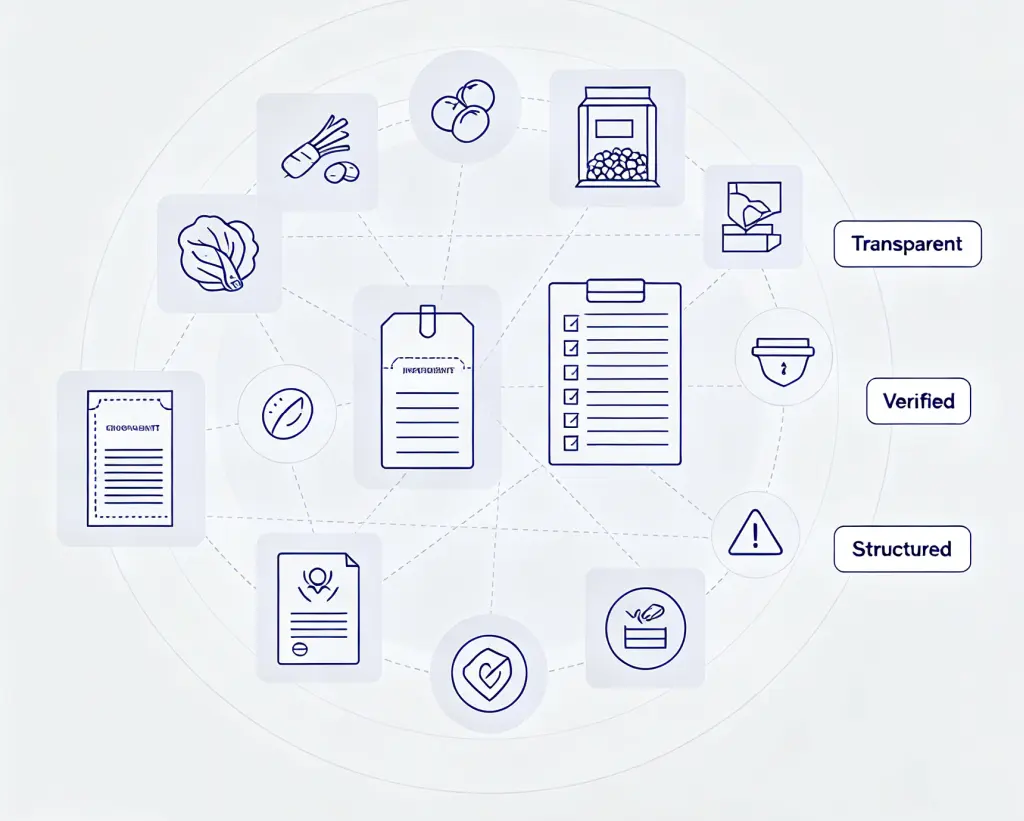
gs1:ingredientsInfo is one of the standardized link types in GS1 Digital Link, used to connect a product with its ingredient information. Per the GS1 Web Vocabulary definition, it is “a link to facts about ingredients.”
The basic idea behind GS1 Digital Link: GS1 identifiers like GTIN are converted into standard Web URIs, giving every product a resolvable network address. The same identifier can point to multiple information sources.
gs1:ingredientsInfo provides one specific entry point: ingredients. The page it points to typically contains the full ingredient list, and what that includes depends on the product category:
- Food: raw materials, food additives (colorings, preservatives, E-numbers, etc.)
- Cosmetics: INCI International Nomenclature of Cosmetic Ingredients list
- Pharmaceuticals: active ingredients and excipients
- Cleaning products: surfactants, fragrances, preservatives
Differences from Related Link Types
| Link Type | Question Answered | Content |
|---|---|---|
gs1:pip | What is the product? | Description, specs, features |
gs1:ingredientsInfo | What is it made of? | Full ingredient list, raw material sources, additive notes |
gs1:nutritionalInfo | How much nutrition does it contain? | Calories, protein, fat, vitamin levels |
gs1:allergenInfo | What allergens does it contain? | Allergen types and levels |
gs1:pip is the product business card, gs1:nutritionalInfo is the nutrition label — gs1:ingredientsInfo is the product formula sheet, telling consumers what’s actually inside.
2. Why Use It
2.1 Breaking Through Packaging Limits
On traditional packaging, ingredient lists are squeezed into small spaces — font so tiny you need a magnifier, content trimmed down to an abbreviated list. For cosmetics and foods with complex formulas, packaging can only hold a fraction of the information.
gs1:ingredientsInfo breaks that limit. Brands can maintain a complete, detailed, always-updatable ingredient page in the cloud, and consumers access it by scanning. Full INCI lists, ingredient source notes, additive explanations — all reachable through this link.
2.2 Meeting Regulatory Requirements
Regulations around ingredient disclosure are getting stricter worldwide:
- EU: wine and spirit products must provide ingredient lists and nutrition info to consumers, regardless of origin
- Food industry: regulations increasingly require complete ingredient and allergen information
- Cosmetics industry: INCI lists are a global regulatory requirement
gs1:ingredientsInfo provides a standardized technical path to meet these requirements without adding packaging complexity.
2.3 Building Trust Through Transparency
Consumers care more and more about what’s inside: Are there allergens? Artificial additives? Is the sourcing sustainable?
With gs1:ingredientsInfo, brands can present full ingredient information openly — names, sources, additive functions, sustainability certifications. Transparency itself builds trust.
2.4 Information That Never Goes Stale
Ingredient lists printed on packaging can’t be changed after printing. Formula changes, supplier swaps, new allergen warnings — the packaging can’t reflect any of it.
With gs1:ingredientsInfo, the QR code stays the same, but the ingredient information behind it can be updated anytime. Formula tweaks, ingredient swaps, new allergen warnings — one cloud update, and every QR code on existing products points to the latest info.
2.5 One Code, Multiple Audiences
The same QR code serves different users differently:
- Consumers scan → see the full ingredient list
- Allergy-sensitive people scan → quickly check for specific allergens
- Regulators scan → get complete compliant ingredient data
- Retailers scan → verify that ingredients match label claims
3. Typical Use Cases
Case 1: Food & Beverage — EU Regulation Compliance
Under EU Regulation 2021/2117, wine and spirit products must provide ingredient lists and nutrition info to consumers. A boutique winery prints GS1 QR codes with gs1:ingredientsInfo on every bottle. Consumers scan and see:
- Full ingredient list (grape variety, sulfur dioxide, fining agents, etc.)
- Detailed descriptions and sources for each ingredient
- Additive function explanations (e.g., “Sulfur dioxide: antioxidant”)
- Allergen information (e.g., “Contains sulfites”)
Low cost, and it satisfies both compliance and transparency.
Case 2: Cosmetics — Digitizing INCI Ingredients
A natural skincare brand uses GS1 QR codes with gs1:ingredientsInfo on its packaging. Consumers scan and see:
- Full INCI list
- Source of each ingredient (plant extract, synthetic, mineral, etc.)
- Function notes (moisturizing, preservative, emulsifier, etc.)
- Whether common allergens are present
- Sustainable sourcing certifications
INCI lists are usually long and technical — hard for regular consumers to interpret. With gs1:ingredientsInfo, the brand turns technical data into clear communication.
Case 3: “Clean Label” Food Brand — Building Trust
A food brand markets “clean label” products with no artificial colorings, preservatives, or flavors. Scanning shows:
- Full ingredient list (all from natural sources)
- Origin and supplier for each ingredient
- “Free from” statements (no artificial colorings, preservatives, flavors)
- Additive function explanations (if any)
- Third-party certifications (organic, non-GMO, etc.)
Not just an ingredient display, but evidence for the brand’s “clean label” promise.
Case 4: Pet Food — Safety and Transparency
A premium pet food brand uses GS1 QR codes with gs1:ingredientsInfo on its packaging. Pet owners scan and see:
- Full ingredient list (meat sources, grains, vegetables, additives, etc.)
- Origin and supplier for each ingredient
- Detailed nutrition information
- Whether artificial colorings, preservatives, or flavors are present
- Allergen information (e.g., “Contains grain”)
Pet owners increasingly focus on ingredient quality. Transparency becomes a core differentiator.
4. Full Usage Example
Here is a JSON example of a food brand configuring gs1:ingredientsInfo in a GS1-compliant resolver:
{
  "anchor": "/01/06933960552835",
  "itemDescription": "Organic Oats 500g",
  "defaultLinktype": "gs1:pip",
  "links": [
    {
      "linktype": "gs1:pip",
      "href": "https://www.example.com/product/12345",
      "title": "Product Detail Page",
      "type": "text/html",
      "hreflang": ["zh-CN"],
      "context": ["general"]
    },
    {
      "linktype": "gs1:ingredientsInfo",
      "href": "https://ingredients.example.com/oats",
      "title": "Full Ingredients List",
      "type": "text/html",
      "hreflang": ["zh-CN"],
      "context": ["clean-label", "transparency"]
    },
    {
      "linktype": "gs1:ingredientsInfo",
      "href": "https://ingredients.example.com/en/oats",
      "title": "Full Ingredients List",
      "type": "text/html",
      "hreflang": ["en"],
      "context": ["clean-label", "transparency"]
    },
    {
      "linktype": "gs1:allergenInfo",
      "href": "https://www.example.com/allergens/oats",
      "title": "Allergen Information",
      "type": "text/html",
      "hreflang": ["zh-CN"],
      "context": ["safety"]
    }
  ]
}
Field Descriptions
| Field | Meaning |
|---|---|
anchor | Router anchor, corresponding to the GTIN. When a scan hits this path, the resolver looks for matching rules. |
defaultLinktype | Default fallback link type, used when no specific rule matches. |
links | Core rules array; multiple links can be configured. |
linktype | Link type; here it is gs1:ingredientsInfo. |
href | URL of the ingredient information page. |
title | Link title for display in tools. |
type | Content type; typically text/html, also supports structured formats like application/ld+json. |
hreflang | Language preference; returns the corresponding language version. |
context | Context tags for refining routing rules. |
Example Ingredient Page Content
<h1>Organic Oats — Full Ingredient Information</h1>

<h2>Ingredients</h2>
<ul>
  <li><strong>Organic Whole-Grain Oats</strong> (100% from certified organic farms)</li>
</ul>

<h2>Additives</h2>
<p>This product contains no artificial colorings, preservatives, or flavors.</p>

<h2>Allergen Information</h2>
<ul>
  <li>Contains gluten (oats)</li>
  <li>May contain traces of soy and nuts (shared production line)</li>
</ul>

<h2>Certifications</h2>
<ul>
  <li>China Organic Product Certification</li>
  <li>Non-GMO Certified</li>
</ul>

<p>Last updated: September 2026</p>
User Scanning Flow
- Scan: Consumer scans the GS1 QR code on the product using a GS1 Digital Link–capable tool (phone camera, WeChat, etc.).
- Resolve: The scanning tool sends a request to the resolver, which matches the appropriate link based on parameters.
- Redirect: The user is directed to the ingredient information page.
- Browse: The consumer reviews the full ingredient list, additive notes, and allergen information.
Advantages
- Minimal QR code: Only contains the base path; all ingredient data lives in the cloud.
- Dynamic routing: Returns Chinese or English ingredient information based on
hreflang. - No re-printing: Formula changes or ingredient updates are made in the backend only.
- Regulatory compliance: Meets requirements such as EU Regulation 2021/2117 on ingredient disclosure.
- Structured data support: Compatible with JSON-LD and similar formats for search engines and smart devices.
- Data analytics: The resolver backend tracks visits to each
gs1:ingredientsInfolink.
Summary
gs1:ingredientsInfo directly serves ingredient transparency. It standardizes one question: “What’s actually inside this product?” The product page answers “what is this,” the nutrition page answers “how much nutrition” — gs1:ingredientsInfo answers the ingredient question consumers are increasingly asking.
Food and beverage brands meeting EU requirements, cosmetics turning technical INCI lists into accessible communication, “clean label” brands providing proof of their promises, pet food brands using transparency as a differentiator — for any category, gs1:ingredientsInfo provides a standardized way to distribute ingredient information. One scan, and the ingredients are fully visible.