

Accurate identification and tracking of logistics units underpin the efficient operation of warehousing, transportation and last-mile delivery across the supply chain. For a long time, inconsistent logistics coding rules across enterprises and regions have made cross-party handover rely on manual document checking and repeated data entry, dragging down efficiency and introducing errors. As the core identification standard for logistics units within the GS1 global identification system, the Serial Shipping Container Code (SSCC) assigns a unique digital identity to every freight pallet, tote and other logistics unit through globally unified coding rules. It serves as fundamental infrastructure for enabling logistics automation, standardization and end-to-end traceability.
Based on authoritative information from the official GS1 Standards Reference Library[1], this article provides a systematic interpretation of GS1 AI 00 (SSCC) across six dimensions: technical specifications, functional positioning, industry applications, implementation value, technical correlations and development trends.
I. Official Definition and Technical Specifications
1.1 Core Definition
Per the official GS1 definition, Application Identifier (AI) 00 corresponds to the Serial Shipping Container Code (SSCC), a globally unique code dedicated to identifying logistics handling units. Its scope is not limited to traditional shipping cartons; it covers pallets, returnable totes, racks, shipping containers and all types of load carriers used in transport and warehousing, assigning a globally unique digital identity to each independent logistics unit.
1.2 Encoding Structure and Check Digit Rules
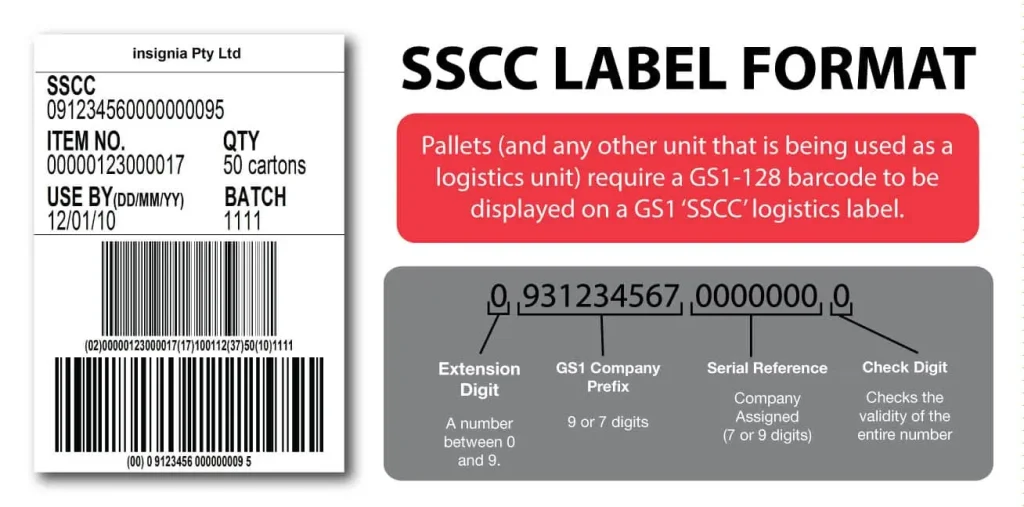
The complete encoding format of GS1 AI 00 is N2 + N18, consisting of a 2-digit numeric application identifier prefix and an 18-digit numeric SSCC body, for a fixed total length of 20 digits. The 18-digit SSCC body adopts a layered structure composed of four segments, detailed in the table below.
Table 1 Breakdown of the SSCC Encoding Structure
| Structure Segment | Length | Description |
|---|---|---|
| Extension digit | 1 digit | An enterprise-assigned identifier with values 0–9, used to distinguish packaging hierarchies and logistics unit types |
| Company prefix | 7–10 digits | A globally unique enterprise code issued by the local GS1 Member Organization |
| Serial reference number | 6–9 digits | A sequentially assigned number controlled by the enterprise, ensuring uniqueness under the same company prefix |
| Check digit | 1 digit | Generated using the standard GS1 modulo 10 algorithm to validate code integrity |
The check digit calculation follows the same method used for the GTIN family of standards: number the 17 data digits from right to left, multiply digits in odd positions by 3 and digits in even positions by 1, sum all results, take the remainder when divided by 10, and subtract the remainder from 10 to obtain the check digit (if the remainder is 0, the check digit is 0).
For character validation, the SSCC body strictly matches the regular expression \d{18}, supporting only numeric digits with no letters, symbols or special characters. This ensures universal readability by scanning devices worldwide.
1.3 Foundational Technical Attributes
Per official GS1 specifications, the core technical attributes of SSCC are as follows:
- FNC1 separator requirement: As a fixed-length code, SSCC does not require an additional FNC1 separator after its data segment when combined with other identifiers in a GS1 element string, and may be followed directly by the next fixed-length application identifier.
- Mandatory associated identifiers: None. It can be used independently and does not require binding to other GS1 identifiers.
- Invalid pairing rules: No explicitly mutually exclusive application identifiers; it can be combined with most GS1 standard AIs.
- GS1 Digital Link capability: Supported as an independent primary key in GS1 Digital Link URIs, and may also be embedded as an additional data attribute in URIs built on other primary keys.
II. Core Functions and Technical Characteristics
The core value of SSCC lies in using a single global standard to solve the problem of cross-party logistics unit identification. Its key technical characteristics can be summarized in four points.
First, globally unique identification capability. Backed by the GS1 global numbering system, every SSCC is unique worldwide, with no duplication across enterprises or regions. A logistics unit retains the same identifier from shipper to consignee and across borders, eliminating the need for recoding or re-entry.
Second, end-to-end data association capability. The SSCC itself carries only an identity code, not business data. However, as a primary key, it can be linked to the full set of business data for the logistics unit, including contents, batch numbers, weight, shipper/consignee details, transport trajectory and temperature records. All business systems only need to recognize the SSCC to retrieve all corresponding information, enabling one-code association and full-chain sharing.
Third, universal automatic identification compatibility. SSCC can be carried by multiple media including GS1-128 linear barcodes, GS1 DataMatrix and GS1 QR Codes. It is compatible with all mainstream industrial scanners, handheld terminals, automated sorting lines and portal scanners, allowing enterprises to deploy it without large-scale hardware retrofits.
Fourth, standardized data exchange capability. As a universal GS1 standard, SSCC can be directly embedded into EDI electronic data interchange messages, matching standard business documents such as advance shipping notices, receiving advices and waybills. This enables automatic alignment of cross-enterprise data without manual format conversion or code mapping.
III. Typical Industry Application Scenarios
SSCC is applied across nearly all industries involving logistics turnover. The following sections describe specific implementation models and outcomes across three representative industries: retail fast-moving consumer goods, pharmaceutical distribution and automotive manufacturing.
3.1 Retail & FMCG: Pallet-Level Fast Receiving and Cross-Warehouse Allocation
The retail and FMCG sector features high logistics turnover and a large number of SKUs. Under the traditional receiving model, two workers are required to unbox, count and reconcile documents for each pallet, taking 8–10 minutes on average. This is not only inefficient but also prone to counting errors.
Implementation workflow:
- The supplier applies for a GS1 company prefix, assigns a unique SSCC to each outbound pallet, and prints standardized SSCC labels on all four sides of the pallet.
- The supplier generates an Advanced Shipping Notice (ASN) message, sending details such as case count, item list, batch and quantity for each SSCC to the retail distribution center in advance.
- Upon arrival, warehouse staff scan the pallet SSCC with a handheld terminal. The system automatically validates against the ASN, and if information matches, completes inbound registration automatically without case-by-case counting.
System integration requirements: The WMS and ERP systems of both supply and demand parties must support GS1 standard code parsing and EDI data exchange, enabling automatic transmission and matching of ASN messages.
Application outcomes: Per-pallet receiving time drops from an average of 8 minutes to less than 1 minute, improving receiving efficiency by over 80%. Manual counting requirements fall by 70%, saving hundreds of thousands of yuan in labor costs per warehouse annually. Receiving error rates drop from around 1.5% under the traditional model to below 0.1%.
3.2 Pharmaceutical Distribution: Cold-Chain Drug Compliance and Traceability
The pharmaceutical industry has strict requirements for drug storage and transport temperatures. In traditional cold-chain management, temperature data is separated from logistics units, making it difficult to quickly locate affected drug batches during anomalies and failing to meet regulatory end-to-end traceability requirements.
Implementation workflow:
- The pharmaceutical distributor assigns an SSCC to each cold-chain pallet and binds it to the corresponding temperature logger ID.
- SSCCs are scanned at outbound, transit and inbound nodes, automatically synchronizing temperature data for the corresponding period to the traceability system.
- Upon delivery, the consignee scans the SSCC to verify full-chain temperature and humidity data, and signs for receipt only after confirming Good Supply Practice (GSP) compliance.
- During regulatory inspections, full-chain storage and transport data for the corresponding drug batch can be retrieved directly via SSCC to meet compliance traceability requirements.
Application outcomes: Cold-chain compliance inspection efficiency improves by 70%, and the time to locate drug batches affected by temperature anomalies shrinks from hours to less than 5 minutes, greatly reducing the risk of non-conforming drugs entering the market.
3.3 Automotive Manufacturing: Inbound Logistics Milk-Run Operations
In automotive manufacturing inbound logistics using the milk-run model, involving multiple suppliers and hundreds of component types, traditional material handover relies on manual case checking and quantity counting, resulting in low efficiency and high misdelivery rates.
Implementation workflow:
- The OEM unifies standards, requiring all suppliers to apply SSCC labels to standard material totes, with each tote assigned a unique SSCC.
- After loading, suppliers scan the SSCC, associate it with component GTINs, batch numbers and quantities, and upload the data to the logistics collaboration platform.
- Milk-run vehicles scan SSCCs to complete handover verification when loading at each supplier site.
- Upon arrival at the OEM’s inbound warehouse, scanning the SSCC automatically completes inbound registration, deducts supplier inventory synchronously, and feeds the data to the line-side material requirement system.
Application outcomes: Inbound logistics handover efficiency improves by 50%, component misdelivery rates fall by 85%, and inventory turnover days shorten by approximately 15%, effectively supporting just-in-time production.
IV. Quantitative Analysis of Implementation Value
Based on real-world enterprise deployments, the value of adopting the SSCC standard can be quantified across three dimensions: operational efficiency, data accuracy and supply chain collaboration.
4.1 Operational Efficiency Improvements
- Warehouse inbound/outbound operations: Pallet/case scanning replaces manual counting, boosting processing efficiency by 30%–80% and increasing daily throughput per warehouse by over 40%.
- Labor costs: Reduction of repetitive manual tasks such as counting, entry and reconciliation cuts frontline logistics labor input by 40%–60%. A mid-sized warehouse can save hundreds of thousands of yuan in labor costs annually.
- Transit and sorting: Automated sorting equipment identifies SSCCs directly to complete sorting, improving sorting efficiency by over 40% and drastically reducing mis-sorting rates.
4.2 Data Accuracy Improvements
- Inventory data accuracy rises from 93%–95% under manual management to over 99.5%, virtually eliminating errors caused by manual counting and entry.
- Cross-enterprise document reconciliation error rates fall by over 85%, as SSCC-based automatic matching replaces manual verification, reducing disputes from document discrepancies.
- Traceability data accuracy reaches 100%, with full-process scan records eliminating omissions and deviations in manual logging and meeting regulatory traceability requirements.
4.3 Supply Chain Collaboration Optimization
- Upstream and downstream information transmission efficiency improves by 60%, as SSCC-based EDI data exchange replaces email and Excel transfers, reducing information latency from days to seconds.
- Supplier onboarding cycles shorten by 70%, with no need for customized coding mapping; system integration can be completed based on universal GS1 standards, lowering collaboration costs.
- Order response speed increases by 30%, with real-time sharing of logistics status enabling upstream and downstream enterprises to adjust production and inventory plans in advance and reduce overall inventory levels.
V. Technical Correlations and Data Exchange Mechanisms
5.1 Hierarchical Relationship with Core GS1 Identifiers
SSCC is not an isolated standard; together with GTIN and GLN, it forms the core identification matrix of the GS1 logistics system. The three correspond to different management dimensions and complement each other:
- GTIN (AI 01): Identifies trade items (individual products, cases), answering the question of what is inside. One SSCC logistics unit may contain one or more GTINs.
- SSCC (AI 00): Identifies logistics units (pallets, totes), answering the question of what carries it. It is the basic unit of logistics circulation.
- GLN (AI 414): Identifies physical locations (warehouses, stores, shelf positions), answering the question of where it is.
Combined, the three can fully describe the state of “a given product loaded in a given logistics unit at a given location”, forming the foundational data model for supply chain visibility.
Chart suggestion: A hierarchical diagram may be drawn, from bottom to top: individual product (GTIN) → case (GTIN) → pallet (SSCC) → warehouse/store (GLN), to visually illustrate the containment and correspondence between the three.
5.2 Application Patterns in GS1 Digital Link
In the GS1 Digital Link system, SSCC has two application patterns:
- As an independent primary key: A dedicated URI is generated directly. Scanning the URI opens the digital landing page for that logistics unit, where you can view details, shipment trajectory, sign-off status, temperature and humidity data, and more. This pattern is suitable for receiver verification and logistics tracking queries.
- As an additional attribute: The SSCC is embedded within the URI of other primary keys such as GTIN or CPID, indicating which logistics unit the product belongs to. This enables traceability linking individual items to their logistics containers, suitable for high-precision traceability scenarios.
SSCC Standard URI Examples
The following examples use SSCC 195201234567891232 to illustrate the canonical and non-canonical forms of GS1 Digital Link URIs.
Basic SSCC Link
The following is the canonical GS1 Digital Link URI for SSCC 195201234567891232, equivalent to the GS1 element string below:
https://id.gs1.org/00/195201234567891232Equivalent GS1 element string:
(00)195201234567891232The following is a further valid non-canonical GS1 Digital Link URI for SSCC 195201234567891232:
https://id.gtin.com/00/195201234567891232Note: The canonical URI uses the official GS1 domain
id.gs1.org; the non-canonical URI uses an equivalent domain such asid.gtin.com. Both conform to the GS1 Digital Link grammar and can be correctly parsed by compliant scanning devices.
SSCC with Specified Content, Count, and Batch/Lot
The following is the canonical GS1 Digital Link URI for SSCC 195201234567891232, containing a count [AI (37)] of 25 instances of Content [AI (02)] 09520123456788 with Batch/Lot identifier [AI (10)] ABC123:
https://id.gs1.org/00/195201234567891232?02=09520123456788&37=25&10=ABC123Equivalent GS1 element string:
(00)195201234567891232(02)09520123456788(37)25(10)ABC123The following is a further valid non-canonical GS1 Digital Link URI for SSCC 195201234567891232, containing a count [AI (37)] of 25 instances of Content [AI (02)] 09520123456788 with Batch/Lot identifier [AI (10)] ABC123:
https://id.gtin.com/00/195201234567891232?02=09520123456788&37=25&10=ABC123Parameter Reference:
00— SSCC primary key (Application Identifier 00), value:195201234567891232;02— Content indicator [AI (02)], value: trade item number09520123456788;37— Count [AI (37)], value:25(i.e., 25 instances of the above content within this logistics unit);10— Batch/Lot [AI (10)], value:ABC123.
5.3 System Compatibility and Data Exchange Specifications
- Carrier compatibility: Supports multiple carriers including GS1-128 linear barcodes, GS1 DataMatrix and GS1 QR Codes. Linear barcodes suit traditional warehousing and sorting scenarios, while 2D codes carry more data and adapt to consumer queries and digital interaction scenarios.
- Data exchange compatibility: Fully compliant with GS1 EDI standards, and can be directly embedded in standard messages such as DESADV (despatch advice), RECADV (receiving advice) and IFTMIN (transport instruction), enabling automatic cross-enterprise and cross-system data exchange.
- System compatibility: All mainstream WMS, TMS and ERP systems natively support SSCC parsing. Enterprises can deploy it without large-scale system retrofits, requiring only configuration of corresponding parsing rules, resulting in a low implementation threshold.
VI. Development Trends and Integration Prospects
As supply chain digital transformation deepens, SSCC — as the foundational identifier for logistics units — is being deeply integrated with IoT, blockchain and artificial intelligence to expand into more application scenarios.
6.1 Integration with IoT: From Passive Scanning to Active Sensing
Traditional SSCC applications rely on manual scanning for data collection. As IoT sensor costs decline, more and more logistics units will be equipped with built-in positioning, temperature/humidity and shock sensors. SSCC will serve as the unique identity anchor connecting physical logistics units to their digital twins. Real-time data collected by sensors will be automatically associated with the corresponding SSCC and uploaded to the cloud, enabling active reporting and real-time monitoring of logistics status, and completing full-chain data collection without manual intervention.
6.2 Integration with Blockchain: Building a Trusted Traceability System
Cross-enterprise logistics data often suffers from low credibility and data silos. SSCC can serve as the unique index on a blockchain, with full-chain data such as dispatch, transit, receipt and environmental monitoring stored on-chain as immutable evidence. Upstream and downstream enterprises as well as regulators can query trusted logistics records directly via SSCC, without relying on a single enterprise’s centralized data. This is particularly valuable for industries with high traceability credibility requirements such as pharmaceuticals, high-end manufacturing and fresh produce.
6.3 Integration with Artificial Intelligence: Driving Intelligent Logistics Scheduling
Based on massive historical logistics data accumulated via SSCCs, AI models can achieve more accurate estimated time of arrival, inventory demand forecasting and sorting path optimization. For example, by analyzing historical transit time data for SSCCs across different routes and time periods, AI can dynamically adjust warehouse shift scheduling and sorting plans, improving logistics resource utilization. Combined with product weight and volume information linked to SSCCs, AI can automatically optimize pallet stacking strategies and improve loading efficiency.
6.4 Extension to Circular Economy and Green Logistics
Per GS1 development roadmaps, SSCC application scenarios are expanding from one-use logistics packaging to reusable packaging systems. In returnable tote and reusable pallet systems, SSCC can serve as the unique identifier for the reusable carrier, recording turnover counts, cleaning status, maintenance records and service life. This supports digital management of reusable packaging systems and helps supply chains advance low-carbon transformation.
Closing
As one of the most widely adopted standards in the GS1 system, SSCC has been validated by decades of industry practice and has become the universal “identity language” of global logistics. For enterprises, implementing the SSCC standard is not only a practical choice to improve logistics efficiency and reduce error rates, but also foundational work to break down upstream and downstream data barriers and support future digital upgrades. As new technologies continue to be integrated, SSCC will continue to expand its application boundaries and play an even more central role in supply chain digital and intelligent upgrading.