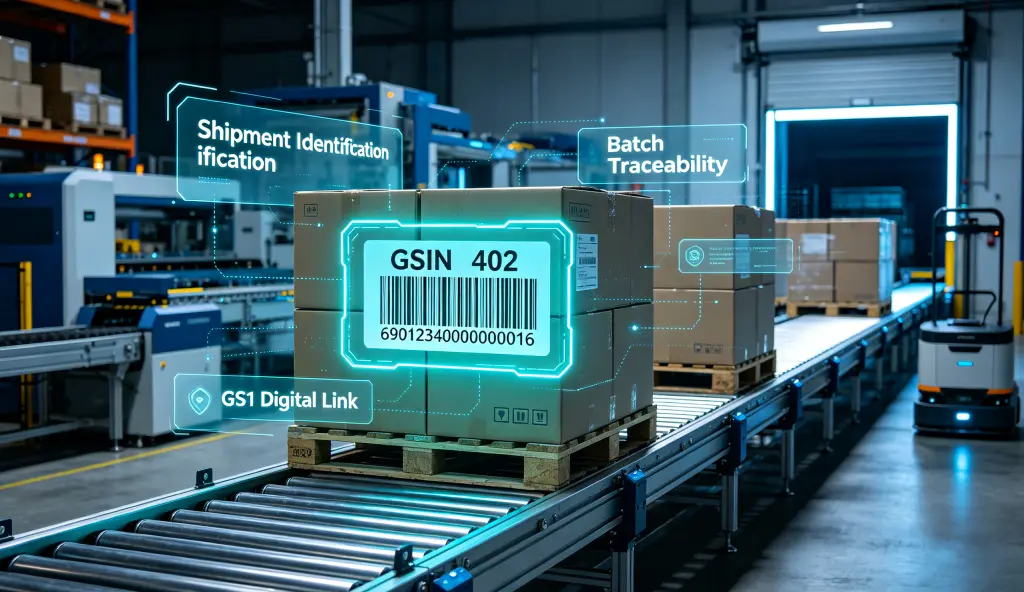
In the supply chain logistics system, shipment is the core business node of goods circulation from the shipper to the consignee. A unified identification for shipment batches is the foundation for collaborative management of the whole outbound, transport and receipt process. For a long time, inconsistent shipment numbering rules across enterprises have led to low document matching efficiency and broken traceability chains during cross-party handover. As a dedicated standard of the GS1 global identification system for shipment operations, the Global Shipment Identification Number (GSIN), carried by GS1 Application Identifier (AI) 402, provides a globally unified standardized digital identity for the entire batch of goods in each shipment. It serves as the core technical support for end-to-end traceability of shipment batches and automated cross-party handover.
Based on official GS1 standard specifications[1][7] and industry implementation practices, this article provides a systematic technical analysis of AI 402 across dimensions including technical parameters, functional positioning, differences from AI 401 (GINC), industry applications and Digital Link implementation, to provide implementation reference for enterprises’ logistics digitization and batch traceability system construction.
1. Standard Definition and Encoding Technical Specifications
1.1 Official Definition
Per official GS1 standard definitions, AI 402 corresponds to the Global Shipment Identification Number (GSIN), an application identifier within the GS1 system dedicated to identifying individual shipment batches[1][7]. Its core function is to assign a globally unique standardized identity code to the entire batch of goods dispatched by the shipper in a single shipment. It covers all shipment scenarios including factory outbound, inter-warehouse transfer, full-truck delivery and consolidated transshipment, unifies the identity of shipment batches across shippers, carriers and consignees, and supports shipment-level logistics handover, document collaboration and batch traceability.
As an official GS1 Identification Key at the same level as SSCC and GTIN, GSIN follows globally unified structure and allocation rules. Unlike SSCC (AI 00) for individual logistics units and GINC (AI 401) for consignment contracts, GSIN focuses on batch identification for “a single physical dispatch action”, and is the key identification node connecting internal warehouse management and external logistics transport.
1.2 Encoding Structure and Format
The complete encoding format of GS1 AI 402 is N3 + N17, consisting of a 3-digit numeric application identifier prefix and a fixed 17-digit pure numeric GSIN body. The total length is fixed at 20 digits with no variable-length component.
The 17-digit GSIN body adopts a three-segment fixed structure, with uniqueness guaranteed by the GS1 global unified allocation system:
- GS1 Company Prefix: 7–10 digits, assigned by the GS1 member organization of the enterprise’s country/region, globally unique;
- Shipment Reference: A shipment serial number assigned independently by the enterprise, which together with the company prefix makes up exactly 16 digits;
- Check Digit: The 17th digit, generated using the standard GS1 modulo 10 algorithm to verify code validity.
Table 1 Breakdown of the GSIN Encoding Structure
| Structure Segment | Length Rule | Character Type | Functional Description |
|---|---|---|---|
| Application Identifier (AI) Prefix | Fixed 3-digit numeric | Numeric only | Fixed value 402, the exclusive GS1 identification prefix marking the following data segment as Global Shipment Identification Number |
| GS1 Company Prefix | 7–10 digits | Numeric only | Globally unique enterprise identity prefix, assigned by GS1 member organizations |
| Shipment Reference | 6–9 digits | Numeric only | Enterprise-assigned shipment serial number, totaling 16 digits when combined with the company prefix |
| Check Digit | Fixed 1-digit numeric | Numeric only | Modulo 10 check digit for verifying overall code validity |
Note: The company prefix plus shipment reference is always 16 digits. With the final 1-digit check digit, the GSIN body is always 17 digits in total length.
1.3 Check Digit Algorithm and Calculation Example
GSIN uses the standard GS1 modulo 10 check algorithm to calculate the 17th check digit. The algorithm steps are fully consistent with SSCC and GTIN:
- Take the first 16 digits (company prefix + shipment reference), and number them from right to left as position 1, position 2, …, position 16.
- Multiply all digits in odd positions by 3, and all digits in even positions by 1.
- Sum all weighted values, and calculate the remainder when the sum is divided by 10.
- If the remainder is 0, the check digit is 0; otherwise, check digit = 10 − remainder.
Calculation Example: Given the first 16 digits of a GSIN as 6901234000000001 (company prefix 6901234 + reference 0000000001), the check digit is calculated as follows:
- Odd-positioned digits (right to left): 1, 0, 0, 0, 0, 3, 1, 9 → Sum = 14 → Weighted value = 14 × 3 = 42
- Even-positioned digits (right to left): 0, 0, 0, 0, 4, 2, 0, 6 → Sum = 12 → Weighted value = 12 × 1 = 12
- Total weighted sum = 42 + 12 = 54
- Remainder of 54 divided by 10 is 4, check digit = 10 − 4 = 6
- Complete 17-digit GSIN body:
69012340000000016
1.4 Character Set and Core Technical Attributes
Per official GS1 specifications, the GSIN body is in pure numeric format, supporting only Arabic numerals 0–9, strictly matching the regular expression \d{17}[9]. Letters, symbols and Chinese characters are not supported.
Based on official specifications, the core technical attributes of AI 402 are summarized in the table below.
Table 2 Core Technical Attributes of GS1 AI 402
| Technical Item | Official Specification | Description |
|---|---|---|
| Format | N3 + N17 | Fixed length: 3-digit AI prefix + 17-digit numeric body |
| FNC1 separator required | No | Fixed-length identifier; the 17-digit data segment can be parsed without FNC1 separation |
| Mandatory associations | None | Can be used independently without binding to other GS1 Application Identifiers |
| Invalid pairings | None | No explicitly mutually exclusive Application Identifiers; can be freely combined with most GS1 standard AIs |
| Primary key in GS1 Digital Link URI? | Yes | Can be used as an independent primary key to build URIs for dedicated shipment batch digital entries |
| GS1 Digital Link key qualifiers | None | No dedicated associated key qualifiers |
| Valid as data attribute in GS1 Digital Link URIs? | Yes | Can be embedded as an additional data attribute in URIs built on other primary keys |
2. Core Technical Functions and System Positioning
2.1 Core Technical Positioning
The core positioning of GSIN is the global identity anchor for shipment-level goods. Together with SSCC and GINC, it forms a three-level identification system for GS1 logistics, with clear complementarity in granularity and applicable scenarios:
- SSCC (AI 00): Targets individual logistics units (pallets, totes, cartons), with granularity at the single load carrier level, used for fine-grained logistics unit management;
- GSIN (AI 402): Targets individual shipment batches, with granularity covering all goods under one dispatch action. One shipment may contain one or more SSCC logistics units, used for dispatch/receipt handover and batch management;
- GINC (AI 401): Targets the entire consignment transaction, with granularity covering all goods under one transport contract. One consignment may contain one or more shipment batches, used for end-to-end logistics tracking across carriers and transport modes.
The three adapt to different business requirements at unit level, shipment level and consignment level respectively, and together form a complete logistics identification hierarchy.
2.2 Core Technical Characteristics
(1) Global Uniqueness Guarantee Mechanism
The global uniqueness of GSIN is mandatorily guaranteed by the GS1 layered allocation system: GS1 headquarters plans the number range uniformly, national member organizations issue unique company prefixes to enterprises, and enterprises independently assign shipment reference numbers within their own number ranges. This three-tier allocation mechanism ensures that each shipment batch corresponds to a unique code worldwide with no cross-enterprise or cross-regional number conflicts, fundamentally solving the problem of incompatible custom shipment numbers.
(2) Multi-Carrier Data Format Specifications
GSIN can be carried by multiple physical carriers to adapt to different logistics scenarios:
- Linear barcodes: Adopt GS1-128 format, suitable for traditional shipping orders, logistics labels and other scenarios, compatible with existing frontline scanning devices;
- 2D barcodes: Adopt GS1 DataMatrix or GS1 QR Code format, which can carry GSIN and extended information such as shipper/consignee details and addresses at the same time, suitable for digital documents and mobile scanning scenarios;
- RFID tags: Can be encoded in EPC format, supporting contactless batch reading, suitable for fast batch cargo verification scenarios such as large warehouses and terminals.
(3) Universal Automatic Identification Compatibility
GSIN fully complies with the general GS1 element string syntax. All GS1-compliant industrial scanners, handheld terminals and fixed gantry scanning devices can natively recognize and parse it without customized decoding logic development. Enterprises can deploy directly based on existing logistics hardware infrastructure with low transformation cost and short implementation cycle.
(4) Standardized Fixed-Length Architecture
The 17-digit fixed-length pure numeric design is highly standardized, facilitating database storage, system interaction and EDI message transmission. It eliminates the parsing ambiguity of variable-length codes, and is especially suitable for automated data exchange scenarios between enterprises.
2.3 Technical Integration with Other GS1 Identifiers
GSIN can be freely combined with various identifiers in the GS1 system to form a complete logistics data network:
- With SSCC (AI 00): One-to-many containment relationship. One shipment (GSIN) can contain multiple logistics units (SSCC), enabling two-way traceability between shipment batches and individual units through combined encoding;
- With GTIN (AI 01): Cargo content association relationship, identifying the trade item categories corresponding to the shipped goods and supporting rapid verification and inbound acceptance of entire batches;
- With GINC (AI 401): Business-level association relationship. One consignment batch (GINC) can contain multiple shipment batches (GSIN), realizing hierarchical traceability from shipment to consignment.
3. Technical Difference Analysis Between GS1 AI 402 and AI 401
Both GSIN (AI 402) and GINC (AI 401) belong to GS1 logistics batch identifiers, but there are clear differences in technical positioning, encoding rules and applicable scenarios. Enterprises shall select appropriately according to business requirements.
3.1 Core Positioning Differences
- AI 402 (GSIN): Shipment perspective dispatch batch identification, corresponding to the shipper’s delivery note and outbound order. It focuses on full-process management of “a single physical dispatch action”, serves as the identifier connecting enterprise warehousing and logistics, and is mostly used for direct handover between the dispatch end and the receipt end. It is an official GS1 Identification Key with globally unified encoding structure and allocation rules.
- AI 401 (GINC): Consignment perspective transport contract identification, corresponding to the waybill and bill of lading issued by the carrier. It focuses on end-to-end tracking of “one transport contract”, serves as the unified identifier under multi-carrier and multimodal transport, and is mostly used for cross-party end-to-end logistics tracking. It is a reference-type identifier with no mandatory internal structure requirements.
In short: GSIN identifies “which enterprise dispatched the batch”, while GINC identifies “which carrier transported the consignment”. One shipment can correspond to one consignment, and one consignment can also include multiple shipments.
3.2 Technical Characteristic Comparison
Table 3 Technical Comparison Between AI 402 and AI 401
| Comparison Dimension | GS1 AI 402 (GSIN) | GS1 AI 401 (GINC) |
|---|---|---|
| Full Name | Global Shipment Identification Number | Global Identification Number for Consignment |
| Business Positioning | Shipment batch identification, corresponding to delivery notes / outbound orders | Consignment batch identification, corresponding to waybills / bills of lading |
| Format | N3 + N17 (fixed-length pure numeric) | N3 + X..30 (variable-length mixed characters) |
| Check Digit | Mandatory built-in 1-digit modulo 10 check digit | No built-in check digit |
| Company Prefix | Mandatory inclusion, standardized structure | Not mandatory at syntax level |
| Character Set | Pure numeric 0-9 only | Supports letters, numbers and ASCII punctuation |
| FNC1 Required | No (fixed length) | Yes (variable length) |
| Typical Users | Shippers, warehouses, consignees | Carriers, freight forwarders, cross-border logistics providers |
| Traceability Granularity | Shipment batch level | Consignment contract level |
3.3 Selection Decision Guide
- Scenarios where AI 402 (GSIN) is preferred:
- Standardized shipment batch management such as inter-warehouse transfer, finished product outbound and inbound acceptance within enterprises;
- Point-to-point handover scenarios such as short-haul full-truck delivery and urban centralized warehouse distribution;
- Shipper-centric supply chain batch traceability requiring connection between warehousing and logistics systems;
- Scenarios requiring EDI automated message exchange and highly standardized encoding structure.
- Scenarios where AI 401 (GINC) is preferred:
- Long-distance transport such as cross-carrier multimodal transport and cross-border sea/air freight;
- Business scenarios corresponding to transport contracts such as bills of lading and waybills;
- Scenarios requiring compatibility with enterprises’ existing complex waybill number systems and retaining special symbols and numbering rules;
- Carrier-centric end-to-end logistics tracking and document collaboration.
4. Industry Application Practices and System Integration
4.1 Retail & FMCG: Centralized Warehouse Distribution Shipment Handover Collaboration
System integration architecture: The regional centralized warehouse uses GSIN as the core handover identifier, connecting WMS (Warehouse Management System), TMS (Transportation Management System) and store receiving systems to realize fast handover and automatic matching of entire batches in urban distribution scenarios. Data collection workflow: During warehouse outbound, the system generates a unique GSIN per GS1 standards, bound to the list of all SSCC pallets, item details and delivery stores for the batch. Upon arrival at the store, the receiver scans a single SSCC to automatically associate the corresponding GSIN. After the entire batch is verified, inbound registration is completed in batches without case-by-case counting, greatly improving store receiving efficiency. Hardware configuration requirements: Fixed gantry scanning devices on the warehouse side, handheld 2D scanners on the store side, supporting GS1-128 and GS1 QR Code parsing. Software interface standards: Connects to WMS outbound interfaces and store POS/receiving systems, supporting automatic alignment of GSIN and ASN (Advance Shipping Notice) data.
4.2 Manufacturing Industry: Full Traceability of Finished Product Factory Shipment
System integration architecture: The manufacturing enterprise uses GSIN as the core identifier for factory shipments across MES, ERP and WMS, realizing end-to-end traceability of finished products from production offline, warehousing, shipment to customer receipt. Data collection workflow: SSCC is generated and bound to batch information when finished products go offline. During factory shipment, the system generates a unique GSIN per standards, bound to all SSCCs, production batches and quality inspection reports for the batch. Upon delivery to the customer, the other party can quickly verify the production and quality information of the entire batch by scanning the GSIN, completing fast acceptance. Hardware configuration requirements: Production-line fixed scanners, plant explosion-proof handheld terminals, adaptable to complex working conditions in production workshops. Software interface standards: Connects to MES and ERP systems, realizing linkage between GSIN and production orders and quality data through standard APIs.
4.3 Pharmaceutical Logistics: Compliant Shipment Batch Management
System integration architecture: Pharmaceutical distribution enterprises use GSIN as the core identifier to meet GSP requirements for shipment batch traceability, realizing full-process traceability of pharmaceutical outbound, transport and receipt. Data collection workflow: GSIN is generated during pharmaceutical outbound review, bound to compliance information such as approval numbers, production batches, validity periods and temperature control records for the batch. Temperature and humidity data during transport are associated with the GSIN. The consignee can quickly retrieve compliance documents and temperature control records of the entire batch by scanning the GSIN, meeting drug administration traceability requirements. Hardware configuration requirements: Pharmaceutical-specific scanning terminals, cold-chain temperature sensing devices, complying with pharmaceutical industry cleanliness and data security standards. Software interface standards: Connects to the drug traceability platform, supporting data association and reporting between GSIN and national drug traceability codes.
5. Technical Implementation of GS1 Digital Link (Key Section)
GS1 Digital Link is the core technical path for GSIN to upgrade from offline barcode identification to a digital logistics entry point, and also the key support for realizing end-to-end traceability of shipment batches.
5.1 URI Construction Rules
GSIN has a dual identity in the GS1 Digital Link system: it can be used as an independent primary key, or embedded as an additional attribute in URIs of other primary keys. The specific construction rules are as follows:
- As an independent primary key: The 17-digit GSIN body is placed directly after AI 402 as a path segment, following the format
https://[enterprise domain]/402/[17-digit GSIN]. It corresponds to the dedicated digital homepage of one shipment batch, displaying full information such as cargo details, logistics trajectory and accompanying documents. - As an additional attribute: Embedded in URIs of other primary keys such as SSCC, following the format
https://[enterprise domain]/00/[SSCC code]/402/[17-digit GSIN]. It is used to identify the shipment batch to which a single logistics unit belongs, enabling reverse traceability from individual units to the entire batch.
5.2 Complete Examples
- Primary key mode example:
https://id.logistics.com/402/69012340000000016 - Attribute mode example:
https://id.example.com/00/123456789012345675/402/69012340000000016
5.3 Parsing Mechanism and Data Interaction Workflow
- The scanning terminal (smartphone or professional device) recognizes the GSIN Digital Link URI in the GS1 2D barcode.
- The terminal initiates an HTTPS request to the enterprise’s Digital Link server, which identifies the requester’s identity (consignee, carrier, regulator) based on request headers and context.
- The system returns corresponding content based on permissions: cargo details and receipt entry for shippers/consignees, transport tasks and node update interfaces for carriers, and compliance document data for regulators.
- Data output follows the JSON-LD structured standard, supporting automatic machine parsing and seamless integration with business systems without manual secondary entry.
5.4 Technical Advantages Over Traditional Shipment Barcodes
Table 4 Comparison of GSIN Digital Link and Traditional Shipment Barcodes
表格
| Comparison Dimension | Traditional Shipment Barcode | GSIN Digital Link |
|---|---|---|
| Information capacity | Carries only the shipment number; details require access to a dedicated system | Directly maps to a digital homepage; details, documents and trajectory are available by scanning |
| Cross-platform interoperability | Only recognizable by internal systems; cross-party access requires API integration | Based on standard HTTP protocol, accessible by any terminal without a dedicated app |
| Data update capability | Information is fixed after barcode generation and cannot be dynamically updated | Server-side data is updated in real time; status and rules can be adjusted dynamically |
| Traceability granularity | Only supports batch-level node query | Supports multi-level two-way traceability from shipment batch to logistics unit to individual item |
| Interaction capability | One-way information reading only | Supports two-way interactions such as scan-to-sign, exception reporting and document download |
6. Technical Details and Usage Specifications
6.1 Independent Encoding Rules
When used independently, GSIN follows the general GS1 element string syntax: it starts with the AI prefix 402, followed by the fixed 17-digit numeric body. As a fixed-length code, it can be directly followed by other identifiers without an FNC1 separator.
- Basic encoding example:
(402)69012340000000016
6.2 Combined Encoding Rules
GSIN can be freely combined with other GS1 Application Identifiers to carry multiple pieces of information. Taking the “GSIN + shipping date” combination as an example:
- Encoding example:
(402)69012340000000016(13)240615 - Parsing rule: First read the fixed 17-digit GSIN code, then read subsequent identifiers. Since GSIN is fixed-length, other AIs can follow directly without additional separation.
Chart suggestion: A combined encoding structure diagram can be drawn, showing the layered structure of AI 402 + GSIN and AI 13 + date from left to right, to visually illustrate that fixed-length encoding requires no separator.
6.3 Usage Restrictions and Best Practices
- Length restriction: The GSIN body must be strictly 17 digits. Any shorter or longer code is invalid.
- Character specification: Only Arabic numerals 0–9 shall be used. Letters, symbols and full-width characters are prohibited.
- Uniqueness constraint: One shipment corresponds to one unique GSIN. The same code must not be reused for different shipment transactions to avoid traceability confusion.
- Mandatory check digit verification: Check digit verification must be performed for all GSIN code generation and recognition to intercept invalid codes.
- Coding allocation best practice: GSIN prefixes must be constructed based on the enterprise’s held GS1 Company Prefix to ensure global uniqueness and cross-party interoperability.
6.4 Code Verification Methods
- Algorithm verification: Verify the correctness of the 17th check digit through the modulo 10 algorithm, which can be directly integrated into enterprise code generation systems.
- Standard tool verification: Use official GS1 AI syntax verification tools to verify compliance of encoding format, length and syntax rules.
- Business verification: Enterprise internal systems must perform uniqueness verification on GSIN to ensure no duplicate or conflicting codes.
7. Technology Development Trends and Evolution Directions
7.1 Batch Identity Foundation for Supply Chain Digitization
With the advancement of end-to-end digitization, GSIN will gradually become the standardized identity credential for shipment links in the supply chain. In the future, dispatch, receipt and reconciliation between enterprises can be fully automatically matched based on GSIN without manual document checking, greatly improving supply chain collaboration efficiency and reducing handover costs.
7.2 Integration with IoT Technology: Real-Time Shipment Status Sensing
Against the backdrop of widespread Industrial IoT adoption, GSIN will evolve from a static identity identifier to a dynamic data entry point. By binding GSIN with positioning, temperature/humidity and shock sensors installed on the shipment, users can obtain real-time status data of the entire batch by scanning the code, realizing active monitoring and anomaly warning during transport and replacing the traditional node-based passive traceability model.
7.3 Core Index for Blockchain Trusted Delivery
Supply chain delivery often faces problems such as opaque data, difficult reconciliation and difficult dispute evidence collection. GSIN can serve as the core index of a blockchain depository system, with full-chain data of shipment outbound, in-transit, receipt and acceptance stored on-chain for evidence preservation, ensuring data immutability and traceability. Compared with enterprise-customized shipment numbers, the globally unified GSIN enables cross-platform and cross-party on-chain data mutual recognition, building a trusted supply chain delivery network.
7.4 Standard Evolution Direction
Combined with the GS1 digital transformation roadmap, the GSIN standard may continue to be optimized in two directions in the future: first, supplementing the qualifier system to support standardized carriage of extended attributes such as shipment type and transport mode; second, deepening integration with Digital Product Passports (DPP) to support shipment-level transmission and verification of product compliance data, further expanding the application boundary of the standard.
Closing
GS1 AI 402 (Global Shipment Identification Number, GSIN) is an important part of the GS1 logistics identification system, with standardized characteristics such as fixed length, pure numeric format, mandatory check digit and global uniqueness, filling the gap of globally unified identification at the shipment batch level. Compared with the variable-length GINC, GSIN has a more standardized structure and is more suitable for automated data exchange between enterprises and standardized batch management.
For industries such as retail, manufacturing and pharmaceuticals, implementing the GSIN standard not only improves shipment handover efficiency and opens up batch traceability chains, but also lays a standardized foundation for future scenarios such as logistics digitization, intelligent scheduling and trusted delivery. As the digitization level of global supply chains continues to improve, GSIN will gradually become the universal “identity language” in the global shipment field, supporting the efficient, transparent and trusted operation of supply chain logistics.