1. What Is gs1:nutritionalInfo?
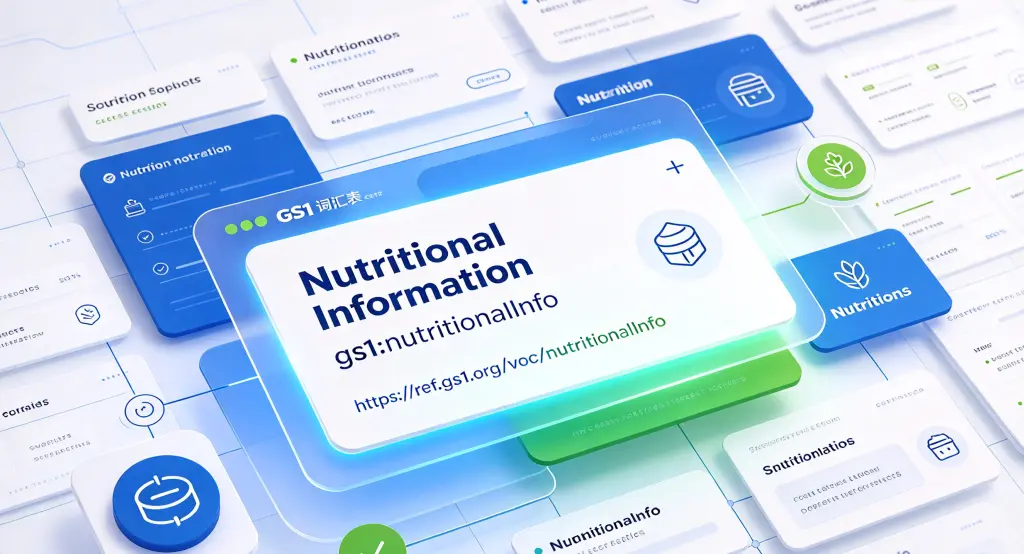
gs1:nutritionalInfo is a link type within the GS1 Digital Link framework specifically designed to connect a product with its nutritional information. According to the official definition in the GS1 Web Vocabulary, it is “a link to nutritional facts”.
To understand gs1:nutritionalInfo, we first need to grasp the basic concept of GS1 Digital Link: by converting GS1 identifiers – such as Global Trade Item Numbers (GTIN) – into standard web URIs, every product obtains a persistent and resolvable web address. Through a compliant resolver, the same product identifier can be linked to multiple different information sources.
Within this information distribution layer, gs1:nutritionalInfo plays a standardised gateway role for nutritional information. The page it points to typically contains the product’s complete nutritional data, which may include:
- Energy – calories, kilojoules
- Macronutrients – protein, carbohydrates, fat (including saturated fat and trans fat)
- Micronutrients – vitamins (A, C, D, B vitamins, etc.), minerals (calcium, iron, zinc, etc.)
- Dietary fibre and sugars – total sugars, added sugars, dietary fibre content
- Sodium and salt – sodium content and its percentage of daily recommended intake
- Daily Value percentage (DV%) – the proportion of each nutrient relative to the daily recommended intake
Differentiation from Related Link Types
Within the GS1 link type system, gs1:nutritionalInfo has a clear and distinct role from several common link types, as explicitly clarified in the GS1 official definition:
| Link Type | Question It Answers | Content Characteristics |
|---|---|---|
gs1:pip (Product Information Page) | What is the product? | Descriptions, specifications, features |
gs1:nutritionalInfo | How much nutrition does it contain? | Calories, protein, fat, carbohydrates, vitamins, minerals, etc. |
gs1:ingredientsInfo (Ingredients Info) | What is it made of? | Ingredient list only |
gs1:allergenInfo (Allergen Info) | What allergens does it contain? | Allergen‑specific information only |
gs1:menuInfo (Menu Info) | What is available? | Complete list of dishes, services, packages |
The GS1 official definition explicitly states: for details specific to allergens only, use gs1:allergenInfo; for details specific to ingredients only, use gs1:ingredientsInfo; for details specific to menus only, use gs1:menuInfo. gs1:nutritionalInfo, by contrast, is dedicated to nutritional data and is an indispensable part of the product information matrix.
In the GS1 Digital Link standard, gs1:nutritionalInfo has been formally defined as a standard link type and is part of the GS1 Web Vocabulary, using the lowerCamelCase naming convention. Applications can request a specific type of nutritional information link by including the parameter linkType=gs1:nutritionalInfo in the query string.
2. Users of gs1:nutritionalInfo and Its Core Value
2.1 For Consumers: From “Hard to Read” to “Easy to Understand” Nutrition Information
Traditional pain point: Nutrition facts panels on food packaging are often compressed into a small corner, with tiny fonts, dense data, and complex formats. Consumers who want to compare the nutritional differences between two products must compare them item by item – time‑consuming and laborious. For special populations needing to control sugar, salt, or fat intake, the readability of paper labels is far from adequate.
Value of gs1:nutritionalInfo:
- Scan to get clear data – After scanning, nutrition information is presented in a clear, easy‑to‑read format, supporting zoom and search
- Multilingual adaptation – Automatically receives nutrition information in the native language during cross‑border shopping
- Personalised presentation – Can highlight specific nutrients based on user needs (e.g., sugar for diabetics, sodium for hypertensive patients)
- Comparable data – Nutritional data formats are unified across products in the same category, making horizontal comparison easy for consumers
2.2 For Food Brands: Dynamic Updates and Compliant Disclosure
Traditional pain point: When formulations change or nutritional information is updated, already‑printed packaging cannot be modified – brands must wait for the next packaging revision. Different markets have different nutrition labelling regulations, requiring separate packaging designs for each market.
Value of gs1:nutritionalInfo:
- Dynamic updates – When formulations or nutritional data change, only the cloud needs updating – all QR codes already in circulation immediately point to the latest data
- Multi‑market compliance – Returns nutrition information formats that comply with local standards based on each market’s regulatory requirements
- Lower printing costs – No need to print different nutrition label versions for each market; one QR code covers global markets
2.3 For Retailers and E‑Commerce: Standardised Data Integration
Traditional pain point: Retailers and e‑commerce platforms must manually enter nutritional data for each SKU, with inconsistent formats, low efficiency, and high error rates.
Value of gs1:nutritionalInfo:
- Standardised data format – Nutritional data is returned in a structured format (JSON‑LD) and can be imported directly into retailers’ PIM systems
- Less manual entry – Data is retrieved automatically, eliminating manual entry errors
- Improved consumer experience – E‑commerce platforms can automatically generate standardised nutrition facts panels, enhancing the shopping experience
2.4 For Health and Nutrition Apps: A Precise Data Interface
Traditional pain point: Nutrition tracking apps and health management platforms require users to manually enter food nutrition data – cumbersome and with low adherence.
Value of gs1:nutritionalInfo:
- Scan to log – Users scan the product QR code and nutritional data is automatically imported into the health app
- Precise tracking – GTIN‑based standardised data ensures the accuracy of nutritional calculations
- Automated management – Diet logging shifts from “manual entry” to “automatic via scan”
2.5 Information Never Goes Out of Date
Traditional nutrition facts panels are fixed once printed. Formulation adjustments, nutritional data updates, and regulatory changes cannot be reflected on already‑printed packaging.
With gs1:nutritionalInfo, the QR code is fixed, but the nutritional data behind it can be updated at any time. Brands only need to make one change in the resolver backend, and all QR codes already in circulation immediately point to the latest nutrition information.
3. Typical Application Scenarios
Scenario 1: Food Brands – A Nutrition Compliance Solution Under New EU Regulations
Under EU Regulation 2021/2117, wine and spirit products must provide consumers with a list of ingredients and nutritional information. A boutique wine brand prints GS1 QR codes containing gs1:nutritionalInfo on every bottle label. Consumers scan and can see:
- Energy content per 100ml (kJ and kcal)
- Carbohydrate content (including sugars)
- Protein and fat content
- Sodium content
- Data per serving (150ml)
The brand meets EU regulatory requirements at very low cost while enhancing consumer trust in product transparency.
Scenario 2: Retail and E‑Commerce – Digital Presentation of Nutrition Facts
A large supermarket chain uses GS1 QR codes containing gs1:nutritionalInfo on its private‑label product packaging. In‑store consumers scan and can:
- View the complete nutrition facts panel
- Compare nutrition with similar products
- See the percentage of each nutrient relative to daily recommended intake
- Save nutrition data to their phone’s health app
This is not just information display – it is a tool to help consumers make healthier choices. GS1 Digital Link enables products to connect directly to digital information such as nutrition data, sustainability information, and usage instructions, giving consumers more comprehensive product information while shopping.
Scenario 3: Health Management Apps – Scan to Automatically Log Diet
A health management app partners with food brands to configure gs1:nutritionalInfo links in product GS1 QR codes. After users scan a product with the app:
- Nutritional data is automatically imported into the app’s diet log
- The system automatically calculates daily calorie and nutrient intake
- Dietary advice is provided based on the user’s health goals
- Multilingual automatic adaptation is supported
Diet logging shifts from “manual entry” to “automatic via scan,” greatly improving user adherence and experience.
Scenario 4: Cross‑Border Food – Automatic Adaptation of Multi‑Market Nutrition Labels
A cross‑border food brand exports products to multiple countries. Different markets have different formats, units, and regulatory requirements for nutrition labels. Through gs1:nutritionalInfo, the brand’s resolver returns the appropriate version of nutritional data based on the requested market region:
- EU market – Returns per 100g/ml nutrition data compliant with EU regulations
- US market – Returns per serving nutrition data and Daily Value percentages compliant with FDA requirements
- China market – Returns nutrition facts panels compliant with GB 28050 requirements
The same QR code delivers locally compliant nutrition information to consumers in different markets.
4. Complete Usage Example
Below is a JSON example of how a food brand configures gs1:nutritionalInfo link data in a GS1‑compliant resolver for a specific product:
{
  "anchor": "/01/06933960552835",
  "itemDescription": "Organic Oatmeal 500g",
  "defaultLinktype": "gs1:pip",
  "links": [
    {
      "linktype": "gs1:pip",
      "href": "https://www.example.com/product/12345",
      "title": "Product Details",
      "type": "text/html",
      "hreflang": ["zh-CN"],
      "context": ["general"]
    },
    {
      "linktype": "gs1:nutritionalInfo",
      "href": "https://nutrition.example.com/oats/zh",
      "title": "Nutrition Facts – Per 100g",
      "type": "text/html",
      "hreflang": ["zh-CN"],
      "context": ["nutrition", "health"]
    },
    {
      "linktype": "gs1:nutritionalInfo",
      "href": "https://nutrition.example.com/oats/en",
      "title": "Nutrition Facts – Per 100g",
      "type": "text/html",
      "hreflang": ["en"],
      "context": ["nutrition", "health"]
    },
    {
      "linktype": "gs1:ingredientsInfo",
      "href": "https://ingredients.example.com/oats",
      "title": "Full Ingredients List",
      "type": "text/html",
      "hreflang": ["zh-CN"],
      "context": ["clean-label", "transparency"]
    },
    {
      "linktype": "gs1:allergenInfo",
      "href": "https://www.example.com/allergens/oats",
      "title": "Allergen Information",
      "type": "text/html",
      "hreflang": ["zh-CN"],
      "context": ["safety"]
    }
  ]
}
Field Descriptions
| Field | Meaning |
|---|---|
anchor | The resolver’s routing anchor, corresponding to the GTIN. When a scan hits this path, the resolver looks for matching link rules. |
defaultLinktype | The default fallback link type. If no specific condition matches, it redirects to this link (usually a product details page). |
links | The core array of rules, allowing multiple links to be configured. |
linktype | The link type – here gs1:nutritionalInfo, indicating a nutritional information link. |
href | The URL of the nutrition information page, containing the nutrition facts data. |
title | The link title, displayed by the resolver or scanning tool. |
type | Content type, typically text/html, but also supports structured data formats such as application/ld+json. |
hreflang | Language adaptation – returns the appropriate language version of the nutrition information page based on the user’s browser language preference. |
context | Context tags for further refinement of distribution rules. |
Example Content of a Nutrition Information Page
<h1>Organic Oatmeal – Nutrition Facts</h1>

<table>
  <tr><th>Item</th><th>Per 100g</th><th>NRV%</th></tr>
  <tr><td>Energy</td><td>1560 kJ</td><td>19%</td></tr>
  <tr><td>Protein</td><td>13.5 g</td><td>23%</td></tr>
  <tr><td>Fat</td><td>6.8 g</td><td>11%</td></tr>
  <tr><td>  - Saturated fat</td><td>1.2 g</td><td>6%</td></tr>
  <tr><td>Carbohydrate</td><td>58.7 g</td><td>20%</td></tr>
  <tr><td>  - Sugars</td><td>1.0 g</td><td>-</td></tr>
  <tr><td>Dietary fibre</td><td>10.6 g</td><td>42%</td></tr>
  <tr><td>Sodium</td><td>8 mg</td><td>0.4%</td></tr>
</table>

<p>NRV% = Nutrient Reference Value percentage (based on a 2000 kcal daily diet)</p>
<p>Last updated: October 2026</p>
User Scanning Workflow
- Scan – The consumer scans the GS1 QR code on the product packaging using a GS1‑compatible scanning tool (phone camera, health management app, etc.).
- Resolution – The scanning tool sends a request to the GS1 resolver, which matches the most appropriate link based on parameters such as
linkType=gs1:nutritionalInfo. If the requestedlinkTypeis unavailable, the resolver redirects to the default link. - Redirect – The system directs the user to the brand’s dedicated nutrition information page.
- Browse – The consumer views the complete nutrition facts panel, with support for zoom, search, and language switching.
Advantages of This Approach
- Concise QR code – the code contains only the base path (e.g.,
/01/06933960552835); all nutrition information is configured in the cloud. - Dynamic distribution – the same QR code automatically returns the Chinese or English nutrition information based on
hreflang. - Instantly updatable – formulation adjustments or nutritional data updates only require backend changes – no reprinting of packaging.
- Multi‑format support – supports HTML pages, JSON‑LD structured data, and other formats.
- Regulatory compliance – meets nutrition labelling requirements in major markets such as EU Regulation 2021/2117, FDA, and GB 28050.
- Traceable data – the resolver backend can track access statistics for each
gs1:nutritionalInfolink.
Summary
gs1:nutritionalInfo is a standardised link type within the GS1 Digital Link ecosystem that directly serves nutrition information transparency. With its definition – “a link to nutritional facts” – it builds a standardised, updatable, and traceable information bridge between products and consumers.
While product details pages answer “what is this product” and ingredient information answers “what is it made of,” gs1:nutritionalInfo answers the core question consumers increasingly care about: “How much nutrition does it contain?”
Whether it’s a food brand meeting the nutrition disclosure requirements of new EU regulations, retail and e‑commerce enabling digital presentation of nutrition data, health management apps enabling scan‑to‑log diet tracking, or cross‑border food brands enabling automatic adaptation of multi‑market nutrition labels, gs1:nutritionalInfo offers brands a standardised, scalable, and low‑cost way to distribute nutrition information – turning every scan into a clear and accurate nutrition dialogue.