1. What is gs1:epil?
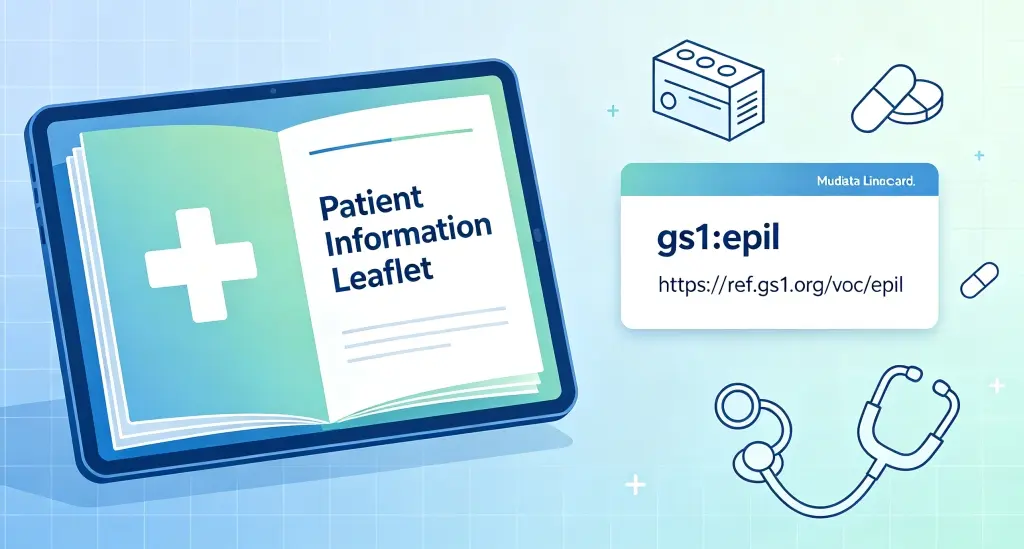
gs1:epil is one of the standard link types in GS1 Digital Link, specifically designed to connect medicines with their electronic Patient Information Leaflet. According to the GS1 Web Vocabulary, it is defined as: “A link to an electronic patient information leaflet.”
To understand gs1:epil, you need to know two background concepts.
What is PIL?
PIL (Patient Information Leaflet) is the paper leaflet that comes with a medicine, providing patients with information on safe and effective use. In the traditional model, every box of medicine contains a folded paper leaflet — the dense, small-print sheet you see when you open the package.
What is ePIL?
ePIL stands for electronic Patient Information Leaflet. It puts the traditional paper leaflet online, allowing patients to scan a QR code on the medicine packaging or visit a designated URL to access it.
gs1:epil combines ePIL with the GS1 Digital Link standard — using a standardized QR code to bind a medicine’s GTIN (Global Trade Item Number) with its electronic patient information, so scanning takes you directly to the correct medicine leaflet.
Differences from Related Link Types
| Link Type | Applicable To | Content |
|---|---|---|
gs1:epil | Medicines | Patient-facing electronic leaflet (usage, dosage, side effects, contraindications) |
gs1:eifu | Medical devices | Electronic instructions for use (operation, safety, maintenance) |
gs1:brandHomepagePatient | Medicines / Devices | Brand patient portal (brand story, patient support) |
gs1:pip | General products | Product details, specifications |
The distinguishing feature of gs1:epil is that it directly serves pharmaceutical regulatory compliance and patient safety. It is the technical implementation method under regulatory frameworks such as the EU EMA and Japan PMDA’s electronic Product Information (ePI) standards.
Difference from gs1:brandHomepagePatient
Although both gs1:epil and gs1:brandHomepagePatient are patient-facing, they serve different purposes:
gs1:epil: Points to regulated, statutory leaflet content approved by pharmaceutical regulatory authorities — the electronic version of the familiar medicine leaflet. Its content is strictly regulated and cannot be modified at will.gs1:brandHomepagePatient: Points to a brand-operated patient portal — which may include brand stories, patient support programs, disease education, and other content not approved by pharmaceutical regulatory authorities.
2. Why Use It
2.1 Information Always Up to Date
Traditional paper leaflets are fixed once printed. When a medicine’s usage, dosage, side effects, or contraindications are updated based on new clinical research, the millions of already-printed paper leaflets cannot be modified.
With gs1:epil, the code is fixed, but the content behind it can be updated at any time. When regulators approve new indications, add safety warnings, or adjust dosages, pharmaceutical companies only need to update the ePIL content in the cloud. Every time a patient scans, they get the most recently approved medicine information — something impossible under the traditional paper model.
2.2 Multilingual Support and Accessibility
Paper leaflets are limited by physical space and can usually only offer one or two language versions. With gs1:epil, pharmaceutical companies can maintain dozens of language versions in the cloud. After scanning, the system automatically pushes the corresponding version based on the phone’s language settings.
Electronic leaflets also support accessibility — text can be enlarged, read aloud by screen readers, or converted to audio. For visually impaired patients, elderly people, or those with limited reading ability, this is an experience paper leaflets cannot provide.
2.3 Improving Patient Safety and Medication Adherence
When patients can scan to access clear, accurate, and timely medicine information, the risk of misuse, missed doses, and abuse decreases. The GS1-Google collaboration has already enabled this: patients, caregivers, and healthcare professionals can directly scan GS1 DataMatrix barcodes with smartphones to access trusted medicine information, including the electronic Patient Information Leaflet.
Research shows that the digital transformation of electronic leaflets (ePIL) not only improves patient safety and information accessibility but also contributes to sustainability.
2.4 Meeting Mandatory Global Regulatory Requirements
In major pharmaceutical markets worldwide, electronic leaflets are moving from “optional” to “mandatory”:
- Japan PMDA: Since July 2023, professional medical devices and IVD products have been required to use ePIL and eIFU. Products that are not registered online or fail to redirect when scanned cannot clear customs or be used clinically.
- EU EMA: Promoting the ePI (electronic Product Information) standard, built on HL7 FHIR, using GS1 identifiers to connect regulated documents with physical packaging.
- Global trend: More and more regulatory authorities are requiring QR codes on medicine packaging to provide direct access to approved electronic leaflets.
For companies hoping to export medicines to these markets, gs1:epil is a requirement.
2.5 Reducing Printing and Logistics Costs
For pharmaceutical companies selling across borders, the printing, translation, warehousing, and logistics costs of paper leaflets are significant. With gs1:epil:
- No need to print different language versions for each market
- No need to include paper leaflets in packaging
- No need to reprint and redistribute when leaflets are updated
This saves costs and also reduces paper consumption and transportation carbon emissions.
2.6 One Code, Multiple Uses
One advantage of GS1 Digital Link is that a single code can serve different roles:
- Patients scan → access plain-language medicine leaflets
- Pharmacists scan → access dispensing information and storage requirements
- Doctors scan → access prescribing information and clinical data
- Regulators scan → access approved statutory leaflet content
No need to print multiple QR codes — one code connects to different information sources.
3. Typical Use Cases
Use Case 1: Prescription Medicines — Patients Scan for the Latest Leaflet
Take a new diabetes medication as an example. After launch, regulatory authorities adjusted the dosage recommendation for patients with renal impairment based on real-world data. Under the traditional model, this update would have to wait for the next packaging print run — during which time tens of thousands of patients might still be reading the old leaflet.
With gs1:epil, after the pharmaceutical company updates the ePIL content in the cloud, all QR codes on already-sold products immediately point to the new leaflet. Patients scan to get the latest dosage recommendation, without waiting for packaging changes or product recalls.
Use Case 2: Cross-Border Medicines — Automatic Multilingual Adaptation
A medicine sold in multiple European countries needs to have leaflets printed in multiple languages on the packaging, taking up significant space. With gs1:epil, the pharmaceutical company maintains 28 European language versions in the cloud. A patient scanning in Belgium sees the Dutch version, in France the French version, in Germany the German version — the same QR code automatically adapts to each patient’s native language.
Use Case 3: Over-the-Counter (OTC) Medicines — Improving Consumer Information Access
For a common painkiller, consumers can scan after purchase at the pharmacy to access complete medicine information: usage and dosage, contraindications, side effects, drug interactions, etc. No need to flip through a paper leaflet or use a magnifying glass — the text on the phone screen is clear and readable, and keywords can be searched to quickly find needed information.
Use Case 4: Special Patient Groups — Accessible Information Access
For visually impaired patients or those with limited reading ability, paper leaflets are nearly unusable. With gs1:epil, electronic leaflets support screen reader narration, font enlargement, audio playback, and other features. After scanning, the phone can read the leaflet content aloud, allowing every patient to access medicine information.
4. Complete Configuration Example
Below is a JSON example of a pharmaceutical company configuring gs1:epil link data in a GS1 resolver:
{
  "anchor": "/01/06933960552835/21/1234ABDE",
  "itemDescription": "ExampleCardio 10mg Tablets - Batch #1234ABDE",
  "defaultLinktype": "gs1:pip",
  "links": [
    {
      "linktype": "gs1:pip",
      "href": "https://www.example.com/product/12345",
      "title": "Product Basic Information",
      "type": "text/html",
      "hreflang": ["zh-CN"],
      "context": ["general"]
    },
    {
      "linktype": "gs1:epil",
      "href": "https://epil.example.com/01/06933960552835/21/1234ABDE",
      "title": "Electronic Patient Information Leaflet - Medicine Leaflet",
      "type": "text/html",
      "hreflang": ["zh-CN"],
      "context": ["patient", "safety"]
    },
    {
      "linktype": "gs1:epil",
      "href": "https://epil.example.com/en/01/06933960552835/21/1234ABDE",
      "title": "ePIL - Patient Information Leaflet",
      "type": "text/html",
      "hreflang": ["en"],
      "context": ["patient", "safety"]
    },
    {
      "linktype": "gs1:brandHomepageClinical",
      "href": "https://professional.example.com/examplecardio",
      "title": "ExampleCardio - Healthcare Professional Portal",
      "type": "text/html",
      "hreflang": ["zh-CN"],
      "context": ["clinical", "prescribing"]
    }
  ]
}
Configuration Field Descriptions
| Field | Description |
|---|---|
anchor | The resolver’s routing anchor. 01/ is followed by the GTIN, 21/ by the serial number, enabling item-level precise identification |
defaultLinktype | Default fallback link type. Redirects when no specific condition is matched (usually the product detail page) |
links | Array of link rules; multiple entries can be configured |
linktype | Link type. Here it is gs1:epil, indicating an electronic patient information leaflet link |
href | The ePIL access URL, containing electronic leaflet content approved by pharmaceutical regulatory authorities |
title | Link title for display by the resolver or scanning tool |
type | Content type, usually text/html; PDF, JSON (e.g., HL7 FHIR format), and other formats are also supported |
hreflang | Language adaptation. Returns the corresponding language version based on phone language settings |
context | Context tags for granular distribution (e.g., distinguishing “patient safety” from “medication guidance”) |
User Scanning Flow
- Scan: Patients, caregivers, or healthcare professionals use a smartphone (e.g., Google Lens) to scan the GS1 DataMatrix QR code on the medicine packaging.
- Resolve: The scanning tool sends a request to the GS1 resolver, which matches the appropriate link based on parameters (e.g.,
linkType=gs1:epil). - Redirect: The user is directed to the medicine’s electronic Patient Information Leaflet (ePIL).
- Access: The patient browses the medicine leaflet — usage and dosage, contraindications, side effects, storage conditions, etc. — with clear, readable text that supports enlargement and search.
Key Benefits
- Minimal QR code: The code only contains the base path; all leaflet content is configured in the cloud.
- Dynamic dispatch: The same code automatically returns the corresponding language version based on
hreflang. - Always updatable: When leaflet content is updated, only the backend needs to be changed — no need to reprint packaging or recall products.
- Multi-format support: HTML pages, PDF downloads, HL7 FHIR structured data, and other formats are all supported.
- Regulatory compliance: Meets ePIL requirements in major global markets including Japan PMDA and EU EMA.
- No additional app needed: Information can be accessed by scanning through native tools like Google Lens.
Summary
gs1:epil is the link type in the GS1 Digital Link system that directly serves pharmaceutical regulatory compliance and patient safety. What it does is straightforward — it binds a medicine’s GTIN with its electronic Patient Information Leaflet in a single QR code, so scanning takes you directly to the correct medicine leaflet.
The product information page answers “what is it?” — the brand portal answers “what is the brand story?” — gs1:epil answers the questions patients care most about: “How do I take this medicine? What are the side effects? When should I not use it?”
For pharmaceutical companies that need to meet regulatory requirements such as Japan PMDA and EU EMA, gs1:epil is a link that needs to be set up, and it is also the way to put medicine leaflet digitization into practice.