1. What Is gs1:epcisRepository?
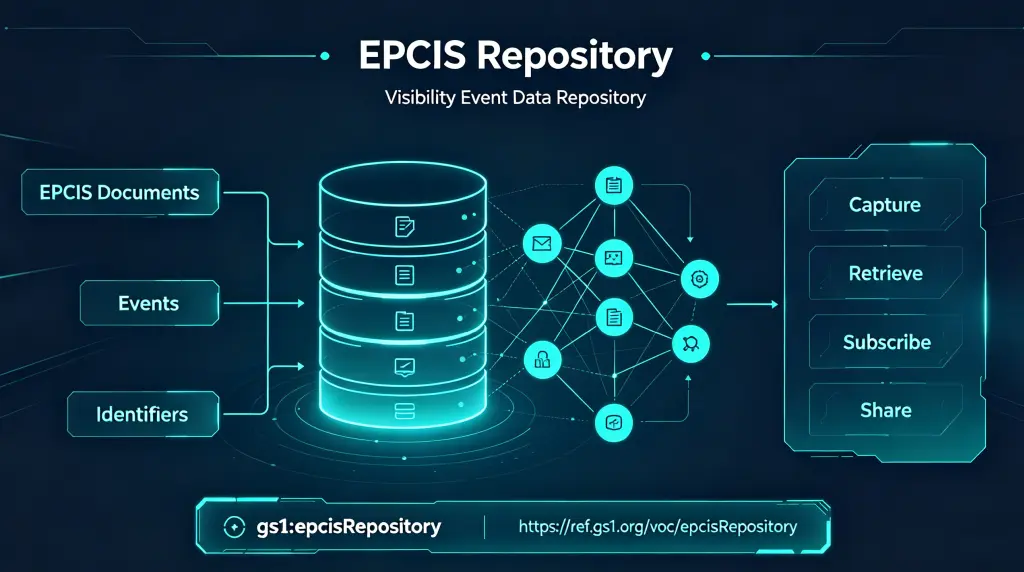
gs1:epcisRepository is a link type within the GS1 Digital Link framework specifically designed to connect an entity with its EPCIS visibility event data repository. According to the official definition in the GS1 Web Vocabulary, it is “a link to an EPCIS repository of visibility event data”.
To understand gs1:epcisRepository, we first need to grasp two core concepts:
What Is EPCIS?
EPCIS (EPC Information Services) is a core GS1 standard that defines a standardised data model for visibility event data, along with standardised interfaces for capturing and querying that data. The goal of EPCIS is to enable different applications to create and share visibility event data both within and across enterprises.
Simply put, EPCIS records “what happened, where it happened, when it happened, and why it happened” for a product in the supply chain. Each EPCIS event is a record of a completed business process step – for example, “this product left the Suzhou warehouse on 31 August 2026 at 14:23, bound for the Shanghai store.”
What Is an EPCIS Repository?
An EPCIS Repository is a system that stores EPCIS visibility event data and provides query services for that data. Think of it as a “supply chain event database” that records the complete movement history of every product from production to consumption.
gs1:epcisRepository combines the EPCIS Repository with the GS1 Digital Link standard – using a standardised QR code or link, the product’s GS1 identifier (e.g., GTIN + serial number) is precisely bound to its corresponding EPCIS event data repository, allowing authorised users to scan and instantly access the complete event history of that product.
Differentiation from Related Link Types
| Link Type | Question It Answers | Data Characteristics |
|---|---|---|
gs1:pip (Product Information Page) | What is the product? | Static master data (description, specs) |
gs1:certificationInfo (Certification Info) | Who recognises it? | Static certification data |
gs1:eifu (Electronic Instructions for Use) | How is it used? | Static operational documentation |
gs1:epcisRepository | What has it been through? | Dynamic visibility event data (time, location, status changes) |
What makes gs1:epcisRepository special is that it points not to static information, but to dynamic, continuously updated event stream data – recording the real‑world journey of a product through every step of the supply chain.
2. Core Value of gs1:epcisRepository
2.1 Achieving End‑to‑End Visibility from Factory to Consumer
Traditional supply chain traceability is often limited to the batch level – you know when a batch was produced, but you cannot track the specific journey of an individual unit.
With gs1:epcisRepository, every product carrying a unique serial number can have its own “digital footprint”. From coming off the production line, leaving the warehouse, arriving at the distribution centre, to being placed on the retail shelf – every step is recorded as an EPCIS event and stored in the EPCIS Repository. Authorised users can scan and drill down into the complete journey of each individual product.
2.2 Enabling Precision Recalls and Quality Traceability
When product quality issues arise, the traditional approach is often a full‑batch recall – even if only a small subset of the batch is affected. This is not only costly but also causes unnecessary resource waste.
With gs1:epcisRepository, brands can precisely identify exactly which product and at which stage the problem occurred. By scanning and querying the EPCIS event data, they can reconstruct the complete supply chain path of that specific unit, enabling item‑level precision traceability and recall.
2.3 Meeting Regulatory Compliance Requirements
Emerging regulations such as the EU Digital Product Passport (DPP) explicitly require products to provide lifecycle‑long traceability information. EPCIS 2.0 and GS1 Digital Link are the key technical combination for meeting this requirement.
gs1:epcisRepository provides products with a standardised access point to EPCIS data, allowing regulators, brands, and consumers to obtain the complete event history of a product through a single QR code.
2.4 Empowering Supply Chain Intelligence
EPCIS event data is not just a “traceability record” – it is the data foundation for supply chain optimisation. By analysing visibility event data stored in the EPCIS Repository, companies can:
- Identify bottlenecks and delays in the supply chain
- Optimise inventory management and replenishment strategies
- Verify supplier delivery performance
- Detect anomalies and risks in logistics processes
gs1:epcisRepository makes this data accessible at your fingertips – scan the code to connect, without complex system integration.
2.5 One Code for Multiple Use Cases
A core advantage of GS1 Digital Link is “one code, multiple uses”. The same QR code can be used by different roles in different scenarios:
- Consumers scan → verify product authenticity and origin
- Retailers scan → validate supply chain compliance
- Regulators scan → access complete EPCIS event data for audits
- Brands scan → trace the root cause of quality issues
One code connects static information with dynamic event data, meeting the needs of all stakeholders.
3. Typical Application Scenarios
Scenario 1: Food Supply Chain – Farm‑to‑Table Traceability
An organic food brand uses GS1 Digital Link QR codes containing gs1:epcisRepository on every product. When consumers scan, they not only see product information but can also view the complete supply chain event history of that specific unit:
- Tier 3 (Raw material procurement) : 15 July 2026 – organic coffee beans harvested from a farm in Ethiopia
- Tier 2 (Processing) : 28 July 2026 – roasted at a roasting facility in Hamburg, Germany
- Tier 1 (Finished goods assembly) : 5 August 2026 – packaged at a packaging facility in the Netherlands
- Logistics : 12 August 2026 – departed Rotterdam Port; 25 August 2026 – arrived Shanghai Port
- Retail : 28 August 2026 – placed on shelf at a Shanghai store
Every step is recorded as an EPCIS event and stored in the EPCIS Repository. Consumers can drill down layer by layer to view the real journey of each product. This level of transparency is virtually impossible under traditional models.
Scenario 2: Pharmaceutical Supply Chain – Precision Recalls and Anti‑Counterfeiting
A pharmaceutical company uses GS1 QR codes containing gs1:epcisRepository (GTIN + serial number) on every drug package. When quality issues arise:
- Precise location – query the EPCIS Repository for the complete distribution path of that serialised product
- Precise recall – recall only the products from the same batch and same distribution path that are affected, rather than the entire batch
- Anti‑counterfeiting – consumers scan to verify authenticity and whether the product comes from a legitimate channel
This significantly reduces recall costs while effectively preventing counterfeit drugs from entering the market.
Scenario 3: Luxury Goods and High‑Value Products – Authenticity Certification
A luxury brand uses GS1 QR codes containing gs1:epcisRepository (GTIN + unique serial number) on every product. Consumers scanning the code can view the product’s “digital birth certificate” :
- Production date and factory
- Material sources
- Quality inspection records
- Historical transfer records
Every record is an immutable EPCIS event. This not only helps consumers verify product authenticity but also enhances transaction transparency in the second‑hand market.
Scenario 4: Electronics – Full‑Lifecycle “Digital Twin”
A consumer electronics brand uses GS1 QR codes containing gs1:epcisRepository on its products. From production to end‑of‑life, every key event is recorded in the EPCIS Repository:
- Production – manufacturing date, factory, quality inspection results
- Sale – first activation date, sales channel
- Repair – each repair time, details, and replaced parts
- Recycling – disposal date, recycling method
This gives every electronic product a complete “digital twin” – not just “what it is,” but “what it has been through.”
4. Complete Usage Example
Below is a JSON example of how a food company would configure gs1:epcisRepository link data in a GS1‑compliant resolver for a specific product:
{
  "anchor": "/01/06933960552835/21/1234ABDE",
  "itemDescription": "Eco‑Town Organic Coffee Beans 250g – Batch #1234ABDE",
  "defaultLinktype": "gs1:pip",
  "links": [
    {
      "linktype": "gs1:pip",
      "href": "https://www.example.com/product/12345",
      "title": "Product Details",
      "type": "text/html",
      "hreflang": ["zh-CN"],
      "context": ["general"]
    },
    {
      "linktype": "gs1:epcisRepository",
      "href": "https://epcis.example.com/repository/01/06933960552835/21/1234ABDE",
      "title": "Supply Chain Traceability – EPCIS Event Data",
      "type": "application/json",
      "hreflang": ["zh-CN"],
      "context": ["traceability", "supply-chain"]
    },
    {
      "linktype": "gs1:epcisRepository",
      "href": "https://epcis.example.com/repository/en/01/06933960552835/21/1234ABDE",
      "title": "Supply Chain Traceability – EPCIS Event Data",
      "type": "application/json",
      "hreflang": ["en"],
      "context": ["traceability", "supply-chain"]
    }
  ]
}
Field Descriptions
| Field | Meaning |
|---|---|
anchor | The resolver’s routing anchor. 01/ is followed by the GTIN, and 21/ is followed by the serial number, enabling item‑level precise identification. |
defaultLinktype | The default fallback link type. If no specific condition matches, it redirects to this link (usually a product details page). |
links | The core array of rules, allowing multiple links to be configured. |
linktype | The link type – here gs1:epcisRepository, indicating an EPCIS repository link. |
href | The EPCIS Repository query endpoint URL for retrieving visibility event data for this product. |
title | The link title, displayed by the resolver or scanning tool. |
type | Content type. EPCIS data is typically returned in application/json or application/xml format. |
hreflang | Language adaptation – returns the appropriate language version based on the device’s language preference. |
context | Context tags for further refinement (e.g., differentiating “supply‑chain traceability” from “consumer verification” sub‑scenarios). |
Sample EPCIS Repository Response Data (JSON Format)
When authorised users access the EPCIS Repository via the gs1:epcisRepository link, they may receive EPCIS event data in the following format:
{
  "@context": "https://ref.gs1.org/standards/epcis/2.0/context.jsonld",
  "type": "EPCISDocument",
  "creationDate": "2026-08-31T10:00:00Z",
  "schemaVersion": "2.0",
  "epcisBody": {
    "eventList": [
      {
        "type": "ObjectEvent",
        "eventID": "urn:uuid:123e4567-e89b-12d3-a456-426614174000",
        "eventTime": "2026-07-15T08:30:00Z",
        "eventTimeZoneOffset": "+03:00",
        "epcList": [
          {
            "epc": "urn:epc:id:sgtin:0693396.055283.1234ABDE"
          }
        ],
        "action": "OBSERVE",
        "bizStep": "urn:epcglobal:cbv:bizstep:harvesting",
        "disposition": "urn:epcglobal:cbv:disp:in_progress",
        "readPoint": {
          "id": "urn:epc:id:sgln:0693396.00001.0"
        },
        "bizLocation": {
          "id": "urn:epc:id:sgln:0693396.00002.0"
        },
        "bizTransactionList": [
          {
            "type": "urn:epcglobal:cbv:btt:po",
            "bizTransaction": "urn:epcglobal:cbv:bt:1234567890"
          }
        ]
      }
    ]
  }
}
User Scanning Workflow
- Scan – A consumer, regulator, or supply chain partner scans the QR code on the product using a GS1‑compatible scanning tool.
- Resolution – The scanning tool sends a request to the GS1 resolver, which matches the most appropriate link based on the request parameters (e.g.,
linkType=gs1:epcisRepository). - Redirect – The system directs the user (or the user’s application) to the EPCIS Repository query endpoint.
- Retrieve Event Data – The application obtains the complete visibility event data (JSON or XML format) for that product from the EPCIS Repository and presents it to the user as needed.
Advantages of This Approach
- Concise QR code – the code contains only the base path (e.g.,
/01/06933960552835/21/1234ABDE); all event data is stored dynamically in the EPCIS Repository. - Item‑level traceability – enables “one item, one code” precision tracing via GTIN + serial number.
- Dynamic data – EPCIS event data is updated in real time – every time a product passes through a supply chain step, a new EPCIS event is appended to the Repository.
- Standardised format – EPCIS data follows GS1 international standards, enabling seamless sharing across different companies and systems.
- Machine‑readable – data is returned in JSON or XML format, facilitating system integration and automated processing.
- Fully traceable – the complete supply chain history of every product is recorded, auditable on demand, permanent and retrievable.
Summary
gs1:epcisRepository is a key link type within the GS1 Digital Link ecosystem that bridges static identifiers with dynamic event data. With its clear definition – “a link to an EPCIS repository of visibility event data” – it builds a standardised, dynamic, and traceable data bridge between products and supply chain event data.
While product details pages answer “what it is” and certification information answers “who recognises it,” gs1:epcisRepository answers “what it has been through” – where this product came from, what stages it passed through, when and where it was handled, and where it ultimately went.
Whether it is food brands achieving full farm‑to‑table transparency, pharmaceutical companies enabling item‑level precision recalls, luxury brands verifying product authenticity, or electronics brands building full‑lifecycle “digital twins” for their products, gs1:epcisRepository offers organisations a standardised, scalable, and regulation‑friendly approach to supply chain visibility data distribution – turning every scan into a deep dive into the product’s real journey.