1. What Is gs1:certificationInfo?
gs1:certificationInfo is a link type within the GS1 Digital Link framework specifically designed to connect an entity with its certification information. The GS1 Web Vocabulary defines it as “a link to certification information”, and in the context of Digital Link resolution, it is further described as “certification and conformity data”.
To understand this link type, we must first grasp the overall architecture of GS1 Digital Link. GS1 Digital Link converts identifiers such as GTIN, GLN, and GRAI into standard web URIs, giving every physical entity (product, location, asset, organisation, etc.) a persistent and resolvable web address. A URI identifies the entity itself, while the resolver returns content that links that same entity to multiple different information sources.
gs1:certificationInfo plays the role of a certification gateway in the distribution layer. Its possible associations include:
- Product certifications – organic, Fair Trade, BRC/IFS food safety, FSC forestry, etc.
- Compliance declarations – CE marking, FDA registration, RoHS, REACH, etc.
- Quality certifications – ISO 9001, ISO 13485, etc.
- Sustainability certifications – carbon footprint, carbon neutrality, LEED, etc.
- Origin and authenticity – certificates of origin, Protected Geographical Indication (PGI), anti‑counterfeiting, etc.
- Personnel and organisational certifications – professional qualifications, industry licences, etc.
In GS1 technical specifications, gs1:certificationInfo has been marked as stable, meaning it is fully validated and ready for production use.
Differentiation from Similar Link Types
Several link types in the Digital Link framework are easily confused with certification information. The table below clarifies their distinct roles:
| Link Type | Question It Answers | Content |
|---|---|---|
gs1:pip | What is the product? | Descriptions, specifications, features |
gs1:backgroundInfo | Where did it come from? Why was it made? | Creative background, technical origins, brand story |
gs1:certificationInfo | Who recognises it? What standards does it meet? | Third‑party certificates, compliance declarations, test reports |
gs1:instructions | How is it used? | Operating guides, safety warnings, maintenance instructions |
Each link type has its own purpose. gs1:certificationInfo sits in the “third‑party endorsement” position, carrying verifiable information issued by independent bodies.
2. Real‑World Problems It Solves
2.1 Turning Certification from an Icon into a Digital Dossier
Traditional packaging usually displays certification marks as small icons – a leaf for organic, a tree for FSC, a combination of letters for CE. Consumers see the icon but cannot access details such as the certifying body, standard number, validity period, or scope.
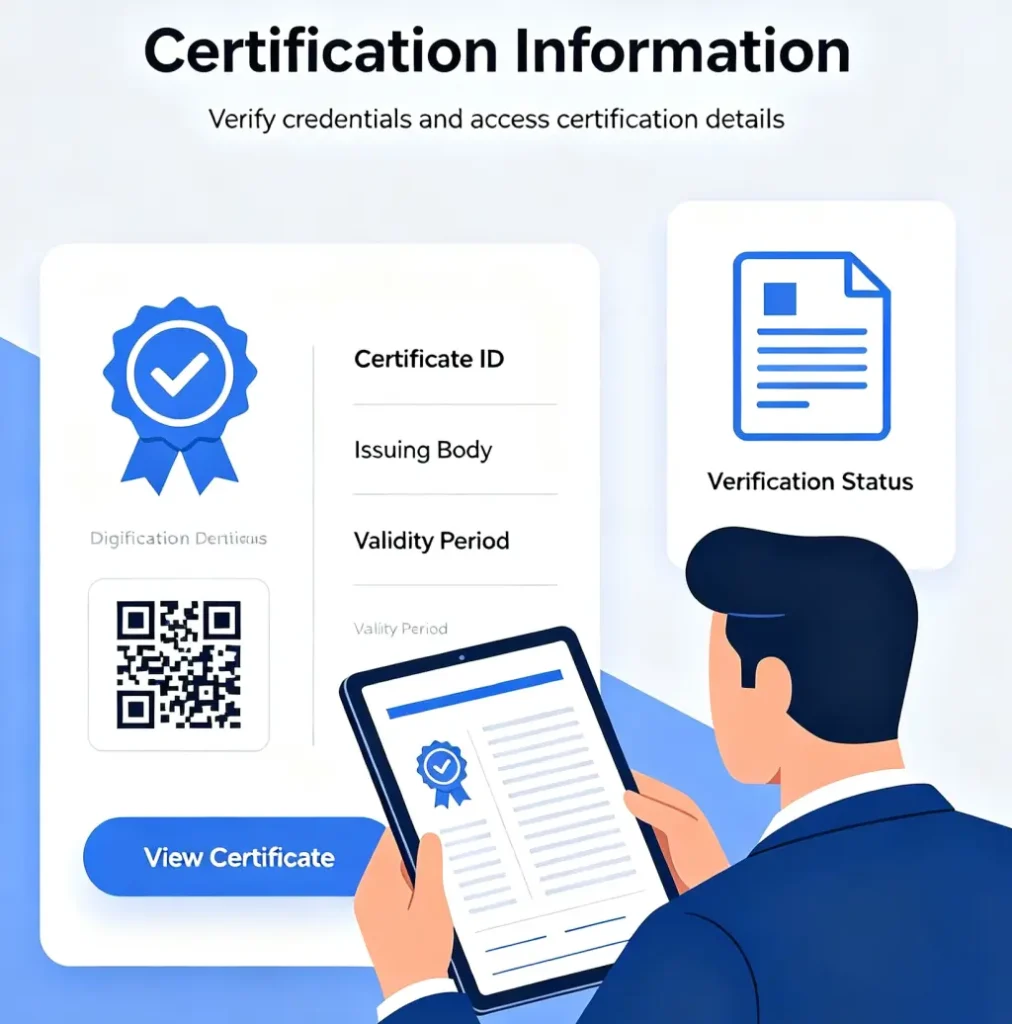
gs1:certificationInfo upgrades these icons into clickable digital dossiers. After scanning, users can see:
- Who issued the certification
- Which standard was applied
- When it expires
- Which product lines it covers
- The full electronic version of the certificate
Moving from “seeing an icon” to “seeing the evidence” makes a substantial difference in building trust.
2.2 Meeting Regulatory Digitalisation Requirements
In industries like food, pharmaceuticals, medical devices, and electronics, regulators are demanding ever more granular compliance information. The EU‑led Digital Product Passport (DPP) initiative explicitly includes certification and conformity data as part of a product’s lifecycle information.
gs1:certificationInfo provides a standardised technical pathway. Through a unified GS1 Digital Link, certification information can be both machine‑readable and human‑friendly, making it accessible to regulators and consumers alike.
2.3 Building Trust on “Verifiability”
With the rise of greenwashing and fraudulent certifications, consumer trust is shifting from “I believe what you say” to “show me the evidence.”
Instead of a vague statement like “we are organically certified,” a scan reveals concrete details such as:
Certification Body: Control Union Certifications
Standard: USDA Organic
Certificate Number: CU‑123456‑2024
Validity Period: 1 Jan 2024 – 31 Dec 2025
Scope: This product and its raw materials (organic coffee beans, origin: Ethiopia)
Trust no longer relies on blind belief – it is built on verifiability.
2.4 Reducing Compliance Information Maintenance Costs
In the past, updating certification information (renewal, scope expansion, new certificates) often required reprinting packaging and marketing materials. With gs1:certificationInfo, you only need to change the link target once in the resolver backend – all QR codes already in circulation will point to the new content. Print once, and it stays effective.
2.5 Connecting Scattered Certifications Across the Supply Chain
A product’s certifications are often distributed across different stages: organic certification for raw materials, food safety certification for the processing plant, cold‑chain certification for transport. gs1:certificationInfo can link these pieces together into a complete certification chain – useful for both brand supply chain management and consumers seeking full visibility.
3. Typical Application Scenarios
Scenario 1: Organic Food – Turning Icons into Digital Dossiers
An organic coffee brand prints QR codes with gs1:certificationInfo on its packaging. When consumers scan, they see:
- The USDA Organic certificate (with number and validity)
- Contact details and credentials of the certification body
- Organic traceability for that batch (plantation, processing facility)
- Equivalency statement for EU Organic certification
One icon becomes a full digital dossier – a clear difference in building brand trust.
Scenario 2: Electronics – Structured Compliance Information
A consumer electronics manufacturer uses QR codes with gs1:certificationInfo on its packaging. Procurement officers, regulators, and environmentally conscious consumers scanning the code can see:
- CE declaration of conformity (including applicable EU directives)
- RoHS test reports
- REACH compliance statement
- Energy efficiency rating
- WEEE recycling compliance information
Structured digital formats make due diligence and regulatory reviews much easier.
Scenario 3: Building Materials – Quick Access to Green Building Certifications
A manufacturer of eco‑friendly building materials holds three certifications: LEED, FSC, and EPD. It prints QR codes with gs1:certificationInfo on packaging and nameplates.
Designers, procurement staff, and green building consultants can scan the code and instantly access all certification details – standards, bodies, validity periods, and scopes – streamlining the material review process for green building projects.
Scenario 4: Medical Devices – Transparent Quality Management Systems
A medical device manufacturer uses QR codes with gs1:certificationInfo on product packaging. Hospital procurement, quality management, and clinical engineering departments scanning the code can view:
- ISO 13485 certificate
- FDA registration information
- CE marking (Medical Devices Directive) compliance documents
- Post‑market surveillance (PMS) reports
These details are valuable for supplier evaluation and quality audits – and gs1:certificationInfo makes them available on demand.
4. Complete Configuration Example
Below is a JSON example for an organic food company configuring gs1:certificationInfo link data in a GS1‑compliant resolver for a specific product:
{
  "anchor": "/01/06933960552835",
  "itemDescription": "Eco‑Town Organic Coffee Beans 250g",
  "defaultLinktype": "gs1:pip",
  "links": [
    {
      "linktype": "gs1:pip",
      "href": "https://www.example.com/product/12345",
      "title": "Product Details",
      "type": "text/html",
      "hreflang": ["zh-CN"],
      "context": ["general"]
    },
    {
      "linktype": "gs1:certificationInfo",
      "href": "https://cert.example.com/organic-coffee",
      "title": "Organic Certification & Compliance Information",
      "type": "text/html",
      "hreflang": ["zh-CN"],
      "context": ["organic", "sustainability"]
    },
    {
      "linktype": "gs1:certificationInfo",
      "href": "https://cert.example.com/en/organic-coffee",
      "title": "Certification & Compliance Information",
      "type": "text/html",
      "hreflang": ["en"],
      "context": ["organic", "sustainability"]
    },
    {
      "linktype": "gs1:backgroundInfo",
      "href": "https://www.example.com/story/coffee",
      "title": "The Story of the Coffee Estate",
      "type": "text/html",
      "hreflang": ["zh-CN"],
      "context": ["brand", "origin"]
    }
  ]
}
Field Descriptions
| Field | Meaning |
|---|---|
anchor | The resolver’s routing anchor, corresponding to the GTIN. When a scan hits this path, the resolver looks for matching link rules. |
defaultLinktype | The default fallback link type. If no specific condition matches, the resolver redirects to this link (usually a product details page). |
links | The core array of rules, allowing multiple links to be configured. |
linktype | The link type – here gs1:certificationInfo. |
href | The landing page URL containing certificates, compliance declarations, etc. |
title | The link title, displayed by the resolver or scanning tool. |
type | Content type, typically text/html. |
hreflang | Language adaptation – returns the appropriate language version based on the browser’s language preference. |
context | Context tags for further refinement (e.g., distinguishing “organic” from “sustainability”). |
Scanning Workflow
- Scan – A consumer, procurement officer, or regulator scans the QR code on the packaging using a GS1‑compatible scanning tool (phone camera, WeChat, dedicated app, etc.).
- Resolution – The scanning tool sends a request to the resolver, which matches the most suitable link based on parameters such as
linkType=gs1:certificationInfo. - Redirect – The system directs the user to the brand’s dedicated certification information page.
- View & Verify – The user browses certificates, compliance declarations, test reports, and can verify their validity online.
Advantages of This Approach
- Minimal QR code – the code contains only the base path (e.g.,
/01/06933960552835); all certification information is configured in the cloud. - Dynamic distribution – the same QR code automatically returns the Chinese or English version based on
hreflang. - Instantly updatable – for renewals or new certifications, only the backend
hrefor the certification page content needs to be changed – no reprinting required. - Multi‑dimensional association – can be flexibly linked with multiple GS1 identifiers: GTIN (product), GLN (location), GRAI (asset), etc.
- Traceable data – the resolver backend can track access statistics for each
gs1:certificationInfolink.
Summary
gs1:certificationInfo is a practical, down‑to‑earth standard within the GS1 Digital Link ecosystem. It does one thing: it builds a bridge between a product (or organisation) and its certification information, making that information discoverable, updateable, and distributable.
While product details pages answer “what it is” and background pages answer “where it came from,” gs1:certificationInfo answers “why you should trust it” – the evidence behind the claim.
Whether it’s a food brand turning icons into dossiers, an electronics manufacturer structuring compliance declarations, or a building materials supplier enabling one‑click access to green certifications, it offers the same thing: a standardised, scalable, and verifiable way to distribute certification information.
Scanning thus becomes something slightly different – no longer just “looking at an icon,” but a verifiable check that builds genuine trust.