1. What Is gs1:masterData?
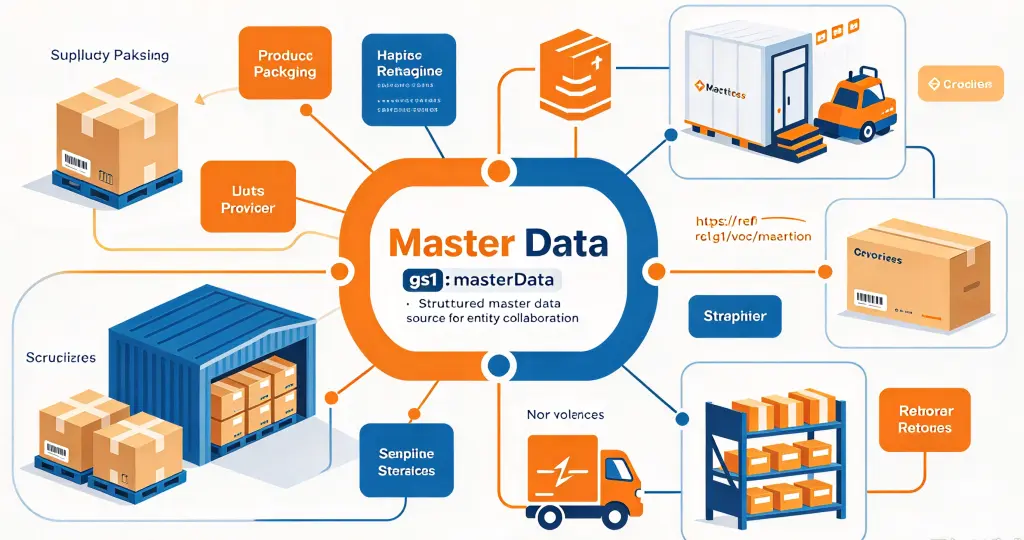
gs1:masterData is a link type within the GS1 Digital Link framework specifically designed to connect an entity with its structured master data source. According to the official definition in the GS1 Web Vocabulary, it is “a link to a source of structured master data for the entity. This is typically for B2B applications.”
To understand gs1:masterData, we first need to grasp two core concepts:
What Is Master Data?
Master data is the fundamental, shared data that describes an enterprise’s core entities and is typically reused across multiple systems throughout an organisation. For a product, master data includes:
- Product identification – GTIN, brand, product name, model
- Physical attributes – dimensions, weight, colour, material
- Packaging information – packaging hierarchy, quantity per case, case dimensions
- Classification information – GPC (Global Product Classification) code, target market
- Compliance information – target market regulations, labelling requirements
- Commercial information – unit of measure, minimum order quantity, shelf life
What Is Structured Data?
“Structured” means the data is presented in a machine‑readable, standardised format – such as JSON‑LD, XML, or GS1 EDI. This enables enterprise systems such as ERP, WMS, and PIM to automatically parse and process the data without manual entry.
Differentiation from Related Link Types
Within the GS1 link type system, gs1:masterData has a clear and distinct role from several common link types:
| Link Type | Target Audience | Content Characteristics |
|---|---|---|
gs1:pip (Product Information Page) | Consumers | Human‑readable HTML pages (descriptions, images) |
gs1:certificationInfo (Certification Info) | Consumers/Regulators | Certificates, compliance declarations |
gs1:masterData | B2B partners | Machine‑readable structured data (JSON/XML) |
If gs1:pip is the consumer‑facing “product business card,” then gs1:masterData is the B2B‑facing “data interface” – it enables trading partners’ systems to automatically retrieve complete product master data.
gs1:masterData has been marked as “stable” in GS1 technical specifications and is a sub‑property of gs1:linkType, meaning it is fully validated and ready for production use.
2. Users of gs1:masterData and Its Core Value
2.1 For Retailers and Buyers: Automated Data Retrieval, Less Manual Entry
Traditional pain point: When introducing a new product, retailers must manually extract product data from suppliers’ PDFs, Excel files, or emails and enter it into their own systems. This process is time‑consuming, error‑prone, and the data becomes outdated quickly.
Value of gs1:masterData:
- Scan to retrieve data – Procurement staff can scan the GS1 QR code on product packaging to obtain the complete structured master data via the
gs1:masterDatalink - Direct system integration – Data is returned in JSON‑LD or XML format and can be imported directly into the retailer’s PIM (Product Information Management) or ERP system
- Fewer errors – Eliminates manual entry errors and ensures data consistency
2.2 For Brands and Manufacturers: Publish Once, Share Everywhere
Traditional pain point: Brands must provide product data separately to different retailers, e‑commerce platforms, and logistics providers, each with different format requirements – resulting in significant duplicated effort.
Value of gs1:masterData:
- Single source of truth – Brands maintain one standardised set of master data in the cloud, and all trading partners access it through the same GS1 Digital Link
- Dynamic updates – When product information changes, only the cloud data source needs updating; all QR codes already in circulation immediately point to the latest data
- Standardised format – Complies with GS1 Web Vocabulary and schema.org standards, eliminating the need for custom data formats for each customer
2.3 For Logistics and Supply Chain: Accurate Cargo Information
Traditional pain point: When handling cargo, logistics providers need accurate weight, dimensions, and packaging hierarchy information to calculate freight costs and plan loading.
Value of gs1:masterData:
- Scan to retrieve logistics attributes – Weight, dimensions, packaging hierarchy, and other data are returned in structured format
- Automated calculation – Logistics systems can read the data directly to automatically calculate freight costs and loading plans
- Fewer exceptions – Accurate data reduces rejections and delays caused by information discrepancies
2.4 For E‑Commerce Platforms: Faster Onboarding, Consistent Data
Traditional pain point: E‑commerce platforms must manually create product pages for each SKU, extracting information from various formats provided by suppliers.
Value of gs1:masterData:
- Automatic product page creation – Platform systems retrieve structured data via
gs1:masterDataand automatically generate product pages - Data consistency – The same product’s information remains consistent across different platforms, improving the consumer experience
- Faster onboarding – New product onboarding time is reduced from days to minutes
2.5 Information Never Goes Out of Date
In traditional models, product data is exchanged via Excel, PDF, or EDI messages and is fixed once sent. Product specification adjustments, packaging changes, and price updates cannot be reflected in already‑sent data.
With gs1:masterData, the QR code is fixed, but the master data behind it can be updated at any time. Brands only need to update the cloud once, and all trading partners’ systems immediately retrieve the latest data.
3. Typical Application Scenarios
Scenario 1: Retail Procurement – Scan to Get Complete Product Data
When evaluating a new product, a procurement officer at a large supermarket chain scans the GS1 QR code on the supplier’s product packaging. Through the gs1:masterData link, the system automatically retrieves the product’s complete master data:
- Basic identification – GTIN, brand, product name, model
- Physical attributes – Net content, gross weight, dimensions, material
- Packaging information – Quantity per case, case specifications, pallet configuration
- Classification information – GPC code, target category
- Compliance information – Target market, labelling requirements, shelf life
This data is returned in JSON‑LD format and imported directly into the supermarket’s PIM system without manual entry. New product onboarding time is reduced from 3–5 days to just a few hours.
Scenario 2: Cross‑Border E‑Commerce – Precise Retrieval of Multi‑Market Compliance Data
A cross‑border beauty brand supplies retailers in multiple countries. Different markets have different requirements for product labelling, ingredient disclosure, and compliance documentation. Through gs1:masterData, the brand’s resolver returns the appropriate version of compliance master data based on the requested market region:
- EU market – Returns the complete ingredient list and compliance declarations in accordance with EU cosmetics regulations
- US market – Returns labelling information and ingredient disclosure in accordance with FDA requirements
- China market – Returns filing information and Chinese labelling in accordance with NMPA requirements
The same QR code delivers locally compliant master data to trading partners in different markets.
Scenario 3: Logistics Loading – Automated Freight Calculation and Loading Plans
When a logistics company’s system receives cargo, it scans the GS1 QR code on the pallet (linked to SSCC or GTIN). Through the gs1:masterData link, the system automatically retrieves:
- Weight information – Unit weight, total pallet weight
- Dimension information – Length, width, height
- Packaging hierarchy – Item → inner case → outer case → pallet
- Stacking restrictions – Maximum stacking layers, whether it can be inverted
The logistics system automatically calculates freight costs, plans loading arrangements, and generates handling instructions, significantly improving operational efficiency and accuracy.
Scenario 4: Manufacturing Procurement – Standardised Integration of Supplier Data
A manufacturing company has hundreds of suppliers, each with different product data formats. The company requires all suppliers to use GS1 QR codes containing gs1:masterData on their product packaging.
After scanning the QR code on a supplier’s delivery note, the procurement system automatically retrieves:
- Material identification – GTIN, supplier material number
- Specification parameters – Material, tolerance, performance indicators
- Packaging information – Quantity per case, packaging dimensions
- Compliance documents – Links to RoHS, REACH, and other compliance declarations
All suppliers’ data is integrated through the same standard format, greatly improving the procurement system’s data processing efficiency and significantly reducing errors caused by inconsistent data formats.
4. Complete Usage Example
Below is a JSON example of how a consumer goods manufacturer configures gs1:masterData link data in a GS1‑compliant resolver for a specific product:
{
  "anchor": "/01/06933960552835",
  "itemDescription": "CloudBrew Craft Beer – IPA 330ml",
  "defaultLinktype": "gs1:pip",
  "links": [
    {
      "linktype": "gs1:pip",
      "href": "https://www.example.com/product/12345",
      "title": "Product Details",
      "type": "text/html",
      "hreflang": ["zh-CN"],
      "context": ["consumer", "general"]
    },
    {
      "linktype": "gs1:masterData",
      "href": "https://masterdata.example.com/01/06933960552835",
      "title": "Product Master Data – B2B Structured Data",
      "type": "application/ld+json",
      "hreflang": ["zh-CN"],
      "context": ["b2b", "retailer"]
    },
    {
      "linktype": "gs1:masterData",
      "href": "https://masterdata.example.com/en/01/06933960552835",
      "title": "Product Master Data – B2B Structured Data",
      "type": "application/ld+json",
      "hreflang": ["en"],
      "context": ["b2b", "retailer"]
    }
  ]
}
Field Descriptions
| Field | Meaning |
|---|---|
anchor | The resolver’s routing anchor, corresponding to the GTIN. When a scan hits this path, the resolver looks for matching link rules. |
defaultLinktype | The default fallback link type. When a normal consumer scans, this is where they are redirected (usually a product details page). |
linktype | The link type – here gs1:masterData, indicating a master data link. |
href | The URL of the master data source, returning structured product master data. |
title | The link title, displayed by the resolver or scanning tool. |
type | Content type. Master data is typically returned in application/ld+json (JSON‑LD) or application/xml format. |
hreflang | Language adaptation – returns the appropriate language version of the master data based on the user’s language preference. |
context | Context tags for distinguishing different purposes (e.g., b2b, retailer). |
Master Data Response Example (JSON‑LD Format, Illustrative)
When a B2B system requests gs1:masterData, the returned structured data may look like this:
{
  "@context": "https://ref.gs1.org/standards/digital-link/1.1/context.jsonld",
  "@type": "gs1:Product",
  "gtin": "06933960552835",
  "brand": {
    "@type": "gs1:Brand",
    "name": "CloudBrew Craft Beer"
  },
  "productName": "CloudBrew Craft Beer IPA 330ml",
  "netContent": {
    "value": 330,
    "unit": "ml"
  },
  "grossWeight": {
    "value": 420,
    "unit": "g"
  },
  "packaging": {
    "type": "glass bottle",
    "quantityPerCase": 24,
    "casesPerPallet": 48
  },
  "gpcCategory": "10000123",
  "targetMarket": ["CN", "SG", "MY"],
  "shelfLife": {
    "value": 12,
    "unit": "month"
  }
}
User Scanning Workflow
- Scan – A trading partner’s system (e.g., a retailer’s procurement app or a logistics provider’s receiving system) scans the GS1 QR code on the product packaging.
- Select link type – The system requests
linkType=gs1:masterData(B2B data) orlinkType=gs1:pip(consumer page) depending on its purpose. - Resolution – The scanning system sends a request to the GS1 resolver, which matches the most appropriate link.
- Retrieve data – The system retrieves structured JSON‑LD or XML data from the master data source.
- Automated processing – The data is imported directly into the trading partner’s PIM, ERP, or WMS system without manual entry.
Advantages of This Approach
- Concise QR code – the code contains only the base path (e.g.,
/01/06933960552835); master data is configured in the cloud. - Dynamic distribution – the same QR code returns either a consumer page (
gs1:pip) or B2B data (gs1:masterData) depending on the user type. - Instantly updatable – product specification changes only require updating the cloud data source – no reprinting of packaging.
- Machine‑readable – structured data formats (JSON‑LD/XML) can be parsed directly by enterprise systems.
- Standards compliant – complies with GS1 Web Vocabulary and schema.org standards.
- Traceable data – the resolver backend can track access statistics for each
gs1:masterDatalink.
Summary
gs1:masterData is a standardised link type within the GS1 Digital Link ecosystem that directly serves B2B data exchange. With its definition – “a link to a source of structured master data for the entity. This is typically for B2B applications.” – it builds a standardised, machine‑readable, and real‑time updatable data bridge between products and trading partners’ systems.
While product information pages answer consumers’ question “what is this product,” master data answers B2B systems’ question: “What is the complete data structure of this product?” It upgrades product identification from “scan to view a webpage” to “scan to retrieve data,” enabling every system in the supply chain to automatically and accurately obtain the product information it needs.
Whether it’s retail procurement retrieving complete product data with a scan, cross‑border e‑commerce precisely obtaining multi‑market compliance data, logistics systems automatically calculating freight and loading plans, or manufacturing companies standardising data integration across hundreds of suppliers, gs1:masterData offers B2B scenarios a standardised, scalable, and highly efficient approach to master data distribution – turning every scan into a seamless data integration.