1. What Is GS1:hasRetailers
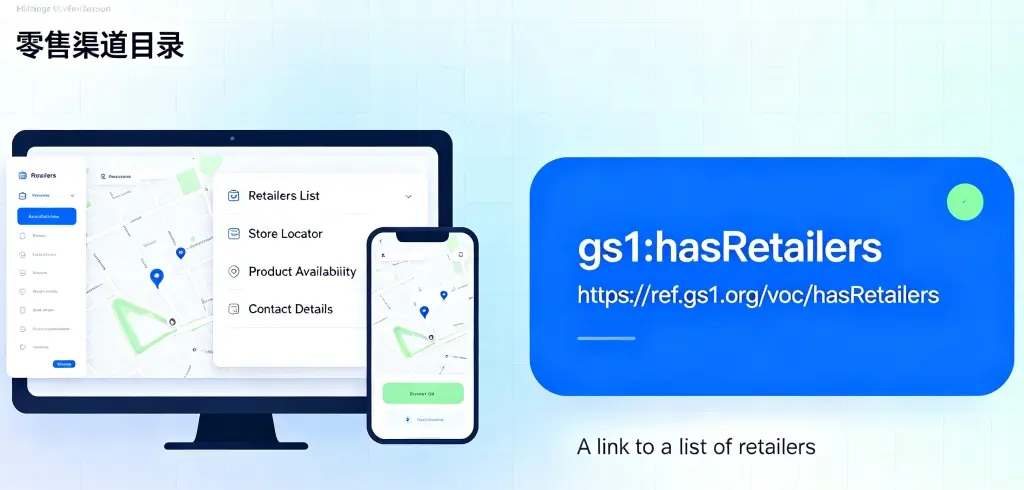
gs1:hasRetailers is one of the standardized link types in GS1 Digital Link, used to connect a product with its list of retailers. Per the GS1 Web Vocabulary definition, it is “a link to a list of retailers.”
To understand it, first consider the basic idea behind GS1 Digital Link: GS1 identifiers like GTIN are converted into standard Web URIs, giving every product a resolvable network address. Through that address, the same product identifier can point to multiple different information sources.
gs1:hasRetailers does one thing: it gives consumers an entry point to purchase channels. The page it points to typically lists retailers selling that product — store names, addresses, online purchase links, stock status, and so on.
Differences from Related Link Types
| Link Type | Question Answered | Content |
|---|---|---|
gs1:pip | What is the product? | Description, specs, features |
gs1:brandHomepage | Who is the brand? | Brand intro, brand story |
gs1:hasRetailers | Where can I buy it? | Retailer names, addresses, purchase links, stock status |
gs1:offers | What promotions are available? | Promos, discounts, coupons |
After reading the product info, the next thing consumers want to know is where to buy it. gs1:hasRetailers answers that.
2. Why Use It
2.1 Shorten the Path from Interest to Purchase
In the traditional flow, a consumer who likes a product has to remember its name, open a shopping app, search, and filter results — each step is another chance to give up.
With gs1:hasRetailers, one scan shows all sales channels, and one tap takes the consumer to the purchase page. Five steps become one.
2.2 Establish an Official Purchase Guide
With so many channels, consumers get confused: “Where is this sold through an authorized seller? Where is it in stock?”
gs1:hasRetailers lets brands proactively show their approved sales channels. Consumers find legitimate sellers quickly, and the risk of buying counterfeits goes down.
2.3 Always Up-to-Date
Text printed on packaging like “Available at major supermarkets nationwide” can’t change — once a channel is dropped or added, the printed copy is already outdated.
With gs1:hasRetailers, the QR code stays the same but the retailer list behind it can be updated anytime. New retailers get added, discontinued ones get removed, out-of-stock stores get marked as such. Consumers always see the latest information.
2.4 Give Retailers Credibility
Being listed in a brand’s official gs1:hasRetailers directory is a form of endorsement that helps build consumer trust.
Brands can also track scan-to-purchase data per retailer through the resolver’s backend — seeing which channels drive the most traffic and which regions have the strongest demand.
2.5 One Code, Multiple Uses
The same QR code serves different users differently:
- Consumers scan → see the retailer list, tap to buy
- Channel partners scan → confirm they’re in the official list
- Brand owners scan → check display and data accuracy
3. Typical Use Cases
Case 1: CPG Brands — Scan to Buy
A craft brewery “CloudBrew” prints GS1 QR codes with gs1:hasRetailers on every bottle. A consumer tries the beer at a friend’s place and likes it — one scan shows:
- Online: Tmall flagship store, JD self-operated, brand mini-program
- Offline: Hema Fresh (200+ stores), Ole’ premium supermarket, local craft beer shops (sorted by distance)
No need to remember the name or search — just scan and find the nearest option.
Case 2: Home Appliance — New Product Availability by Region
A home appliance brand launches a new air purifier, but rollout varies by region: first-tier cities are fully stocked, while second- and third-tier cities are still receiving shipments.
Using gs1:hasRetailers, the brand shows region-specific retailer info: Beijing users see JD, Suning, and Shundian already in stock; Chengdu users see JD in stock and offline stores marked “coming soon.” As availability expands, the brand updates the list in the cloud and every existing QR code reflects the change — no re-printing needed.
Case 3: Cross-Border Brand — Global Channel Navigation
A Swedish outdoor brand sells in 30+ countries. US consumers see REI and Backcountry; German consumers see Globetrotter and SportScheck; Chinese consumers see Tmall, JD, and Decathlon.
The resolver returns the country-specific list based on the user’s IP or browser language. One QR code, locally relevant results worldwide.
Case 4: Limited-Edition Product — Real-Time Stock Guidance
A limited-edition collaborative sneaker sells out instantly. Consumers are still looking for a chance to buy.
The brand updates gs1:hasRetailers with real-time stock status: “Brand website — sold out,” “Tmall flagship — sold out,” “Shanghai Nanjing Road store — 5 pairs left,” “Resale — check prices.” Consumers know exactly where to look.
4. Full Usage Example
Here is a JSON example of a CPG brand configuring gs1:hasRetailers in a GS1-compliant resolver:
{
  "anchor": "/01/06933960552835",
  "itemDescription": "CloudBrew IPA 330ml",
  "defaultLinktype": "gs1:pip",
  "links": [
    {
      "linktype": "gs1:pip",
      "href": "https://www.example.com/product/12345",
      "title": "Product Detail Page",
      "type": "text/html",
      "hreflang": ["zh-CN"],
      "context": ["general"]
    },
    {
      "linktype": "gs1:hasRetailers",
      "href": "https://retailers.example.com/cloudbrew-ipa",
      "title": "Where to Buy - CloudBrew IPA",
      "type": "text/html",
      "hreflang": ["zh-CN"],
      "context": ["purchase", "online"]
    },
    {
      "linktype": "gs1:hasRetailers",
      "href": "https://retailers.example.com/en/cloudbrew-ipa",
      "title": "Where to Buy - CloudBrew IPA",
      "type": "text/html",
      "hreflang": ["en"],
      "context": ["purchase", "online"]
    }
  ]
}
Field Descriptions
| Field | Meaning |
|---|---|
anchor | Router anchor, corresponding to the GTIN. When a scan request hits this path, the resolver looks for matching link rules. |
defaultLinktype | Default fallback link type, used when no specific rule matches. |
links | Core rules array; multiple links can be configured. |
linktype | Link type; here it is gs1:hasRetailers. |
href | URL of the retailer list page. |
title | Link title for display in tools. |
type | Content type, typically text/html. |
hreflang | Language preference; returns the corresponding language version based on browser settings. |
context | Context tags for refining routing rules. |
Example Retailer List Page Content
<h1>CloudBrew IPA — Where to Buy</h1>

<h2>Online</h2>
<ul>
  <li><a href="https://tmall.com/...">Tmall Flagship Store</a> — In stock</li>
  <li><a href="https://jd.com/...">JD Self-Operated</a> — In stock</li>
  <li><a href="https://mini-program...">Brand Official Mini-Program</a> — In stock</li>
</ul>

<h2>Offline</h2>
<ul>
  <li>Hema Fresh (200+ stores nationwide) — In stock</li>
  <li>Ole' Premium Supermarket (Beijing / Shanghai / Shenzhen) — In stock</li>
  <li>Local Craft Beer Shops — <a href="/store-locator">Find nearby stores</a></li>
</ul>

<p>Last updated: September 2, 2026</p>
User Scanning Flow
- Scan: Consumer scans the GS1 QR code on the product using a GS1 Digital Link–capable tool (phone camera, WeChat, etc.).
- Resolve: The scanning tool sends a request to the GS1 resolver, which matches the most appropriate link based on parameters (e.g.,
linkType=gs1:hasRetailers). - Redirect: The user is directed to the brand’s retailer list page.
- Browse and Buy: The consumer reviews retailers and taps to go to the purchase page.
Advantages
- Minimal QR code: Only contains the base path (e.g.,
/01/06933960552835); all retailer data lives in the cloud. - Dynamic routing: Returns Chinese or English retailer lists based on
hreflang; returns region-specific channels based on location. - No re-printing: Updates are made in the backend only.
- Real-time stock visibility: Each channel’s stock status (in stock / out of stock / coming soon) can be displayed.
- Data analytics: The resolver backend tracks visits to each
gs1:hasRetailerslink, helping brands measure channel performance.
Summary
gs1:hasRetailers directly serves purchase conversion. It standardizes one question: “Where can I buy this?” The product page answers “what is this?” and the brand page answers “who makes this?” — gs1:hasRetailers answers the last question consumers actually care about.
Whether it’s a CPG brand enabling scan-to-buy, a home appliance brand showing rollout progress, a cross-border brand providing global channel navigation, or a limited-edition product offering real-time stock updates, gs1:hasRetailers provides a standardized channel distribution mechanism. One scan, and the consumer knows where to buy.