
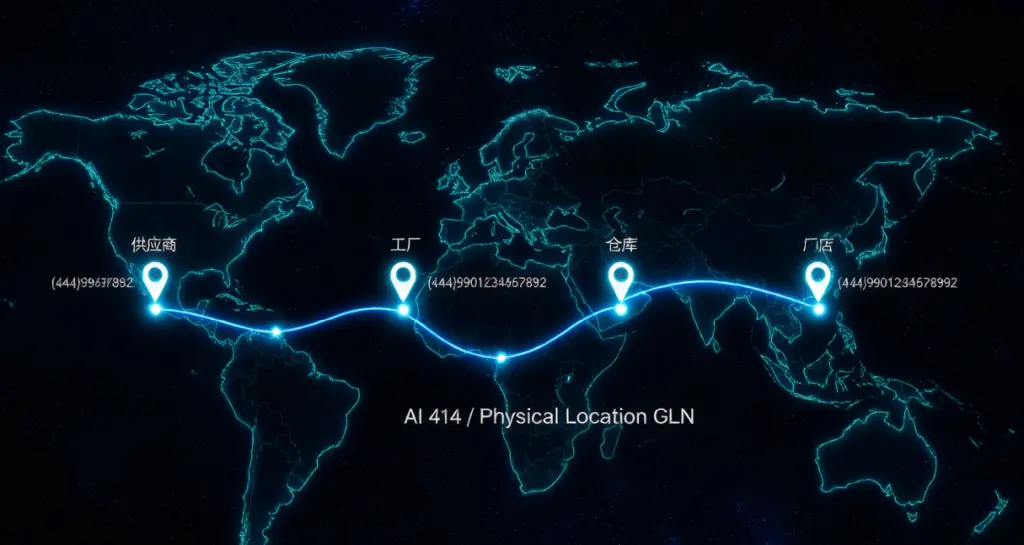
In supply chain and physical commerce systems, physical locations serve as core spatial anchors for goods storage, circulation and handover. For a long time, inconsistent internal location coding rules across enterprises have prevented direct mutual recognition of cross-entity and cross-system location information, resulting in inaccurate inventory positioning, low handover efficiency, and missing spatial dimensions in end-to-end traceability. As a dedicated standard of the GS1 global identification system for physical spaces, the Global Location Number (GLN) for physical locations, carried by GS1 Application Identifier (AI) 414, provides a globally unified standardized digital identity for various physical locations such as warehouses, stores, shelves, storage bins, and receiving docks. It is the core technical foundation for enabling spatial digitization, end-to-end location traceability and cross-party location collaboration.
Based on official GS1 standard specifications[1][2], this article provides a systematic technical analysis of GS1 AI 414 across six dimensions: standard definition, technical characteristics, industry applications, Digital Link implementation, technical details and development trends, to provide a standard basis and implementation reference for enterprises’ logistics and warehousing digitization and supply chain spatial traceability system construction.
1. Standard Definition and Encoding Technical Specifications
1.1 Official Definition
Per official GS1 standard definitions, AI 414 corresponds to the physical location type Global Location Number (GLN), an application identifier within the GS1 system dedicated to identifying physical locations[1]. Its core function is to assign a globally unique standardized identity code to all kinds of fixed physical points in the real world, covering scenarios such as warehouse zones, shelves, storage bins, store receiving docks, production workstations and medical medicine cabinets. It enables universal mutual recognition of location information across different enterprises and systems.
The Global Location Number (GLN) itself can identify three types of objects: legal entities, functional entities and physical entities. AI 414 specifically carries physical entity GLNs, focusing on the identification of spatial locations, and is the core carrier extending the GS1 identification system from “objects” to “spaces”.
1.2 Encoding Structure and Format
The complete encoding format of GS1 AI 414 is N3 + N13, consisting of a 3-digit numeric application identifier prefix and a fixed 13-digit pure numeric GLN body. The total length is fixed at 16 digits with no variable-length component.
The 13-digit GLN body adopts a three-segment fixed structure, with uniqueness guaranteed by the GS1 global unified allocation system:
- GS1 Company Prefix: 7–10 digits, assigned by the GS1 member organization of the enterprise’s country/region, globally unique;
- Location Reference: A location serial code assigned independently by the enterprise, which together with the company prefix makes up exactly 12 digits;
- Check Digit: The 13th digit, generated using the standard GS1 modulo 10 algorithm to verify code validity.
Table 1 Breakdown of the GLN Encoding Structure
| Structure Segment | Length Rule | Character Type | Functional Description |
|---|---|---|---|
| Application Identifier (AI) Prefix | Fixed 3-digit numeric | Numeric only | Fixed value 414, marking the following data segment as a physical location Global Location Number |
| GS1 Company Prefix | 7–10 digits | Numeric only | Globally unique enterprise identity prefix, assigned by GS1 member organizations |
| Location Reference | 2–5 digits | Numeric only | Enterprise-assigned location code, totaling 12 digits when combined with the company prefix |
| Check Digit | Fixed 1-digit numeric | Numeric only | Modulo 10 check digit for verifying overall code validity |
Note: The company prefix plus location reference is always 12 digits. With the final 1-digit check digit, the GLN body is always 13 digits in total length.
1.3 Check Digit Algorithm and Calculation Example
GLN uses the standard GS1 modulo 10 check algorithm to calculate the 13th check digit. The algorithm steps are fully consistent with GTIN-13 and SSCC:
- Take the first 12 digits (company prefix + location reference), and number them from right to left as position 1, position 2, …, position 12.
- Multiply all digits in odd positions by 3, and all digits in even positions by 1.
- Sum all weighted values, and calculate the remainder when the sum is divided by 10.
- If the remainder is 0, the check digit is 0; otherwise, check digit = 10 − remainder.
Calculation Example: Given the first 12 digits of a GLN as 690123456789 (company prefix 6901234 + location reference 56789), the check digit is calculated as follows:
- Odd-positioned digits (right to left): 9, 7, 5, 3, 1, 9 → Sum = 34 → Weighted value = 34 × 3 = 102
- Even-positioned digits (right to left): 8, 6, 4, 2, 0, 6 → Sum = 26 → Weighted value = 26 × 1 = 26
- Total weighted sum = 102 + 26 = 128
- Remainder of 128 divided by 10 is 8, check digit = 10 − 8 = 2
- Complete 13-digit GLN body:
6901234567892
1.4 Character Set and Core Technical Attributes
Per official GS1 specifications, the GLN body is in pure numeric format, supporting only Arabic numerals 0–9, strictly matching the regular expression \d{13}[1]. Letters, symbols and Chinese characters are not supported.
Based on official specifications, the core technical attributes of AI 414 are summarized in the table below.
Table 2 Core Technical Attributes of GS1 AI 414
| Technical Item | Official Specification | Description |
|---|---|---|
| Format | N3 + N13 | Fixed length: 3-digit AI prefix + 13-digit numeric body |
| FNC1 separator required | No | Fixed-length identifier; the 13-digit data segment can be parsed without FNC1 separation |
| Mandatory associations | None | Can be used independently without binding to other GS1 Application Identifiers |
| Invalid pairings | None | No explicitly mutually exclusive Application Identifiers; can be freely combined with most GS1 standard AIs |
| Primary key in GS1 Digital Link URI? | Yes | Can be used as an independent primary key to build URIs for dedicated physical location digital entries |
| GS1 Digital Link key qualifiers | None | No dedicated key qualifiers; physical location itself is an independent identification object |
| Valid as data attribute in GS1 Digital Link URIs? | Yes | Can be embedded as an additional location attribute in URIs built on other primary keys |
2. Core Technical Functions and System Positioning
2.1 Core Technical Positioning
The core positioning of AI 414 is the global identity anchor for physical spaces, providing a universally applicable digital identity for all physical locations. Compared with other GLN-related application identifiers, the three have clearly differentiated positioning:
- AI 414: Focuses on physical entities, identifying spatial points such as warehouses, shelves and storage bins;
- AI 415/416/417: Focuses on business roles, identifying legal/functional entities such as payers, suppliers and consignees respectively;
- GLN as a whole: Covers three types of entities: legal, functional and physical. AI 414 is its dedicated carrier in the spatial dimension.
In the GS1 end-to-end identification system, AI 414 completes the identification capability of the “location” dimension. Together with GTIN (trade items), SSCC (logistics units), and GSIN/GINC (transport batches), it forms a four-dimensional identification network of “item – unit – batch – location”.
2.2 Core Technical Characteristics
(1) Global Uniqueness Guarantee Mechanism
The global uniqueness of GLN is mandatorily guaranteed by the GS1 layered allocation system: GS1 headquarters plans the number range uniformly, national member organizations issue unique company prefixes to enterprises, and enterprises independently assign location reference numbers within their own number ranges. This three-tier allocation mechanism ensures that each physical location corresponds to a unique code worldwide with no cross-enterprise or cross-regional number conflicts, fundamentally solving the problem of incompatible custom location codes.
(2) Multi-Carrier Data Format Specifications
AI 414 can be carried by multiple physical carriers to adapt to different scenarios:
- Linear barcodes: Adopt GS1-128 format, suitable for shelf labels, location plates and other scenarios, compatible with existing frontline scanning devices;
- 2D barcodes: Adopt GS1 DataMatrix or GS1 QR Code format, which can carry location codes and extended information such as addresses and contacts at the same time, suitable for digital storage bins and smart workstation scenarios;
- RFID tags: Can be encoded in EPC format, supporting contactless batch reading, suitable for automated stereoscopic warehouses and unattended warehouse zone scenarios.
(3) Universal Automatic Identification Compatibility
AI 414 fully complies with the general GS1 element string syntax. All GS1-compliant industrial scanners, handheld terminals and fixed code readers can natively recognize and parse it without customized decoding logic development. Meanwhile, due to the fixed-length design, the parsing logic is simpler and the recognition accuracy is higher than variable-length codes.
(4) Standardized Fixed-Length Architecture
The 13-digit fixed-length pure numeric design is highly standardized, facilitating database storage, system interaction and EDI message transmission. It eliminates the parsing ambiguity of variable-length codes, and is especially suitable for automated location data exchange scenarios between enterprises.
2.3 Technical Integration with Other GS1 Identifiers
AI 414 can be freely combined with various identifiers in the GS1 system to form a complete business data network:
- With GTIN (AI 01): Combined to identify “a certain item at a certain location”, used for precise inventory positioning and store shelf item management;
- With SSCC (AI 00): Combined to identify “the location of a certain logistics unit”, used for warehousing operations and cargo location tracking;
- With GSIN (AI 402): Combined to identify “the sending and receiving locations of a certain shipment batch”, used for automatic verification of logistics handover nodes.
3. Industry Application Practices and System Integration
3.1 Retail Industry: Precise Shelf Inventory Management in Stores
System integration architecture: Retail enterprises use AI 414 as the core identification, connecting POS systems, WMS and store inventory systems to realize shelf-level precise inventory management. Data collection workflow: Assign a unique GLN code to each group of shelves and paste GS1 barcode labels; during replenishment and inventory counting, scan the shelf GLN and item GTIN to automatically associate location and item inventory data; consumers can obtain item details, inventory and promotion information by scanning the shelf code. Hardware configuration requirements: Store handheld inventory terminals, desktop 2D scanners, supporting GS1 standard barcode parsing. Software interface standards: Connects to WMS and store inventory systems, supporting query of inventory details and shelf movement records by GLN.
3.2 Logistics Industry: Warehouse Location and Operation Node Identification
System integration architecture: Warehouse WMS uses AI 414 as the core identification for storage locations, connecting automated stereoscopic warehouses, AGV equipment and sorting systems to realize full-process digitization of warehousing operations. Data collection workflow: Assign a unique GLN code to each storage bin, receiving dock and shipping dock; in all operation links such as inbound, put-away, picking and outbound, scan the bin GLN and cargo SSCC/GTIN to automatically update location inventory and operation records; AGV equipment completes precise point docking by recognizing GLN. Hardware configuration requirements: Fixed industrial code readers, explosion-proof handheld terminals, AGV visual recognition modules, adaptable to complex warehouse operating environments. Software interface standards: Connects to WMS and warehouse control systems, supporting automatic linkage between GLN and operation tasks.
3.3 Healthcare Industry: Pharmacy Shelf and Ward Material Positioning
System integration architecture: Hospital pharmacy and material management systems use AI 414 as location identification, meeting GSP requirements for drug storage location traceability. Data collection workflow: Assign a unique GLN code to each group of medicine shelves and each ward material cabinet; when drugs are put into storage and onto shelves, scan the shelf GLN and drug traceability code to accurately record the storage location; during dispensing and inventory counting, quickly locate drugs through GLN, realizing full-process location traceability of drugs from inbound to dispensing. Hardware configuration requirements: Medical-grade dedicated scanning terminals, complying with cleanliness and data security standards. Software interface standards: Connects to hospital HIS and drug traceability platforms, supporting association and reporting of GLN and drug traceability data.
3.4 Manufacturing Industry: Workshop Workstation and Raw Material Location Management
System integration architecture: Enterprise MES and WMS use AI 414 as location identification, realizing full location tracking of raw materials, work-in-progress and finished products. Data collection workflow: Assign a unique GLN code to each production workstation, raw material bin and finished product buffer area; when materials circulate, scan the location code and material code to automatically update the location ledger; during production traceability, quickly locate all workstations and storage positions that the product has passed through via GLN. Hardware configuration requirements: Production-line fixed scanners, plant explosion-proof handheld terminals, adaptable to complex production workshop environments. Software interface standards: Connects to MES and ERP systems, realizing linkage between location data and production data through standard APIs.
4. Technical Implementation of GS1 Digital Link (Key Section)
GS1 Digital Link is the core technical path for AI 414 to upgrade from offline barcode identification to a digital spatial entry point, and also the key support for realizing end-to-end location traceability.
4.1 URI Construction Rules
AI 414 has a dual identity in the GS1 Digital Link system: it can be used as an independent primary key, or embedded as an additional attribute in URIs of other primary keys. The specific construction rules are as follows:
- As an independent primary key: The 13-digit GLN body is placed directly after AI 414 as a path segment, following the format
https://[enterprise domain]/414/[13-digit GLN]. It corresponds to the dedicated digital homepage of a physical location, displaying full information such as location details, inventory information, operation records and contacts. - As an additional attribute: Embedded in URIs of other primary keys such as GTIN and SSCC, following the format
https://[enterprise domain]/[primary key AI]/[primary key code]/414/[13-digit GLN]. It is used to identify the physical location where items, logistics units and other objects are located, enabling reverse traceability from “object” to “location”.
4.2 Complete Examples
- Primary key mode example:
https://id.logistics.com/414/6901234567892 - Attribute mode example (SSCC + location):
https://id.example.com/00/123456789012345675/414/6901234567892
4.3 Parsing Mechanism and Data Interaction Workflow
- The scanning terminal (smartphone or professional device) recognizes the GLN Digital Link URI in the GS1 2D barcode.
- The terminal initiates an HTTPS request to the enterprise’s Digital Link server, which returns corresponding content based on request headers and permissions.
- It returns inventory details and operation entries for warehouse operators, location guidance and contact information for visitors, and structured location data for systems.
- Data output follows the JSON-LD structured standard, supporting automatic machine parsing and seamless integration with business systems without manual secondary entry.
4.4 Technical Advantages Over Traditional Location Barcodes
Table 3 Comparison of GLN Digital Link and Traditional Location Barcodes
| Comparison Dimension | Traditional Location Barcode | GLN Digital Link |
|---|---|---|
| Information capacity | Carries only location code; details require access to a dedicated system | Directly maps to a digital homepage; inventory, guidance and contacts are available by scanning |
| Cross-platform interoperability | Only recognizable by internal systems; no cross-party mutual recognition | Based on standard HTTP protocol, accessible by any terminal, universally applicable worldwide |
| Data update capability | Information is fixed after barcode generation and cannot be dynamically updated | Server-side data is updated in real time; location attributes and inventory are dynamically adjusted |
| Traceability dimension | Only supports query of the location itself | Supports multi-dimensional two-way traceability of location – item – logistics unit |
| Interaction capability | One-way information reading only | Supports two-way interactions such as scan-to-put-away, scan-to-count and exception reporting |
4.5 End-to-End Location Traceability Application Solution
Based on GLN Digital Link, an end-to-end location traceability system of “one item, one location, full traceability” can be built: from supplier outbound, warehouse inbound and put-away, intra-warehouse transfer to outbound shipping, location information of each node is recorded via GLN. Upstream and downstream enterprises can complete seamless docking of location information through unified GLN codes without code mapping and conversion, greatly improving cross-enterprise collaboration efficiency.
5. Technical Details and Usage Specifications
5.1 Independent Encoding Rules
When used independently, AI 414 follows the general GS1 element string syntax: it starts with the AI prefix 414, followed by the fixed 13-digit numeric GLN body. As a fixed-length code, it can be directly followed by other identifiers without an FNC1 separator.
- Basic encoding example:
(414)6901234567892
5.2 Combined Encoding Rules and Examples
AI 414 can be freely combined with other GS1 Application Identifiers to carry multiple pieces of information. Taking the “SSCC + physical location” combination as an example:
- Encoding example:
(00)123456789012345678(414)6901234567892 - Parsing rule: First read the fixed 18-digit SSCC code, then read the fixed 13-digit GLN code. Both are fixed-length and can be accurately parsed without additional separators.
5.3 Usage Restrictions and Best Practices
- Length restriction: The GLN body must be strictly 13 digits. Any shorter or longer code is invalid.
- Character specification: Only Arabic numerals 0–9 shall be used. Letters, symbols and full-width characters are prohibited.
- Uniqueness constraint: One physical location corresponds to one unique GLN. The same code must not be reused for different locations to avoid positioning confusion.
- Mandatory check digit verification: Check digit verification must be performed for all GLN code generation and recognition to intercept invalid codes.
- Coding allocation best practice: GLN prefixes must be constructed based on the enterprise’s held GS1 Company Prefix to ensure global uniqueness and cross-party interoperability.
5.4 Code Verification Methods
- Algorithm verification: Verify the correctness of the 13th check digit through the modulo 10 algorithm, which can be directly integrated into enterprise code generation systems.
- Standard tool verification: Use official GS1 AI syntax verification tools to verify compliance of encoding format, length and syntax rules.
- Business verification: Enterprise internal systems must perform uniqueness verification on GLN to ensure no duplicate or conflicting codes.
5.5 GS1 Digital Link Usage Specifications
- Key qualifier specification: When AI 414 is used as an independent primary key, there is no dedicated key qualifier. The physical location itself is a complete identification object, which can be uniquely determined without additional qualification.
- Attribute embedding specification: When embedded as an additional attribute in URIs of other primary keys, it must be appended as a standard path segment in the form
/414/[GLN]. The path structure must not be modified. - Data return specification: The GLN Digital Link interface as a primary key must return standard location metadata, including core fields such as address, type and contact, compatible with universal parser recognition.
6. Technology Development Trends and Evolution Directions
6.1 Identity Foundation for Physical Space Digitization
With the advancement of supply chain digitization and smart logistics, GLN will gradually become the standardized digital identity foundation for physical spaces. In the future, all physical points such as warehouses, stores and workstations will have standard GLN codes, serving as spatial data anchors for digital twins and smart parks, supporting full-scenario spatial digitization management.
6.2 Integration with IoT and Indoor Positioning Technologies
Against the backdrop of the widespread adoption of IoT and indoor positioning technologies, AI 414 will evolve from a static identity identifier to a dynamic data entry point. By binding GLN with indoor positioning devices such as UWB and Bluetooth beacons, users can obtain real-time equipment status, inventory dynamics and operation tasks around the location by scanning the code, realizing deep integration of physical locations and digital information.
6.3 Standard Carrier for End-to-End Supply Chain Location Traceability
Current supply chain traceability generally lacks a standardized location dimension. In the future, GLN will become an essential element of end-to-end traceability. From raw material supply, production and processing, warehousing and logistics to terminal sales, location information of each node will be recorded through unified GLN codes, realizing full-dimensional traceability of “goods – locations – personnel” and further improving supply chain transparency and compliance.
6.4 Standard Evolution Direction
Combined with the GS1 digital transformation roadmap, AI 414 related standards may continue to be optimized in two directions in the future: first, supplementing the extended attribute system to support standardized carriage of extended information such as location type, area and load capacity; second, deepening integration with Digital Product Passports (DPP) to support standardized transmission and verification of product full-lifecycle location data, further expanding the application boundary of the standard.
Closing
GS1 AI 414 (physical location type Global Location Number GLN) is an important standard extending the GS1 identification system from “physical object identification” to “spatial identification”, completing the location dimension of supply chain full-factor identification. It has standardized characteristics such as fixed length, pure numeric format, mandatory check digit and global uniqueness, and enables universal mutual recognition of location information across enterprises and systems.
For industries such as retail, logistics, healthcare and manufacturing, implementing the AI 414 standard not only improves inventory positioning accuracy and optimizes warehousing operation efficiency, but also lays a standardized foundation for future scenarios such as spatial digitization, end-to-end traceability and digital twins. As the digitization level of the physical industry continues to improve, GLN will gradually become the universal “digital house number” for global physical spaces, supporting the efficient, precise and collaborative operation of supply chains and commercial operations.