
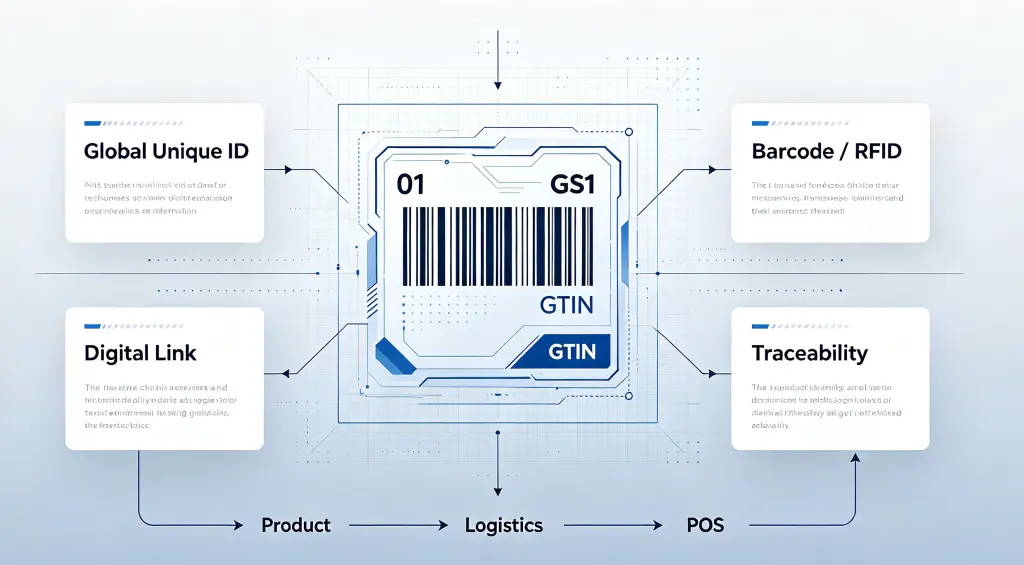
In the global supply chain system, unified identification of trade items is the foundation for automated checkout, inventory management and end-to-end traceability. As a core component of the GS1 global identification system, the Global Trade Item Number (GTIN), carried by GS1 Application Identifier (AI) 01, is currently the most widely adopted product identification standard worldwide. Based on official GS1 standard specifications, this article provides a systematic technical analysis of AI 01 across dimensions including technical definition, functional characteristics, industry practices, combined encoding rules and development trends, serving as a reference for enterprises’ digital supply chain development.
1 Standard Definition and Encoding Technical Specifications
1.1 Official Definition
Per the official GS1 standard definition, AI 01 corresponds to the Global Trade Item Number (GTIN), a globally universal code for uniquely identifying trade items. Trade items refer to all products or services that can be priced, ordered and invoiced in the supply chain, covering retail units, case-packed goods, palletized shipments and other trade units at different levels. GTIN uniqueness is guaranteed by the GS1 global number allocation system, and it is widely recognized as the digital identity card for products in global trade.
1.2 Encoding Structure and Specifications
The encoding format of GS1 AI 01 is N2 + N14, consisting of a 2-digit numeric application identifier prefix 01 and a 14-digit numeric GTIN body, with a fixed total length of 16 digits. GTIN itself has four length specifications, all of which are padded with leading zeros to 14 digits for uniform carriage in AI 01.
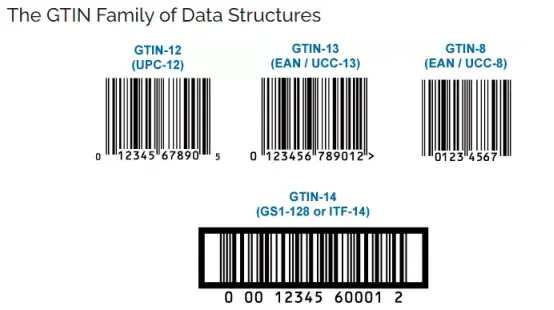
Table 1 GTIN Encoding Specifications and Application Scenarios
| Encoding Type | Total Length | Structure | Typical Application Scenarios |
|---|---|---|---|
| GTIN-8 | 8 digits | Company prefix (2–3 digits) + item reference number + check digit | Small retail items such as confectionery and stationery |
| GTIN-12 (UPC-A) | 12 digits | Company prefix (6–10 digits) + item reference number + check digit | Retail products in the North American market |
| GTIN-13 (EAN-13) | 13 digits | Company prefix (7–10 digits) + item reference number + check digit | Retail products in most regions worldwide |
| GTIN-14 | 14 digits | Packaging indicator (1 digit) + company prefix + item reference number + check digit | Non-retail trade units such as cases and pallets |
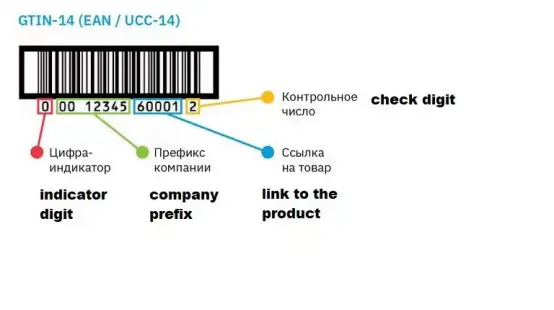
GTIN-14 is the standard carriage format for AI 01, with each field defined as follows:
- Packaging indicator: 1 digit with values 0–9. A value of 0 indicates a retail-level trade item, while values 1–9 indicate non-retail packaging at different levels, assigned at the enterprise’s discretion.
- Company prefix: A globally unique enterprise code issued by the GS1 Member Organization of the relevant country/region, with a length of 7–10 digits depending on regional rules.
- Item reference number: Assigned by the enterprise to identify trade items of different specifications and categories.
- Check digit: 1 digit, generated using the standard GS1 modulo 10 algorithm to verify code validity.
1.3 Check Digit Algorithm and Calculation Example
GTIN uses the standard modulo 10 check algorithm, calculated as follows:
- Remove the check digit, and number the remaining digits from right to left as position 1, position 2, …, position n.
- Multiply all digits in odd positions by 3, and all digits in even positions by 1.
- Sum all weighted values, and calculate the remainder when the sum is divided by 10.
- If the remainder is 0, the check digit is 0; otherwise, the check digit equals 10 minus the remainder.
Calculation Example: Given the first 13 digits of a GTIN-14 as 10614141999993, the check digit is calculated as follows:
- Digits in odd positions (from right to left): 9, 9, 9, 4, 4, 6, 1 → Sum = 42 → Weighted sum = 42 × 3 = 126
- Digits in even positions (from right to left): 9, 9, 1, 1, 1, 0 → Sum = 21 → Weighted sum = 21 × 1 = 21
- Total weighted sum = 126 + 21 = 147
- Remainder of 147 divided by 10 = 7
- Check digit = (10 − 7) mod 10 = 3
- Complete GTIN-14:
10614141999993
1.4 Character Set and Foundational Technical Attributes
- Character set: Supports only Arabic numerals 0–9. The body segment strictly matches the regular expression
\d{14}. - FNC1 separator requirement: AI 01 is a fixed-length code with a 14-digit data segment. When used in a GS1 element string, no additional FNC1 separator is required after the data segment, and subsequent application identifiers may follow directly.
- Mandatory associated identifiers: None. It can be used independently.
- GS1 Digital Link capability: Supported as an independent primary key for URI construction, and may also be embedded as an attribute in URIs built on other primary keys.
2 Core Technical Functions and System Positioning
2.1 Core Technical Positioning
GTIN is the core primary key of the GS1 global identification system, running through the entire lifecycle of trade items from production and distribution to retail and after-sales. All trade-related business data in the GS1 system is associated with GTIN as the core index, serving as the foundational identifier for cross-enterprise, cross-industry and cross-border trade data interoperability.
2.2 Core Technical Characteristics
(1) Global Uniqueness Guarantee Mechanism
GTIN uniqueness is guaranteed by the GS1 global tiered allocation system: GS1 headquarters plans the number range uniformly, national member organizations are responsible for allocating local company prefixes, and enterprises assign item reference numbers independently within the scope of their issued company prefix. This three-tier allocation mechanism ensures that each GTIN corresponds to exactly one trade item worldwide with no duplication.
(2) Multi-Carrier Data Format Specifications
GTIN can be carried by multiple data carriers to adapt to different application scenarios:
- Linear barcodes: Including EAN-13, UPC-A, ITF-14 and GS1-128, suitable for retail checkout, outer case identification and logistics barcode scenarios respectively.
- 2D barcodes: Including GS1 DataMatrix and GS1 QR Code, which can carry GTIN together with extended data such as batch numbers and serial numbers.
- RFID tags: Encoded in EPC (Electronic Product Code) format, suitable for contactless batch identification in warehousing and logistics scenarios.
(3) Universal Automatic Identification Compatibility
GTIN complies with ISO/IEC international standards. All mainstream POS terminals, industrial scanners, self-checkout devices and RFID readers natively support GTIN parsing and identification without customized development, allowing enterprises to deploy directly on existing hardware.
(4) Extensible Data Structure Design
GTIN itself only carries the identity of the trade item, not business attribute data. When combined with other GS1 Application Identifiers, it can extend attribute information such as batch, serial number, expiration date and country of origin, adapting to the information needs of different business scenarios without changing the core GTIN identifier.
2.3 Technical Integration with Other GS1 Components
GTIN forms a hierarchical complementary relationship with other core identifiers in the GS1 system:
- With SSCC (AI 00, Serial Shipping Container Code): Content-to-container relationship. One SSCC logistics unit may contain multiple GTIN trade items.
- With GLN (Global Location Number): Trade item-to-location correspondence. It can accurately describe the inventory status of “a given GTIN product at a given GLN location”.
- With GS1 Digital Link: GTIN is the most widely used primary key type in the Digital Link system. It can be directly converted into a web-resolvable URI format, enabling mapping from offline identifiers to online digital content.
3 Industry Application Practices and System Integration
3.1 Retail Industry: POS Checkout and Omnichannel Inventory Management
System integration architecture: GTIN serves as the unique primary key for product master data, connecting POS systems, WMS (Warehouse Management System), ERP systems and omnichannel order systems to achieve unified product information, inventory data and sales data across the entire business.
Data collection workflow: Front-end POS terminals scan product barcodes to parse GTIN, automatically retrieve price and promotion information to complete checkout. Sales data is synchronized to the back-end system in real time, automatically deducting inventory and triggering replenishment logic.
Hardware configuration requirements: Desktop 1D/2D scanners and self-checkout terminals supporting EAN-13, UPC-A and other barcode formats, compliant with GS1 barcode parsing standards.
Software interface standards: Supports GS1 GDSN (Global Data Synchronization Network) interfaces to enable automatic synchronization of product master data with suppliers. POS systems have built-in standard GS1 barcode parsing modules.
3.2 Logistics Industry: Warehouse and Distribution Automation and In-Transit Tracking
System integration architecture: WMS and TMS (Transportation Management System) use GTIN as the core index, bound to SSCC logistics unit identifiers to enable refined inventory management and end-to-end logistics tracking.
Data collection workflow: Scan GTINs during inbound processing to complete goods inspection and quantity verification. During outbound processing, bind multiple GTIN items to an SSCC pallet, and complete pallet-level outbound and transport handover by scanning the SSCC.
Hardware configuration requirements: Industrial-grade handheld terminals and gantry fixed scanning devices supporting GS1-128, GS1 DataMatrix and other carriers, suitable for high-frequency scanning scenarios in warehouses.
Software interface standards: Supports GS1 EDI standard messages, enabling automatic synchronization of GTIN item detail data between upstream and downstream enterprises via DESADV (despatch advice) and RECADV (receiving advice) messages.
3.3 Healthcare Industry: Pharmaceutical and Medical Consumable Compliance Traceability
System integration architecture: Hospital SPD (Supply, Processing, Distribution) systems and drug administration traceability platforms use GTIN as the core identifier, associated with drug registration certificates, batch numbers, expiration dates and other compliance data to meet regulatory requirements for full-chain traceability.
Data collection workflow: Scan GTIN and batch number at each stage of drug inbound, departmental requisition and patient administration, automatically recording circulation nodes and uploading to the drug administration traceability platform.
Hardware configuration requirements: Medical-grade antibacterial handheld scanning terminals supporting high-density GS1 DataMatrix 2D barcode parsing, suitable for clean environment requirements in hospitals.
Software interface standards: Complies with national drug/medical device traceability standards, supports GTIN encoding parsing and compliance data reporting interfaces, and connects to drug administration traceability platforms at all levels.
3.4 Manufacturing Industry: Component Procurement and Inbound Logistics Management
System integration architecture: SRM (Supplier Relationship Management), MES (Manufacturing Execution System) and ERP systems use GTIN as the unique code for component materials, connecting data across procurement, inbound and production processes.
Data collection workflow: Suppliers synchronize GTIN and batch information to the OEM via EDI when shipping. Components are scanned at inbound to automatically match purchase orders, complete goods receipt and synchronize to the MES system for production material picking.
Hardware configuration requirements: Fixed industrial code readers on production lines and handheld scanning terminals supporting high-density GS1 DataMatrix barcodes, suitable for complex environments in production workshops.
Software interface standards: Supports GS1 EDI ORDERS (purchase order) and DELFOR (delivery forecast) messages, enabling automatic interaction of procurement data and material master data synchronization based on GTIN.
3.5 GS1 Digital Link Technical Implementation
GTIN is the most widely used primary key type in the GS1 Digital Link system. Its technical implementation is as follows:
- URI format: A Digital Link URI with GTIN as the primary key follows the format
https://[brand domain]/01/[14-digit GTIN], for example:https://id.brand.com/01/10614141999993. - Data interaction workflow: After the scanning terminal parses the URI, it initiates a request to the brand server or GS1 resolution service. The system returns corresponding content based on the requester’s identity (consumer, retailer, regulator).
- System integration requirements: The server must comply with GS1 Digital Link syntax specifications, support standard HTTP/HTTPS protocols, return structured data (JSON-LD), and be compatible with access from ordinary smartphones and professional scanning devices.
4 Quantitative Analysis of Implementation Benefits
Based on GS1 global industry survey data and enterprise implementation practices, adoption of the GTIN standard delivers quantifiable business value across three dimensions.
Table 2 Comparison of GTIN Implementation Benefits
表格
| Benefit Dimension | Specific Indicator | Improvement Magnitude | Description |
|---|---|---|---|
| Operational efficiency improvement | Retail checkout processing speed | 30%–50% increase | Scanning replaces manual entry, reducing per-item checkout time from 2–3 seconds to less than 1 second |
| Warehouse inbound operation efficiency | 40%–60% increase | Scanning-based inspection replaces manual counting, significantly improving pallet-level inbound efficiency | |
| Manual operation workload | 70%–90% reduction | Greatly reduces manual operations such as product information entry, document reconciliation and inventory counting | |
| Data quality improvement | Product information error rate | Reduced from 5%–8% to below 0.5% | Unified coding eliminates errors caused by manual entry and inconsistent multi-party coding |
| Cross-system data consistency | Improved to over 99.5% | All systems align data based on the same GTIN primary key, avoiding mapping deviations | |
| Order error rate | Over 80% reduction | Standardized coding reduces product mismatches in ordering and shipping processes | |
| Supply chain collaboration optimization | Product information alignment cycle | Shortened from days to real-time | Via GDSN data synchronization, supplier product information changes can be synchronized to downstream parties in real time |
| Inventory turnover efficiency | 20%–30% improvement | Accurate inventory data supports efficient replenishment and reduces safety stock levels | |
| Product out-of-stock rate | 15%–25% reduction | End-to-end data visibility improves demand forecasting accuracy and reduces stockouts |
5 Combined Encoding Rules and Technical Implementation
GTIN can be used in combination with multiple GS1 Application Identifiers to carry both trade item identity and extended attribute information in a single barcode. The basic rule for combined encoding is: AI 01, as the primary key, is placed at the front of the element string, followed by attribute application identifiers. For variable-length identifiers, an FNC1 separator must be added after the data segment (except for the last identifier in the string), while fixed-length identifiers may follow directly.
The encoding rules and examples for typical combinations are as follows.
5.1 AI 01 + AI 10 (Batch/Lot)
AI 10 (Batch/Lot) is used to identify the production batch of a trade item, with a format of N2 + X..20 and variable length.
- Encoding rule: AI 10 follows directly after the fixed-length AI 01 data segment. If additional identifiers follow, an FNC1 separator is required after the AI 10 data segment.
- Encoding example:
(01)10614141999993(10)B20240601 - Parsing rule: Extract the first 14 digits as GTIN, then read the batch number until the end of the barcode or an FNC1 position.
5.2 AI 01 + AI 21 (Serial Number)
AI 21 (Serial Number) is used to assign a unique serial number to individual trade items for item-level identification, with a format of N2 + X..20 and variable length.
- Encoding rule: FNC1 separator is required for the variable-length data segment.
- Encoding example:
(01)10614141999993(21)SN00123456 - Application scenarios: Item-level traceability of high-value goods, medical devices and electronic products.
5.3 AI 01 + AI 22 (Consumer Product Variant, CPV)
AI 22 (Consumer Product Variant, CPV) is used to identify consumer-level product variants under the same GTIN, such as differences in color, flavor and size, with a format of N2 + X..20 and variable length.
- Encoding rule: FNC1 separator is required after the variable-length data segment.
- Encoding example:
(01)10614141999993(22)RED_M - Application scenarios: Multi-variant management of the same product, allowing differentiation of specifications without assigning a separate GTIN.
5.4 AI 01 + AI 235 (Trade Item Extension, TPX)
AI 235 (Trade Item Extension, TPX) is used to carry extended attribute codes for trade items, supplementing custom attributes outside the standard system, with a format of N3 + X..30 and variable length.
- Encoding rule: Follows AI 01 as an attribute identifier, with FNC1 separator required after the data segment.
- Encoding example:
(01)10614141999993(235)EXT_ATTR_001
Chart suggestion: A combined encoding structure diagram may be drawn, showing from left to right the FNC1 start character, AI 01 + GTIN, AI 10 + batch + FNC1, and AI 21 + serial number in a layered structure, to visually illustrate the encoding composition and separation rules.
6 Technology Development Trends and Evolution Directions
Based on the GS1 global technology roadmap and combined with the trend of supply chain digital transformation, the GTIN standard will evolve in the following directions.
6.1 Identification Digitization: From Offline Barcode to Universal Digital Entry
With the popularization of GS1 Digital Link and the Sunrise 2027 2D barcode upgrade, GTIN will evolve from a simple offline checkout identifier to a universal digital entry. Via GTIN Digital Link URIs carried in 2D barcodes, users can directly access online content such as product details, traceability data, after-sales service and digital product passports, realizing “one code for all queries and all uses”. According to GS1 plans, major retail markets worldwide will fully support 2D barcode POS checkout by 2027, and the digital application scenarios of GTIN will expand significantly.
6.2 Integration with IoT Technology: Full-Lifecycle Status Sensing
In IoT scenarios, GTIN will serve as the identity anchor for smart products, bound to operating data from built-in sensors to enable full-lifecycle status sensing of trade items. For example, smart home appliances and industrial equipment can associate equipment operating data and maintenance records through GTIN, allowing users to view real-time status and service information by scanning. GS1 is advancing standards for the integration of GTIN and IoT identification systems to achieve unified mapping between product identities and device identities.
6.3 Integration with Blockchain: Building a Trusted Traceability System
GTIN will serve as the core index in blockchain traceability systems, with full-chain data of trade items including production, logistics, sales and after-sales stored on-chain as immutable evidence, ensuring data tamper-resistance and traceability. Compared with enterprise-customized codes, the globally unified GTIN enables cross-enterprise and cross-platform on-chain data interoperability, solving the data silo problem of traditional blockchain traceability projects. It is particularly suitable for scenarios with high credibility requirements such as food, pharmaceuticals and high-end consumer goods.
6.4 Integration with AI: Supporting Intelligent Supply Chain Decision-Making
Standardized GTIN data is an important foundation for the application of artificial intelligence in the supply chain. Based on massive sales, inventory and logistics data with unified GTIN coding, more accurate AI models for demand forecasting, intelligent replenishment and category optimization can be trained, eliminating data quality problems caused by inconsistent coding and greatly improving model accuracy. GS1 is also promoting standardized product semantic data specifications based on GTIN to provide high-quality basic datasets for AI applications.
6.5 Standard Update Direction: Adapting to Digital Product Passport Compliance Requirements
With the advancement of global compliance policies such as the EU Digital Product Passport (DPP), GTIN will serve as the core identity identifier for digital product passports, carrying sustainability data such as product carbon footprint, environmental attributes and recycling guidelines. In the future, GS1 will expand the attribute set of GTIN in Digital Link to support standardized carriage and interaction of DPP-related data, helping enterprises meet global compliance requirements.
Closing
Carried by GS1 AI 01, GTIN is the most mature identification standard in global trade and the core infrastructure for supply chain digitization. Its globally unified coding rules, wide device compatibility and extensible structure design can support the automation and digitization needs of multiple industries including retail, logistics, healthcare and manufacturing. With the popularization of 2D barcodes and the development of Digital Link technology, GTIN will continue to evolve, upgrading from a checkout identifier to an end-to-end digital entry, and playing an even more central supporting role in the integration of emerging technologies such as IoT, blockchain and artificial intelligence. For enterprises, building a standardized product identification system based on GTIN not only improves current operational efficiency and collaboration capabilities, but also lays a solid foundation for future digital upgrades.