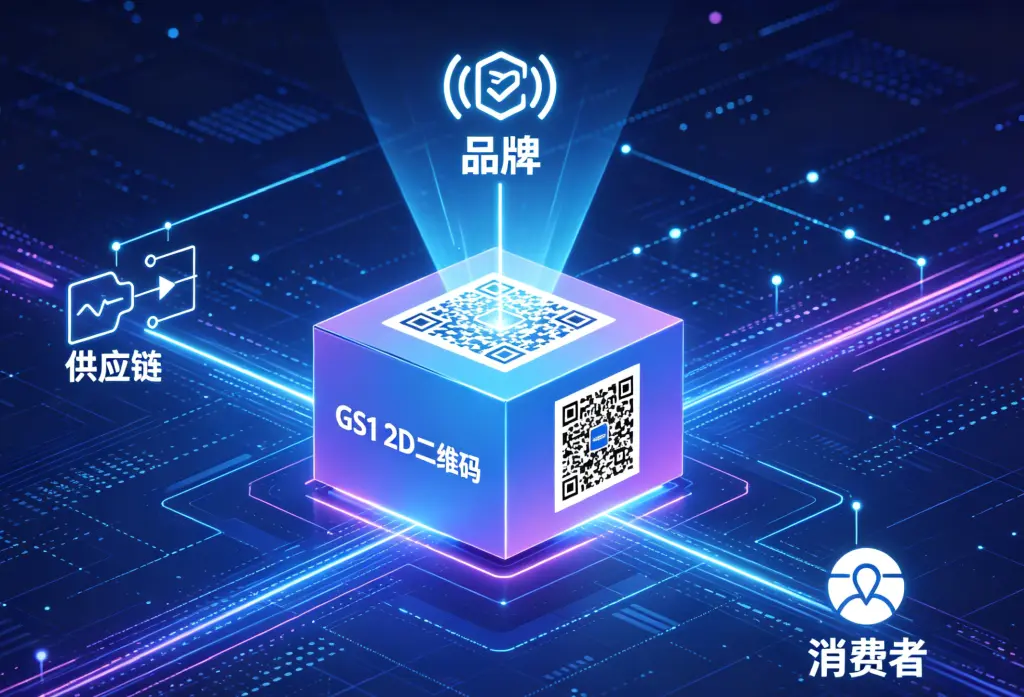
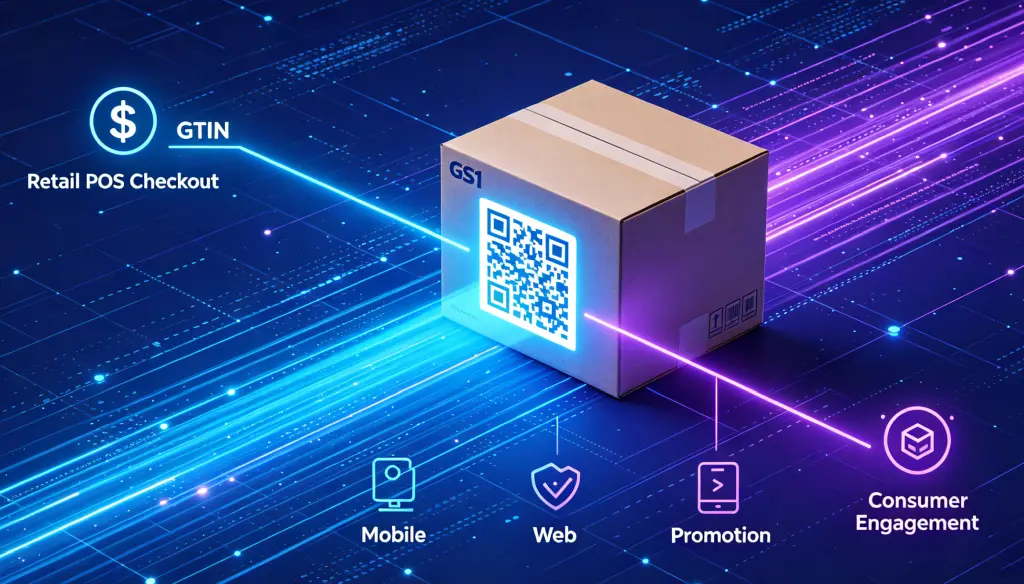
Traditional QR codes on product packaging typically carry only a web URL, limited to consumer engagement use cases and unable to support retail point-of-sale checkout. As a result, brands often print both a 1D barcode for checkout and a separate QR code for interactions — wasting packaging space and adding operational complexity.
Dual-Purpose Codes for POS Checkout & Consumer Engagement (Sunrise 2027 Ready)
With the global retail industry’s Sunrise 2027 2D barcode transition underway, GS1 Digital Link enables dual-function QR codes: they embed a Global Trade Item Number (GTIN) for POS scanning while also acting as a standardized web gateway to digital content. GS1’s official Best Practices for QR Code powered by GS1 guide lays out five authoritative implementation rules covering domain architecture, encoding rules and business adoption, helping brands build compliant, future-proof and reusable 2D barcode systems.
As Marcelo Silva, Founder and Owner of Parla Deli, put it: “When we embedded GS1 Digital Link Syntax in our QR Codes, something magical happened. We connected everything to everyone at any time.”
What Is a GS1 Digital Link URI?
A GS1 Digital Link URI is a standardized URL that serves as both a product identifier and a digital content entry point:
- B2B industrial function: Professional scanners can directly extract structured data such as GTIN, batch/lot number, expiration date and serial number from the code, enabling checkout, inventory logging and expiry verification without an internet connection.
- B2C web function: Consumers can scan with any standard smartphone camera and be redirected via to brand-controlled content including product details, promotions, traceability information and care instructions.
This design allows a single QR code to serve both supply chain operations and consumer engagement — no multiple separate codes on packaging required. It is the core technical foundation of the Sunrise 2027 industry transition.
5 Official Best Practices
Best Practice 1: Host on your brand’s own domain
Implementation: Build your GS1 Digital Link URIs on a domain owned and fully controlled by your brand, rather than third-party short links or public platform domains.
Example: https://gtin.xin/01/09506000134352
Technical detail: The domain itself does not define product identity — the globally unique GS1 identifier (such as GTIN) in the URI path does. Retailer apps can automatically replace the domain to pull product price and inventory data from their own systems.
Key benefits:
- Consumers recognize the domain as official brand content, increasing trust and scan-through rates.
- If the brand is sold or acquired, the domain transfers as a business asset — no need to reprint QR codes on all existing product packaging.
Best Practice 2: Use a dedicated id subdomain
Implementation: Use an id.yourbrand.com subdomain exclusively for GS1 Digital Link URIs, physically separating your product identification layer from your main brand website.
Example: https://id.gtin.xin/01/09506000134352
Technical detail: The subdomain is controlled independently by the domain owner and decoupled from the main website, so it is unaffected by site redesigns or URL restructuring.
Key benefits:
- Product identifier management and website operations can be handled by separate teams without workflow conflicts.
- Website redesigns and navigation changes will not break already-printed QR codes, ensuring long-term code stability.
- Scan analytics are naturally separated from general website traffic, making it easier to measure scan conversion performance independently.
Best Practice 3: Use redirection to connect to digital content
Implementation: Configure GS1 Digital Link URIs to redirect directly to the relevant product page. Avoid multi-step navigation, secondary searches or landing on a homepage — these create a poor user experience.
Technical detail: Redirection is a standard web capability. Administrators can update the redirect target at any time, and redirects can point to brand websites, third-party platforms, SaaS systems or any web-based resource.
Key benefits:
- Update landing pages without reprinting packaging: switch from a standard product page to a limited-time promotion page, then switch back when the campaign ends.
- Keep product identifier URIs permanently stable while updating backend content on demand, drastically reducing packaging iteration costs.
Best Practice 4: Keep URIs short to minimize barcode size
Implementation: Include only essential GS1 identification data in the URI — do not add marketing tracking parameters, redundant directories or other unnecessary content. Use uppercase letters for the scheme and domain name (web protocols are case-insensitive, but uppercase encodes more efficiently in barcodes) to further reduce footprint.
Technical detail: Longer URIs produce larger QR codes, which are harder to fit on small packaging and hangtags. URI paths and parameters are case-sensitive and must not be altered arbitrarily. For very long brand names, a recognizable abbreviated domain may be used, but full brand names are preferred for consumer trust.
Key benefits:
- Smaller barcode dimensions fit miniature packaging for cosmetics, accessories and other small items.
- Avoid frequent URI changes driven by marketing campaign updates, reducing reprint costs and enabling long-term code reuse.
Best Practice 5: Include structured data for business processes
Implementation: Add GS1 Application Identifiers such as batch/lot number (AI 10), expiration date (AI 17) and serial number (AI 21) based on supply chain and retail needs. Use official GS1 generation and validation tools to create codes and avoid formatting errors.
Technical detail: These extended data elements can be read offline by scanning devices. They are the core value driver of the global 2D barcode transition, enabling item-level inventory management, targeted batch recalls and automated expiry control.
Key benefits:
- A single QR code supports B2B use cases (POS checkout, warehouse management, traceability and recalls) and B2C use cases (consumer engagement and information lookup), maximizing the value of unique item identification.
- Tool-generated codes ensure compliance with global GS1 standards and interoperability across enterprises and countries.
Closing
“2D barcodes have immense potential, and we’re excited to see how they will improve traceability and stock management,” said Richard Plunkett, General Manager of Business Enablement at Woolworths.
The core value of GS1 Digital Link QR codes lies in using one standardized system to drive both B2B efficiency and C2C experience. Following these five best practices will not only help brands prepare for Sunrise 2027 POS requirements, but also build a stable, long-term digital entry point for products — eliminating redundant investment and packaging waste, and laying the foundation for end-to-end digitization.
For implementation support, contact your local GS1 Member Organisation or validate your codes using GS1’s official syntax verification tools.