1. What is gs1:consumerHandlingStorageInfo?
Within the GS1 Digital Link standard link‑type portfolio, gs1:consumerHandlingStorageInfo is a dedicated link‑type for communicating product handling and storage requirements to end‑consumers. The official definition from the GS1 Web Vocabulary reads: “A link to information about safe handling and storage for consumer use.”
Specifically, this link points to manufacturer‑provided storage and handling guidance for consumers. The target resource may be a web page, a PDF document, or a video clip.
Alongside gs1:pip (product‑information page), gs1:instructions (usage instructions), and gs1:certificationInfo (certification information), it is one of the standard link‑types defined for GS1 Digital Link.
Distinction from Related Link‑Types
| Link‑Type | Question Addressed | Content Scope |
|---|---|---|
gs1:pip (Product‑Information Page) | What is this product? | Product descriptions, specifications, features |
gs1:instructions (Instructions for Use) | How do I use this product? | Operating procedures, safety warnings |
gs1:consumerHandlingStorageInfo | How should I store and dispose of this product? | Storage‑temperature requirements, shelf‑life, disposal guidance |
gs1:certificationInfo (Certification Information) | What certifications does this product hold? | Third‑party certifications, compliance declarations |
These four link‑types collectively cover the full consumer journey: from learning about the product, through usage, to storage and end‑of‑life handling. gs1:consumerHandlingStorageInfo addresses the post‑usage phase.
2. Why use gs1:consumerHandlingStorageInfo
2.1 Limited and static on‑pack real‑estate
Printed storage instructions on physical packaging are often cramped and abbreviated, for example “store in a cool, dry place”. Once printed, the text cannot be modified. If storage recommendations change following formula updates, brands must wait for the next packaging reprint cycle.
gs1:consumerHandlingStorageInfo hosts storage guidance in the cloud. Consumers scanning the QR code access complete, updatable content presented as text‑and‑image documents or video. Brands update backend resources without modifying physical packaging.
2.2 Help consumers avoid common mistakes
According to the UNEP Food Waste Index Report 2024, roughly one billion tonnes of food are wasted annually across retail and consumer‑household segments worldwide. A large share of household food waste stems from incorrect storage practices.
Common practical questions include: should olive oil be kept in a cabinet or refrigerator? How long do opened coffee beans remain viable? When must opened skincare products be discarded? By centralising this guidance behind a scannable link, brands make practical information available exactly when consumers need it.
2.3 Mitigate product‑liability risks
Improper handling or storage can create tangible hazards, especially for food, pharmaceuticals, cosmetics and chemical goods. Brands frequently face consumer complaints for product degradation caused by incorrect storage, even when the root cause lies with end‑user behaviour.
gs1:consumerHandlingStorageInfo provides a standardised channel for brands to publish clear handling‑and‑storage guidance, lowering dispute risks created by information asymmetry.
2.4 Reduce waste and lower carbon footprints
Prolonged product service life reduces resource consumption and carbon emissions. The GS1 Digital Link QR code is already printed on packaging; adding this dedicated link‑type incurs minimal incremental cost while supporting sustainable end‑user behaviour.
2.5 Dynamically adaptable information
Printed packaging content is static. By contrast, content behind gs1:consumerHandlingStorageInfo is dynamic. In the event of product recalls, new research findings or regulatory revisions, backend web‑page content can be updated instantly with no packaging re‑print required.
3. Typical Use‑Case Scenarios
Food & Beverage: Storage guidance
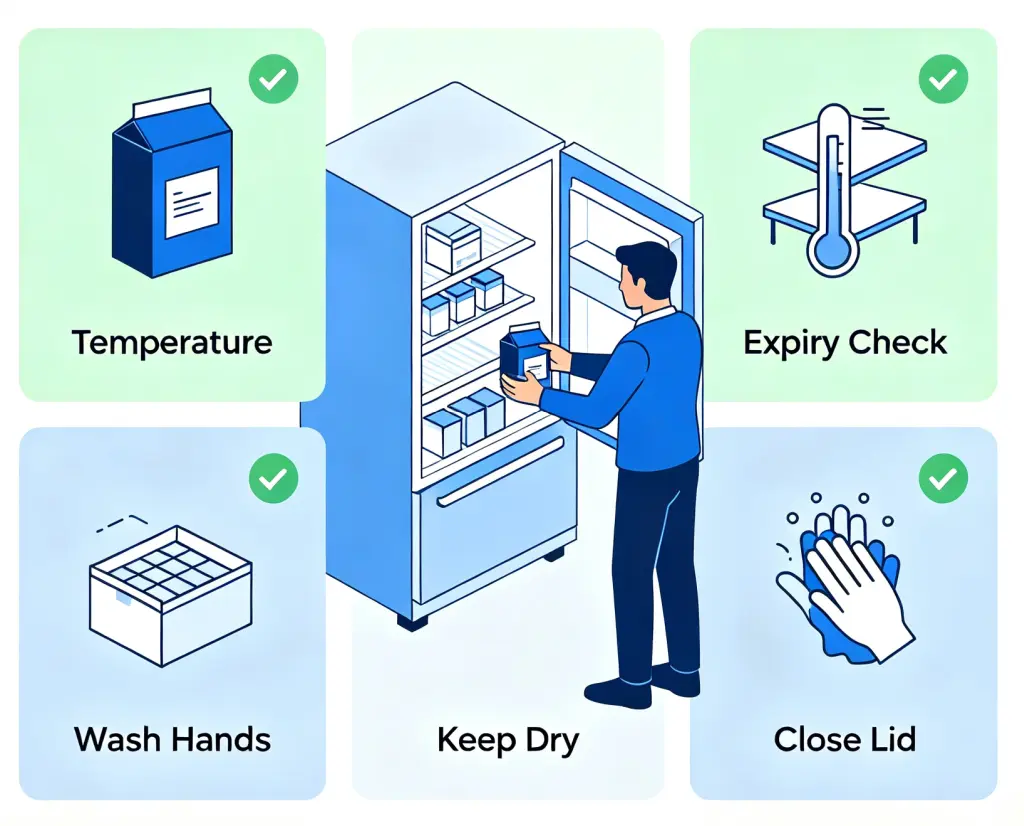
A brand sells cold‑pressed juice requiring refrigeration at 2‑4 °C and consumption within 24 hours after opening. The GS1 QR code on packaging includes the gs1:consumerHandlingStorageInfo link‑type. On scanning, consumers view: ‑ Recommended storage temperatures (supported by thermometer graphics) ‑ Differentiated storage rules for unopened versus opened containers ‑ Visual indicators for product spoilage ‑ Contingency advice for situations without refrigeration
This delivers far richer guidance than short printed text on bottle labels.
Cosmetics: Period‑after‑opening guidance
A premium skincare product requires light‑protected storage and must be discarded six months after opening. Scanning returns: ‑ Explanation of PAO (Period After Opening) rules ‑ A simple tool to record the first‑opening date ‑ Background explaining light‑sensitivity of active ingredients ‑ Reminders approaching the end‑of‑use window
This enables brands to differentiate through transparency and technical communication.
Pharmaceuticals & Health Supplements: Safe‑storage guidance
A biological medicine requires continuous refrigeration at 2‑8 °C; temperature deviation compromises therapeutic effect. Pharmaceutical manufacturers embed gs1:consumerHandlingStorageInfo within the on‑pack QR‑code. Patients accessing the link obtain: ‑ Precise storage‑temperature requirements plus monitoring tips ‑ Practical travel‑carrying solutions ‑ Safe‑disposal procedures for expired or unused medicine ‑ Common user errors and their consequences
This reduces repetitive explanatory work for pharmacists and clinicians.
Consumer Electronics: Service‑life extension
An electronics brand implements gs1:consumerHandlingStorageInfo on product packaging. Scanning delivers detailed advice beyond generic warnings such as “avoid high temperature and humidity”: ‑ Optimal battery charging and storage practices ‑ Device‑cleaning protocols ‑ Long‑term‑storage procedures for unused equipment ‑ Operational limits under extreme environmental conditions
Better guidance helps consumers extend device lifespans and reduces e‑waste generation.
4. Configuration Example
Below is a JSON resolver‑configuration example for a food‑brand implementing gs1:consumerHandlingStorageInfo:
{
  "anchor": "/01/06933960552835",
  "itemDescription": "Eco‑Town Cold‑Pressed Juice 330ml",
  "defaultLinktype": "gs1:pip",
  "links": [
    {
      "linktype": "gs1:pip",
      "href": "https://www.example.com/product/12345",
      "title": "Product Information Page",
      "type": "text/html",
      "hreflang": ["zh‑CN"],
      "context": ["general"]
    },
    {
      "linktype": "gs1:consumerHandlingStorageInfo",
      "href": "https://www.example.com/storage/juice",
      "title": "Storage & Handling Guide",
      "type": "text/html",
      "hreflang": ["zh‑CN"],
      "context": ["refrigeration", "shelf‑life"]
    },
    {
      "linktype": "gs1:consumerHandlingStorageInfo",
      "href": "https://www.example.com/en/storage/juice",
      "title": "Storage & Handling Guide",
      "type": "text/html",
      "hreflang": ["en"],
      "context": ["refrigeration", "shelf‑life"]
    },
    {
      "linktype": "gs1:instructions",
      "href": "https://www.example.com/ifu/juice",
      "title": "Consumption Instructions",
      "type": "text/html",
      "hreflang": ["zh‑CN"],
      "context": ["general"]
    }
  ]
}
Field‑by‑Field Explanation
| Field | Description |
|---|---|
anchor | Resolver routing anchor mapping to the GTIN. Link‑matching rules activate when scans target this path. |
defaultLinktype | Fallback link‑type invoked when no specialised matching condition is satisfied; commonly points to the product‑information page. |
links | Array containing one or multiple link‑rule objects. |
linktype | The GS1 vocabulary link‑type identifier; here gs1:consumerHandlingStorageInfo. |
href | URL pointing to the storage‑and‑handling guidance landing page. |
title | Human‑readable link title displayed by scanning‑client applications. |
type | MIME‑type for target content; typically text/html. PDFs or video resources are also permitted. |
hreflang | Language‑code array supporting language‑adapted content delivery based on client‑browser locale. |
context | Context‑tag array used for granular content routing, e.g. distinguishing refrigerated‑storage versus ambient‑shelf‑life scenarios. |
Scan Workflow
- Scan: Consumers scan the on‑pack QR‑code using a GS1‑Digital‑Link‑compliant client (native smartphone camera, WeChat, dedicated mobile application).
- Resolution: The scanner submits a request to the GS1 resolver. The resolver evaluates parameters including
linkType=gs1:consumerHandlingStorageInfoto match configured link rules. - Redirect: The end‑user browser is forwarded to the brand‑configured storage‑and‑handling guidance landing page.
- Information retrieval: Consumers access storage‑condition rules, handling protocols and shelf‑life information.
Core Advantages of this Implementation
‑ Minimal QR‑code payload: the QR‑code only encodes a compact base path e.g. /01/06933960552835; all storage‑guidance content resides in cloud‑hosted resources. ‑ Dynamic content routing: the identical physical QR‑code serves Chinese‑language or English‑language pages automatically according to hreflang. ‑ Zero‑packaging‑change updates: revise backend URLs or page‑content when storage advice evolves; no physical‑label reprint required. ‑ Multi‑format support: target resources can be web pages, PDFs or video assets. ‑ Analytics capability: backend systems can collect access metrics for each gs1:consumerHandlingStorageInfo link invocation.
Summary
gs1:consumerHandlingStorageInfo is a simply‑defined yet practically valuable link‑type within the GS1 Digital Link ecosystem.
Whereas the product‑information page answers “what is this product?”, and usage‑instructions answer “how do I use it?”, gs1:consumerHandlingStorageInfo answers “how should I store and handle it?”. For food‑and‑beverage, cosmetic, pharmaceutical and electronics brands, it delivers a standardised extension mechanism: print packaging once, while enabling associated product‑related information to keep evolving throughout the product lifecycle.