
Executive Summary
European Commission Mandate M/594 tasked the CEN/CENELEC Joint Technical Committee JTC 24 with developing eight harmonised standards for Digital Product Passports (DPP). The standards establish consistent rules governing physical data carriers, registration protocols and cryptographic security frameworks.
Key framework references include EU Mandate M/594, prEN 18246 (data authentication), prEN 18220 (data carriers), W3C Verifiable Credentials and GS1 Digital Link. These horizontal cross-sector specifications facilitate interoperable product passports across all commodity categories. All eight standards reached final draft status in March 2026. Official publication is scheduled for Q2–Q4 2026, followed by national transposition within EU Member States.
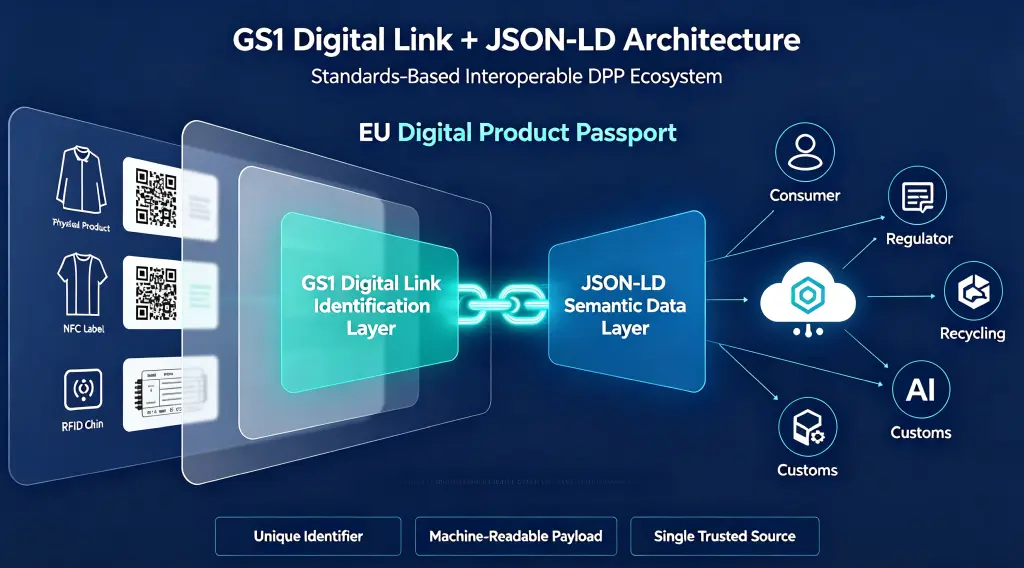
Crucially, the EU Digital Product Passport is neither a static PDF document nor a simple redirect link hosted behind consumer-facing QR codes. It defines a standards-compliant, machine-readable, interoperable data payload accessible via a single physical identifier. Authorised stakeholders – consumers, customs authorities, recycling operators, market surveillance bodies and automated digital systems – may retrieve structured product data through this identifier. The technical foundation of the DPP ecosystem rests on two primary specifications: GS1 Digital Link (identification and routing layer) and JSON-LD (data payload and semantic interoperability layer). This white paper provides a technical breakdown of both standards, outlines the full suite of JTC 24 specifications and defines practical implementation requirements for market operators.
1. GS1 Digital Link: Universal Unique Product Identification
Standard Overview
GS1 Digital Link is formalised within GS1 General Specifications Version 23 (2024) and published as ISO/IEC 18975:2024 Automatic identification and data capture techniques — GS1 Digital Link. The specification carries regulatory recognition under EU legislation, maintained via open multi-stakeholder consensus independent of single commercial entity control.
The standard addresses a critical industry limitation: enabling one barcode or RFID tag to support parallel use cases, including retail point-of-sale scanning, consumer information retrieval, regulatory compliance verification and end-of-life sorting. GS1 Application Identifiers (AIs) are encoded as path segments within resolvable web Uniform Resource Identifiers (URIs).
Reference URI structure:
https://id.brand.com/01/09506000134352/21/SERIAL-2026-K78/10/BATCH-Q2-YARN27
URI Component Mapping Table
| URI Segment | GS1 Application Identifier (AI) | Description | Example Value | Mandatory |
|---|---|---|---|---|
https://id.brand.com/ | — | Brand-controlled resolver domain with SSL encryption and validated DNS configuration | Custom enterprise domain | Yes |
01/09506000134352 | AI 01 | GTIN‑14 Global Trade Item Number | Unique base product identifier | Yes |
21/SERIAL-2026-K78 | AI 21 | Item-level serial number | Unique identifier for each physical unit | Yes |
10/BATCH-Q2-YARN27 | AI 10 | Production batch/lot identifier | Traceability reference for manufacturing batches | Recommended |
?17=260531 (query parameter) | AI 17 | Expiry date (YYMMDD format) | Product validity metadata | Optional |
DPP Implementation Benefits
Conventional identification architectures frequently operate in silos: separate GTIN barcodes for retail, standalone QR codes for consumers and dedicated web endpoints for regulators. Multiple identifiers for a single product fragment traceability workflows, increase authentication overhead and conflict with the ESPR requirement for a single trusted data source.
GS1 Digital Link delivers a unified URI usable across all stakeholder groups. The standardised resolution workflow is outlined below:
QR Code / Mobile Device / NFC / RFID Reader
        ↓
Brand resolver service: https://id.brand.com/01/GTIN/21/serialnumber
        ↓
Content negotiation via HTTP Accept header enables differentiated responses
text/html             application/ld+json              application/json (fallback)
Consumer web portal   Structured DPP dataset           Generic JSON compatibility
                      (for regulators & automated systems)
Mandatory Compliance Provisions
HTTP Accept header content negotiation constitutes a binding compliance requirement. Resolver services must differentiate request types and serve corresponding payloads:
- Web browser requests from end users: Return
text/htmlformatted user interface pages - Machine-to-machine requests from regulators, recyclers and automated systems: Return
application/ld+jsonstructured documents - Interoperability fallback: Return standard
application/json
ESPR compliance verification systems will actively request application/ld+json payloads. Valid structured responses must be delivered within 200 milliseconds. Redirection of JSON-LD requests to marketing landing pages will be treated as non-compliance.
2. JSON-LD: Standardised Data Payload for DPP
JSON-LD (W3C Recommendation 2020: JSON for Linked Data) has been selected by the European Commission as the primary serialisation format for DPP data exchange. In contrast to generic JSON, JSON-LD incorporates semantic context definitions, binding each data field to globally agreed terminology and enabling interoperability between heterogeneous enterprise systems.
Textile Sector DPP JSON-LD Example Payload
{
 "@context": [
 "https://schema.org",
 "https://gs1.org/voc/",
 "https://dpptex.com/contexts/dpp-textile-v1.jsonld"
 ],
 "@type": "Product",
 "@id": "https://id.brand.com/01/09506000134352/21/SERIAL-2026-K78",
 "gtin14": "09506000134352",
 "serialNumber": "SERIAL-2026-K78",
 "batchNumber": "BATCH-Q2-YARN27",
 "name": "Circular Wool Blend Overshirt",
 "description": "70% recycled wool, 30% TENCEL Lyocell",
 "manufacturer": {
 "@type": "Organization",
 "name": "Nordic Circular Textiles AB",
 "location": {
 "@type": "Place",
 "address": {
 "@type": "PostalAddress",
 "addressCountry": "SE"
 }
 }
 },
 "countryOfOrigin": {
 "@type": "Country",
 "name": "Portugal"
 },
 "material": {
 "@type": "Product",
 "materialComposition": [
 {
 "@type": "TextileMaterial",
 "name": "Recycled Wool",
 "percentageComposition": 70,
 "recycledContent": 100,
 "certification": "GRS-2025-TE-004782"
 },
 {
 "@type": "TENCEL Lyocell",
 "percentageComposition": 30,
 "certification": "Lenzing-2025-LY-1273"
 }
 ]
 },
 "sustainability": {
 "@type": "SustainabilityRating",
 "carbonFootprint": {
 "@type": "QuantitativeValue",
 "value": 8.4,
 "unitCode": "KGM",
 "unitText": "kg CO2e per kg product"
 },
 "waterFootprint": {
 "@type": "QuantitativeValue",
 "value": 2850,
 "unitCode": "LTR",
 "unitText": "litres per kg product"
 },
 "durabilityWashIndex": 78,
 "recyclabilityScore": 92
 },
 "hasGS1DigitalLink": "https://id.brand.com/01/09506000134352/21/SERIAL-2026-K78",
 "productionDate": "2026-03-15",
 "discontinuedDate": null
}
JSON-LD Core Fields – ESPR Textile Compliance Matrix
| JSON-LD Field | Vocabulary Source | DPP Data Category | Mandatory under Textile ESPR |
|---|---|---|---|
@context | Namespace declaration | Semantic framework foundation | Yes |
@type: Product | Schema.org ontology | Product classification | Yes |
gtin14 | GS1 Vocabulary | Primary product identifier | Yes |
serialNumber | Schema.org | Unit-level unique identifier | Yes |
materialComposition | GS1 extended schema | Raw material traceability | Yes |
carbonFootprint | Schema.org QuantitativeValue | Environmental impact metrics | Yes |
waterFootprint | Custom extension ontology | Water consumption metrics | Mandatory audit requirement effective 2029 |
durabilityWashIndex | Custom extension ontology | Product durability indicator | Yes |
recyclabilityScore | Custom extension ontology | Circular recovery performance | Yes |
countryOfOrigin | Schema.org Country type | Supply chain transparency | Yes |
manufacturer | Schema.org Organization type | DPP responsible legal entity | Yes |
certification (per material) | Custom field | Supply chain certification traceability | Recommended |
hasGS1DigitalLink | Proposed Schema.org extension | Self-referential Digital Link URI | Recommended |
productionDate | Schema.org | Manufacturing timestamp | Recommended |
discontinuedDate | Schema.org | Product lifecycle tracking | Optional |
Evaluation of Data Serialisation Formats
Between 2024 and 2025, EU technical committees assessed four candidate serialisation formats for DPP deployment. The comparative assessment is summarised below:
| Format | Semantic Interoperability | Native Web Resolution | Mature Tooling Ecosystem | HTML Embedding Support | Evaluation Outcome |
|---|---|---|---|---|---|
| JSON-LD | Supported (context-driven semantics) | Native URI/HTTP compatibility | Established (Schema.org, GS1 Vocabulary) | Embeddable within HTML markup | Selected official standard |
| Plain JSON | Absent (unregulated field semantics) | Supported | Established | Supported | Rejected – insufficient cross-system interoperability |
| XML (RDF/XML) | Supported (requires RDF mapping) | Supported | Established | Supported | Rejected – legacy architecture with complex parsing overhead |
| CSV/TSV | Absent | No native URI resolution | Limited tooling | Non-embeddable | Rejected – inadequate structured data capabilities |
Key Functional Advantages of JSON-LD
A single JSON-LD document simultaneously fulfils multiple functional requirements:
- Human readability for manual review via standard web browsers
- Machine interpretability through standardised semantic context for automated data processing
- Web-addressable ontology via globally recognised URI definitions
- Native indexing capability for commercial search engine crawlers
3. CEN/CLC JTC 24: The Complete Suite of Eight DPP Standards
The European Commission mandated CEN and CENELEC Joint Technical Committee JTC 24 to develop the full portfolio of DPP technical specifications. Publication status and scope are detailed in the table below:
| Standard Reference | Title | Technical Scope | Status (May 2026) | Expected Publication |
|---|---|---|---|---|
| prEN 18219 | Unique Identifier Specifications | Cross-sector coding rules for products, batches and components | Final draft completed | Q1 2026 |
| prEN 18220 | Data Carriers and Physical-to-Digital Linkage | QR/NFC/RFID specifications, GS1 Digital Link URI syntax, resolver performance and security requirements | Final draft completed | Q1 2026 |
| prEN 18223 | Cross-Sector Interoperable Product Data | Generic data model, JSON-LD context schemas, cross-industry data dictionaries | Committee draft | Q2 2026 |
| prEN 18216 | Data Exchange Protocols and Formats | DPP system API specifications (REST, WebSocket, event-driven architectures) | Committee draft | Q2 2026 |
| prEN 18221 | Data Storage, Archiving and Long-Term Preservation | Minimum 15-year retention rules, backup protocols and business continuity requirements | Working group draft | Q3 2026 |
| prEN 18222 | Retrieval, Access and API Query Mechanisms | DPP registry search functions, access governance and API throttling frameworks | Working group draft | Q3 2026 |
| prEN 18239 | Access Rights Management and Role Hierarchies | Permission architecture for consumers, recyclers, market authorities and customs agencies | Working group draft | Q4 2026 |
| prEN 18246 | Product Data Authentication and Integrity Verification | Cryptographic integrity mechanisms, digital signature schemes and validation protocols | Committee draft | Q3 2026 |
Note: Final draft completion in March 2026 does not constitute a regulatory compliance deadline. Once formally published as European Standards (ENs), EU and EEA Member States are obligated to transpose these documents into national standards. Market participants are recommended to align internal systems with final draft specifications during Q2 2026. Formal compliance assessments will reference the officially released EN versions.
4. Integration of hasGS1DigitalLink within the Schema.org Ecosystem
GS1 and Schema.org operate a joint working group to incorporate the hasGS1DigitalLink property into the official Schema.org Product ontology. Successful adoption delivers three primary outcomes:
- Automated DPP discovery by search engine crawlers via recognised structured markup
- Native support for automated data retrieval by artificial intelligence platforms for sustainable product benchmarking
- Low-effort upgrade pathway for operators already implementing Schema.org product metadata, avoiding full system redesign
5. Industry Misconceptions Regarding DPP Implementation
- Misconception: DPP can be delivered as PDF documents ESPR technical annexes mandate machine-readable structured data. Static PDF files support only manual human review and cannot be processed automatically by compliance verification systems, sorting infrastructure or digital analytics platforms. Regulatory guidance confirms PDF-only deployments constitute non-compliance.
- Misconception: DPP datasets are centrally hosted on government servers EU central registries store only identifiers, linkage metadata and public verification keys. Full product datasets remain under the custody of brand owners or authorised third-party DPP service providers.
- Misconception: DPP records are static and immutable DPP datasets support continuous updates across the full product lifecycle, accommodating batch revisions, safety recalls, recalculated environmental metrics and other lifecycle events.
- Misconception: DPP obligations apply exclusively to newly manufactured goods Proposed revisions to the Waste Framework Directive introduce requirements for retrospective DPP records applicable to second-hand and vintage goods traded within the EU, effective 2029.
6. Enterprise Implementation Roadmap
- Secure dedicated resolver domain (Q2 2026) GS1 Digital Link deployments require an SSL-enabled, enterprise-controlled DNS domain (e.g. id.brand.com). Finalise domain ownership prior to resolver service rollout in Q3.
- Allocate GTINs for all SKUs; complete unit-level serialisation (Q4 2026) Organisations not yet participating in the GS1 system shall engage national GS1 authorities to assign 14-digit GTINs. Establish serial number generation workflows for individual unit identification.
- Develop JSON-LD DPP templates proactively Core mandatory fields including GTIN, serial number, material composition, environmental metrics, manufacturer information and origin data are stable. Organisations may deploy base templates and incrementally extend schemas following formal standard publication.
- Implement HTTP content negotiation within resolver infrastructure Build differentiated response logic triggered by the HTTP Accept header. Validate functionality via test requests:
curl -H "Accept: application/ld+json". Redirection of structured data requests to marketing pages is prohibited. - Deploy global CDN infrastructure to optimise latency Compliance audits require resolver response times within 200 milliseconds. Enterprise-grade global CDN services are recommended to meet latency requirements.
- Decommission PDF-only information architectures QR codes delivering only PDF downloads represent legacy non-compliant solutions. Operators must transition fully to JSON-LD structured data architectures ahead of formal enforcement timelines.
7. Technical & Regulatory References
- GS1 General Specifications Version 23 (2024); GS1 Digital Link Standard v1.4
- ISO/IEC 18975:2024
- W3C JSON-LD 1.1 Recommendation (2020)
- Schema.org Official Product Type Documentation
- CEN/CLC JTC 24 Work Programme 2025–2026
- Regulation (EU) 2024/1781 (ESPR), Article 31 and Annex III
- GS1–Schema.org Joint Working Group:
hasGS1DigitalLinkProperty Specification (2025–2026) - European Commission Joint Research Centre (JRC), DPP Data Architecture Technical Report, February 2026
Supplementary Industry Perspectives
- Cross-domain interoperability: Data space alignment for Catena‑X, Gaia‑X and SEMI. API gateway architecture options to enable secure data exchange amid globalised, fragmented supply chain ecosystems.
- Global electronics standardisation: Approaches to align digital traceability requirements across East Asian manufacturing regions, Japan, Taiwan and the EU.
- Standardised DPP deployment based on GS1 Digital Link syntax: Engineering framework for consistent physical data carrier addressing under ESPR regulation.
Extended Reference Materials
- European Commission ESPR Guidance Documents (EUR-Lex Circular Economy Directives and Mandates)
- GS1 Global Standards Library (GTIN‑14, resolver service architecture specifications)
- W3C Verifiable Credentials VC 2.0 (cryptographic validation protocols, JSON-LD syntax)
- ISO management system portfolio (ISO 17025 laboratory testing competence standard)