I. Standard Definition and Encoding Specifications
1.1 Official Positioning and Functional Definition
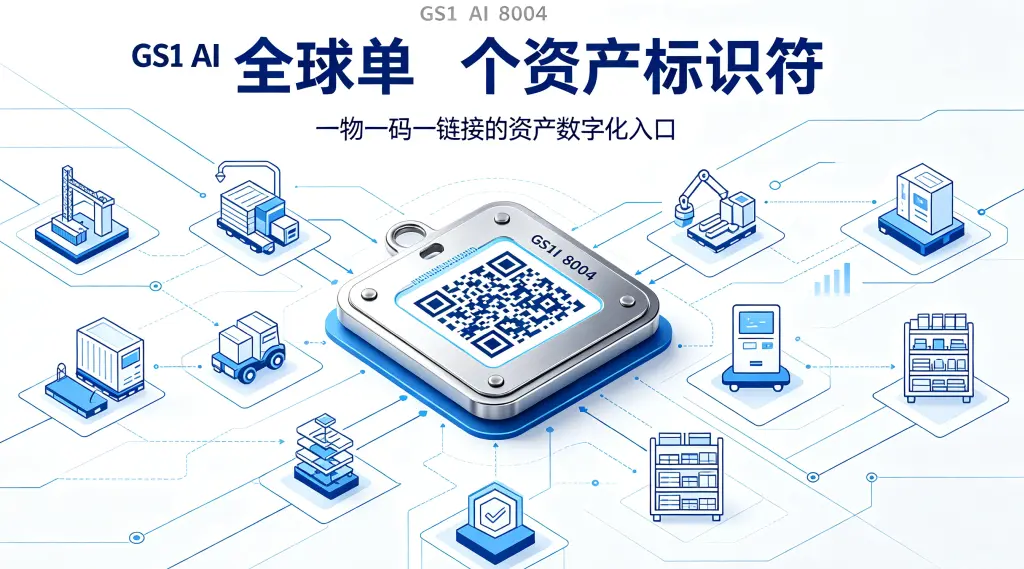
The Global Individual Asset Identifier (GIAI) is a standardized coding system within the GS1 system used to uniquely identify individual tangible assets, corresponding to Application Identifier (AI) 8004. Its core positioning is to provide a globally unique, interoperable identity for individual physical assets both within enterprises and across supply chains, covering the full lifecycle management scenarios from procurement, operation and maintenance, transfer, to disposal.
According to the GS1 General Specifications, GIAI is assigned and generated by the asset owner based on their own allocated GS1 Company Prefix (GCP). Once assigned, the code shall not be reused in principle. If ownership of an asset changes, whether the code remains with the asset is determined by business scenarios; however, if retained, its lifelong uniqueness must be ensured. This standard is also compatible with ISO/IEC 15459-4 and ISO/IEC 15459-5 international standards, ensuring global applicability.
1.2 Encoding Structure and Technical Parameters
GS1 AI 8004 encoding follows the GS1 Element String syntax of “Application Identifier + Data Field.” The complete technical parameters are shown in the table below:
Table 1: GS1 AI 8004 Core Technical Parameters
| Parameter | Specification Value | Description |
|---|---|---|
| Application Identifier | 8004 | Fixed 4-digit number identifying the meaning of the data field |
| Data Field Format | N4 + X..30 | 4-digit AI + 1–30 variable-length character data |
| Character Set | Regex: ([!%-?A-Z_a-z\x22]{1,30}) | Supports uppercase/lowercase English letters, digits, and printable ASCII special characters (including !, “, %, -, ., /, :, =, ?, _, etc.) |
| Data Length Range | 1–30 characters | Single-byte character encoding; maximum data field length 30 bytes |
| FNC1 Requirement | Mandatory | Used for data field separation and syntax identification |
| Digital Link Key | Supported | Can serve as the primary key in a GS1 Digital Link URI |
| Key Qualifier | AI 7040 | Unique qualifier identifier in Digital Link scenarios |
Encoding Composition Logic
The GIAI data field is logically divided into two parts at the business level:
- GS1 Company Prefix (GCP): A numeric prefix allocated by local GS1 Member Organizations, typically 7–10 digits long, ensuring global enterprise uniqueness.
- Individual Asset Reference Code: A character sequence autonomously defined by the asset owner, supporting letters, digits, and special symbols for unique differentiation within the enterprise.
Check Digit Explanation
The GIAI data field is a variable-length alphanumeric code; the GS1 standard does not define a built-in check digit. Data integrity is jointly ensured through error correction mechanisms of barcode symbologies (e.g., Reed-Solomon in Data Matrix) and validation rules within business systems. If a purely numeric asset reference code is adopted, the GS1 Modulo 10 check algorithm may optionally be applied as a supplementary check digit, but this is not mandatory under the standard.
1.3 FNC1 Usage Rules
FNC1 (Function 1) is a dedicated functional character in the GS1 barcode system. As AI 8004 has a variable-length data field, the use of FNC1 for boundary identification is mandatory:
- In barcode symbologies such as GS1-128 and GS1 DataMatrix, FNC1 appears before the first AI as a syntax prefix.
- When concatenating multiple AI data fields, FNC1 must be inserted after a variable-length AI (such as 8004) as a separator to mark the end of the current data field.
II. Core Technical Functions and Value Proposition
2.1 Full Lifecycle Unique Traceability
The core technical value of GIAI lies in establishing a globally unique digital identity for individual physical assets, breaking down coding silos across internal enterprise systems and departments. By printing or laser marking the GIAI directly onto the asset, full-process data linkage—from procurement receipt, daily O&M, repair and maintenance, cross-location transfers, to disposal—can be achieved, with all operational records bound to and archived against the unique asset identifier.
2.2 Cross-System Interoperability
As an integral part of the global GS1 standards ecosystem, GIAI inherently supports cross-enterprise and cross-industry interoperability. In scenarios such as asset handovers across supply chain partners, third-party maintenance services, and financial leasing, data exchange can occur without additional coding mapping, eliminating interface development costs and data conversion errors associated with proprietary coding schemes.
2.3 Multi-Carrier Compatibility
GIAI supports various Automatic Identification and Data Capture (AIDC) carriers, including GS1-128 linear barcodes, GS1 DataMatrix 2D barcodes, EPC/RFID tags, and GS1 Digital Link URI QR codes. Enterprises can select the appropriate carrier based on the asset’s operating environment, read range, and cost requirements. A single GIAI code can be reused across multiple carriers, ensuring flexibility in technical implementation.
III. GS1 Digital Link Implementation
3.1 URI Construction Rules
GS1 Digital Link is a technical specification that maps GS1 identification systems into Web-standard URIs, enabling asset identifiers to be parsed by professional scanning devices while also allowing access to corresponding online services via standard mobile terminals. AI 8004, as an officially recognized primary key AI, follows hierarchical path construction rules for its URI.
3.1.1 Primary Key Encoding Rule
When GIAI serves as the primary key, the path structure “domain + /8004/ + GIAI value” is adopted:
https://id.example.com/8004/{giai-value}- The domain uses the enterprise’s own subdomain; examples uniformly use
id.example.com. - The first path segment
8004is the Application Identifier, indicating that the subsequent path segment is the GIAI primary key value. - The GIAI value must be URI-encoded, with special characters escaped according to RFC 3986 specifications.
3.1.2 Key Qualifier Usage Specification
The official key qualifier for GIAI is AI 7040 (GS1 UIC with Extension 1 and Importer index). Per GS1 standards, AI 7040 has a data field format of N1+X3, i.e., fixed 4-character length: the first character is a digit, followed by three characters. It supplements information such as component numbers, bin locations, or extended classification details. The qualifier must be placed after the primary key, concatenated in the path in fixed order:
https://id.example.com/8004/{giai-value}/7040/{qualifier-value}AI 7040 Technical Parameter Details:
- Data Format: N1 + X3 (1 digit + 3 characters, fixed total length 4)
- Regular Expression:
(\d)([!%-?A-Z_a-z\x22])([!%-?A-Z_a-z\x22])([!%-?A-Z_a-z\x22]) - FNC1 Requirement: Mandatory
- Digital Link Primary Key: No (may only be used as a qualifier or attribute)
The key qualifier is optional and should only be used when further subdivision of the primary key is required. It must always appear together with the primary key and cannot exist as a standalone path element.
3.1.3 Data Attribute Encoding
Beyond the primary key and qualifier in the path, other GS1 AI data attributes must be appended to the URI as query parameters, with the parameter name being the corresponding AI number:
https://id.example.com/8004/6901234500001?10=LOT202607&253=ASSET-0013.2 Resolution Mechanism and Workflow
GS1 Digital Link URIs employ a dual-mode resolution mechanism:
- Barcode Device Parsing: Professional scanners identify the AI number within the URI path and extract the corresponding identifier value according to GS1 syntax rules, directly outputting structured AI-data pairs, fully compatible with traditional barcode parsing results.
- Web Access Resolution: When accessed by a standard smartphone camera or browser, an enterprise-deployed Resolver service returns the corresponding web resource (e.g., asset record, maintenance history, operation manual) based on request headers and link type parameters.
The resolver service must deploy a standard descriptor file at the /.well-known/gs1resolver path to enable automatic discovery of resolution capabilities by third-party systems.
3.3 Technical Comparison with Traditional Barcodes
Table 2: Comparison Between GS1 Digital Link and Traditional Barcode Technology
| Comparison Dimension | Traditional GS1 Element String Barcode | GS1 Digital Link URI |
|---|---|---|
| Data Carrier | Dedicated barcode symbology (GS1-128/DataMatrix) | Standard QR Code/Data Matrix; compatible with generic scanners |
| Reading Device | Requires professional GS1 decoding device | Readable by generic scanners, smartphone cameras |
| Information Capacity | Carries only structured identification data | Identification data + online service entry point |
| Interaction Capability | Unidirectional data capture | Bidirectional interaction; can redirect to web pages |
| Upgrade Flexibility | Requires reprinting of barcode | Backend service can be updated dynamically without changing carrier |
| Consumer Reach | Not supported | Can directly deliver information services to end-users |
3.4 Complete URI Examples and Parsing
Basic GIAI Digital Link Example
https://id.example.com/8004/69012345-MED00128- Structural Parsing:
id.example.comis the resolver domain;8004is the primary key AI;69012345-MED00128is the GIAI code value (containing the company prefix and asset reference code). - Access Effect: Professional devices parse and output
(8004)69012345-MED00128; smartphone access redirects to the electronic record page for this medical device.
Complete Example with Key Qualifier
https://id.example.com/8004/69012345-MED00128/7040/1A03- Qualifier Explanation: AI 7040 value is
1A03, conforming to the N1+X3 format—the first digit1indicates an extended classification, and the following three charactersA03indicate a component number. - Business Scenario: Used for component-level traceability of complex assets, e.g., identifying core components and extended attributes of surgical instruments.
3.5 Combination Rules
According to GS1 standards:
- Mandatory Association: Neither AI 8004 nor AI 7040 has mandatory associated application identifiers; AI 8004 can be used independently.
- Invalid Combinations: No officially defined invalid pairings; compatible with most attribute-class AIs.
- Data Attribute Validity: GIAI can be embedded as a data attribute within another primary key’s Digital Link URI as a query parameter.
- Specificity of 7-Series AIs: AI 7040 belongs to the 7-series Application Identifiers, typically restricted to specific industries or national/regional use, lacking universal global cross-industry applicability.
IV. Industry Application Practices
4.1 Healthcare: Full Lifecycle Management of Surgical Instruments
Scenario Overview
General hospitals manage a vast variety of surgical instruments with high turnover rates, requiring strict control over usage counts, sterilization records, and maintenance cycles. Traditional manual ledger methods are inefficient and error-prone. Combining GIAI with direct part marking enables comprehensive digital traceability throughout the instrument lifecycle.
System Architecture
- Hardware Layer: Laser marking equipment, handheld Data Matrix scanners, RFID readers at sterilization points, hospital asset management servers.
- Software Layer: GIAI code generation module, Central Sterile Services Department (CSSD) management system, operating room nursing system, equipment maintenance management system.
- Data Flow: Instrument procurement → Assign GIAI → Laser marking → Scan to receive into inventory → Scan during sterilization logging → Scan to issue to operating room → Scan upon return and count → Update maintenance records → Scan for decommissioning/disposal.
Implementation Results
A tertiary hospital implemented the GIAI solution for endoscope instrument lifecycle management, reducing sterilization errors by 92%, improving instrument counting efficiency by 75%, and extending the average service life of individual instruments by 18%.
4.2 Manufacturing: Production Equipment Maintenance Traceability
Scenario Overview
Discrete manufacturing enterprises operate numerous production machines, tooling fixtures, and precision cutting tools distributed across wide areas. Executing maintenance plans and tracing faults is costly. Binding equipment electronic records to GIAI enables scanning to view records, report faults, and log maintenance activities.
System Architecture
- Hardware Layer: Laser-marked metal nameplates on equipment, fixed scanning terminals in workshops, maintenance staff PDAs, industrial IoT gateways.
- Software Layer: Enterprise Asset Management (EAM) system, GIAI resolver service, maintenance work order system, equipment data acquisition platform.
- Data Flow: Equipment registration generates GIAI → Apply label/marking → Daily patrol scan logging → Fault scan reporting → Maintenance scan updates → Spare part replacement linked to GIAI → Lifecycle data analytics.
Implementation Results
An automotive parts manufacturer observed a 30% reduction in Mean Time To Repair (MTTR), improved spare parts inventory accuracy to 98.5%, and reduced annual maintenance costs by approximately 15% after deployment.
4.3 Logistics: Dynamic Control of Transport Assets
Scenario Overview
Logistics enterprises manage high-value assets like long-haul transport vehicles, handling equipment, and specialized containers moving across regions. Manual registration struggles to track real-time location and status. Combining GIAI with GPS and scanning enables dynamic asset tracking.
System Architecture
- Hardware Layer: On-vehicle RFID tags, fixed readers at terminals, driver mobile app scanning, onboard GPS terminals.
- Software Layer: Transport Management System (TMS), asset scheduling platform, GIAI resolver service, geo-fencing system.
- Data Flow: Asset registration assigns GIAI → Install tag → Scan verification at site entry/exit → GPS positioning during transit → Scan logging for maintenance/inspection → Update records for asset transfers.
Implementation Results
A third-party logistics provider reduced asset counting cycles from quarterly to monthly, decreased asset loss rates by 80%, and improved vehicle utilization by 12% after implementation.
4.4 Retail: Store Fixed Asset Management
Scenario Overview
Chain retailers operate numerous stores where fixed assets like refrigerators, POS terminals, and shelving undergo frequent inter-store transfers, leading to significant asset-reconciliation discrepancies. Combining GIAI with mobile scanning enables rapid counting and traceability of inter-store transfers.
System Architecture
- Hardware Layer: Asset barcode labels, store employee mobile apps, headquarters asset management servers.
- Software Layer: Fixed asset management system, GIAI encoding center, store operations platform, financial accounting system.
- Data Flow: Headquarters allocates GIAI centrally → Stores scan to confirm receipt → Scan during daily transfers → Scan to verify during annual audits → Scan to process disposal requests.
Implementation Results
A supermarket chain brand reduced single-store inventory counting time from 3 days to 4 hours, improved asset-physical reconciliation rates from 78% to 96%, and increased inter-store transfer reconciliation efficiency by 60% after adoption.
V. Implementation Recommendations and Future Trends
GIAI implementation should adhere to four principles: “prefix compliance, unique encoding, carrier suitability, and data integration.” Enterprises should first apply for a GS1 Company Prefix from their local GS1 Member Organization, then design internal encoding rules aligned with their asset classification systems. Pilot programs should prioritize high-value, high-turnover assets with strong traceability requirements.
With the proliferation of the GS1 Digital Link standard, GIAI is evolving from a traditional internal asset management identifier into a “one item, one code, one link” digital asset gateway. Looking ahead, combined with Web 3.0 and digital twin technologies, GIAI is poised to become the standard identity anchor linking physical assets to their digital twins, underpinning broader Industrial Internet and supply chain digitalization scenarios.