1. Standard Definition Analysis
1.1 Normative Definition
GS1 Application Identifier (AI) 417 is defined as the “Party Global Location Number” (GLN). Within the GS1 global standards system, its official positioning is to serve as the core identification key for uniquely identifying legal entities, companies, or organizations (i.e., “parties”) participating in transactions across supply chains, Electronic Data Interchange (EDI), and the Global Data Synchronisation Network (GDSN). Unlike AI 414, which identifies physical locations, AI 417 focuses exclusively on the digital identity authentication of transaction entities.
1.2 Coding Structure Technical Parameters
- Length Specification: The data field for AI 417 is of fixed length, containing exactly 13 numeric digits (Regular Expression:
^[0-9]{13}$), occupying 13 bytes (under ASCII/UTF-8 encoding). - Data Field Format: The 13-digit code consists of three logical components:
- GS1 Company Prefix: Assigned by a GS1 Member Organization, variable in length (typically 7 to 10 digits).
- Location Reference: Assigned by the enterprise itself. Its length is complementary to the Company Prefix, with the combined total strictly fixed at 12 digits.
- Check Digit: The 13th digit, used to verify the integrity of data entry and scanning.
- Check Digit Algorithm: Utilizes the GS1 standard Modulo 10 algorithm. The calculation rule is as follows: starting from right to left (excluding the check digit), multiply odd-positioned digits by 3 and even-positioned digits by 1. Sum all the products. The check digit is the difference required to reach the next multiple of 10.
- Calculation Example: Assume the first 12 digits are
952012345678.- Digit sequence (right to left): 8, 7, 6, 5, 4, 3, 2, 1, 0, 2, 5, 9
- Weight assignment: 3, 1, 3, 1, 3, 1, 3, 1, 3, 1, 3, 1
- Sum of products: (8×3) + (7×1) + (6×3) + (5×1) + (4×3) + (3×1) + (2×3) + (1×1) + (0×3) + (2×1) + (5×3) + (9×1) = 24 + 7 + 18 + 5 + 12 + 3 + 6 + 1 + 0 + 2 + 15 + 9 = 102
- Check digit calculation: 110 (next multiple of 10) – 102 = 8.
- Complete GLN:
9520123456788.
- Character Set and Encoding Specifications: Only numeric characters (0-9) are permitted. In GS1 barcode carriers, because AI 417 has a fixed length of 13 digits, the FNC1 character is not required as a field separator.
2. Core Technical Functions
2.1 Core Technical Positioning and Value
The core technical value of AI 417 lies in providing an authoritative digital identity anchor for “parties” across systems and jurisdictions. It eliminates mapping ambiguities inherent in disparate internal enterprise coding systems (e.g., Vendor IDs, Customer IDs), serving as the foundational infrastructure for supply chain master data synchronization and automated reconciliation.
2.2 Global Uniqueness Identification Mechanism
Uniqueness is guaranteed through a two-tier allocation architecture:
- Prefix Allocation: GS1 Member Organizations ensure the global uniqueness of the GS1 Company Prefix.
- Internal Control: The allocated enterprise must adhere to the GLN Allocation Rules Standard to ensure internal location references are not duplicated. Furthermore, in the event of corporate changes (e.g., mergers, acquisitions, or bankruptcy), the retirement or transfer of the GLN must be executed according to standardized protocols.
2.3 Data Carrier Format Specifications
AI 417 can be encoded into various GS1-approved data carriers:
- 1D Barcodes: GS1-128 (typically used in combination with other AIs).
- 2D Barcodes: GS1 Digital Link QR Code or Data Matrix, supporting higher data density and direct URL resolution.
- RFID Tags: Indirectly associated via specific encoding schemes (e.g., SGTIN or GSRN) on EPC/RFID tags, or by directly storing GLN data within specific tag memory banks.
2.4 Data Structure Extensibility Design
To accommodate complex organizational structures, AI 417 supports combination with AI 254 (GLN Extension). When the 13-digit GLN is insufficient to细分 (subdivide) specific departments or virtual business units within a large enterprise, an extension code can be appended to achieve hierarchical identification without the need to apply for a new GS1 Company Prefix, ensuring smooth architectural evolution.
3. Application in GS1 Digital Link
The GS1 Digital Link standard transforms traditional barcode data into standard Web URIs, elevating AI 417 from a static data field to an interactive network resource.
3.1 URI Construction Rules and Resolution Mechanism
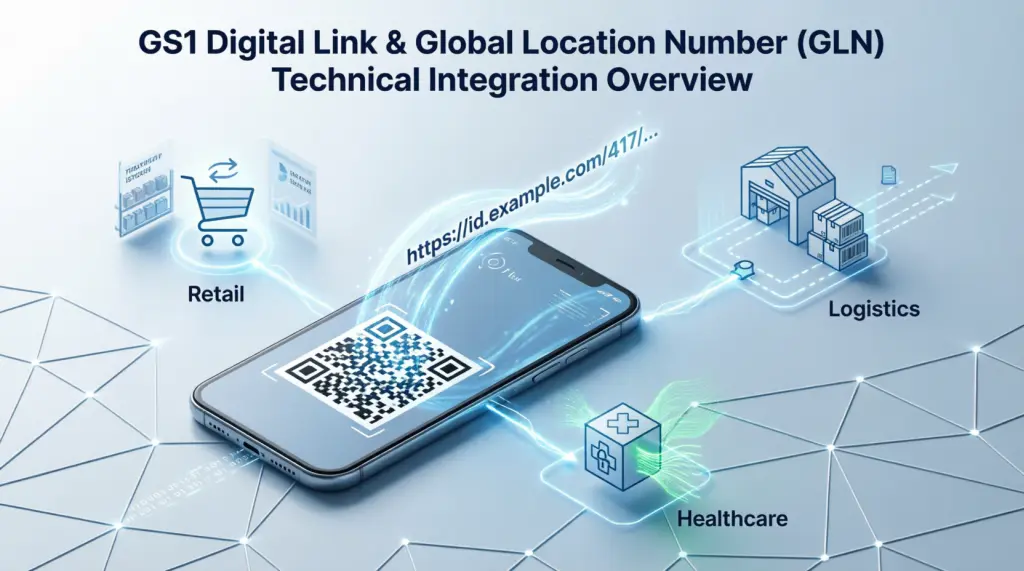
AI 417 is explicitly defined as a Primary Key within the GS1 Digital Link URI. Its standard URI construction follows this syntax:
https://id.example.com/417/{13-digit GLN value}- Convenience Alpha: To enhance developer friendliness, the standard permits the use of
partyinstead of417, i.e.,https://id.example.com/party/{13-digit GLN value}. - Resolution Mechanism: When a scanning device reads this URI, it initiates an HTTP GET request. The resolver server identifies the request type based on the
/417/or/party/path segment and, combined with the HTTPAcceptheader, returns an HTML page (e.g., a company profile) to consumers, or machine-readable master data inapplication/ld+jsonformat to enterprise systems.
3.2 Technical Differences and Advantages vs. Traditional Barcodes
| Comparison Dimension | Traditional GS1 Barcode (e.g., GS1-128) | GS1 Digital Link (Based on AI 417) |
|---|---|---|
| Data Form | Closed, static numeric string | Open, routable Web URI |
| System Dependency | Heavily relies on local databases for ID mapping | Real-time resolution via the internet, supporting global dynamic updates |
| Application Scenarios | Single scenario (e.g., warehouse receiving scan) | Multi-scenario reuse (B2B reconciliation, compliance review, marketing landing pages) |
| Maintenance Cost | Partner changes require reprinting or remapping | Target URLs can be redirected server-side; physical labels remain unchanged |
3.3 Key Qualifiers, Mandatory Associations, and Invalid Pairings
- Key Qualifiers: AI 417 supports combination with qualifiers to provide contextual attributes. For example, combining with AI 254 (GLN Extension).
- Qualifier Example:
https://id.example.com/417/9520123456788/254/001(Identifies extension department 001 under a specific GLN). - Mandatory Associations and Invalid Pairings: According to GS1 specifications, AI 417 currently has no mandatory associations and no specific invalid pairings. However, as a best practice, AI 417 is typically not used as the direct primary key for serialized individual items (like AI 21), but rather exists as a party attribute field within transaction messages (e.g., orders, invoices).
3.4 End-to-End Traceability and Multi-channel Marketing Technical Architecture
[End User / System]
      │ (1) Scans QR Code (containing https://id.example.com/417/9520123456788)
      ▼
[GS1 Digital Link Resolver Server]
      │ (2) HTTP GET request, carrying Accept: application/ld+json
      ▼
[Enterprise Master Data Management (MDM) / GDSN]
      │ (3) Queries authoritative JSON-LD data corresponding to the GLN
      ▼
[Response Returned]
      ◄─ (4) Returns structured data containing @context, name, address, contactPoint
In this architecture, the marketing end can redirect to the brand’s official website, while a logistics TMS system can automatically extract the JSON data via API to verify carrier qualifications, achieving “one code, multiple uses.”
4. Industry Application Practices
4.1 Retail Industry: Supplier Master Data Synchronization (GDSN)
- Application Scenario: Large retailers require all new suppliers to provide an AI 417 GLN during system registration.
- System Integration Architecture: Supplier ERP ──(EDI/GS1 XML)──> GS1 GDSN Data Pool ──(Subscription Sync)──> Retailer SRM System.
- Data Collection Process: The supplier generates the AI 417 GLN in the GS1 Data Hub and embeds it into product master data records. The retailer’s system automatically pulls the supplier’s compliance certificates and bank account information via the GLN, eliminating manual entry errors.
4.2 Logistics Industry: E-Invoicing and e-CMR Collaboration
- Application Scenario: Identification of consignors and consignees in cross-border logistics electronic waybills and B2B e-invoices.
- System Integration Architecture: TMS (Transportation Management System) generates a Digital Link QR code containing AI 417, printed on the waybill.
- Data Collection Process: The carrier uses a handheld terminal to scan the waybill. The resolver converts
https://id.example.com/417/...into the Participant ID format required by electronic data exchange networks (e.g.,0088:9520123456788), automatically populating the EDI INVOIC message to ensure absolute accuracy of the settlement entity.
4.3 Healthcare Industry: UDI Responsible Entity Traceability
- Application Scenario: Identifying the registrant or filer within the Unique Device Identification (UDI) carrier of medical devices.
- System Integration Architecture: Hospital HIS/SPD System ──(API Call)──> National Medical Products Administration UDI Database.
- Data Collection Process: Scanning the GS1 Data Matrix on the device packaging extracts AI 417. The hospital system queries the regulatory database using this GLN to verify the legal liability entity’s qualifications for the device, preventing非法 (illegal) channel products from entering the supply chain.
4.4 Manufacturing Industry: B2B Order Collaboration and Automated Reconciliation
- Application Scenario: Embedding the authoritative digital identities of both buyers and sellers within Purchase Orders (PO).
- System Integration Requirements (API Specification):
- Request:
GET https://id.example.com/417/9520123456788 - Response Header:
Content-Type: application/ld+json - Response Body Example:
json { "@context": "https://schema.org", "@id": "https://id.example.com/417/9520123456788", "@type": "Organization", "name": "Example Manufacturing Co., Ltd.", "globalLocationNumber": "9520123456788" }
When the manufacturing enterprise’s ERP system receives an order containing this URI, it automatically calls the resolution API to verify the counterparty’s identity. If the GLN is invalid or its status is “retired,” a risk control interception is triggered.
4.5 Industry Implementation Effect Comparison Table
| Industry | Traditional Model Pain Points | Technical Benefits after Introducing AI 417 + Digital Link |
|---|---|---|
| Retail | Multiple concurrent supplier codes, prone to reconciliation errors | Master data matching accuracy increased to 99.9%; onboarding cycle shortened by 40% |
| Logistics | Physical waybill entity information is easily blurred and hard to machine-read | Waybill information is 100% structured; EDI message auto-population rate reaches 95% |
| Healthcare | Responsible entity traceability relies on manual verification of paper certificates | Instant verification via scan; compliance review time reduced from hours to milliseconds |
| Manufacturing | Supply chain upstream/downstream system integration requires custom mapping table development | Plug-and-play based on standard URIs; API integration development costs reduced by 60% |
5. Technical Development Trends
5.1 Prediction of Future Standard Update Directions
Based on the current evolutionary path of GS1 specifications, the technical standards for AI 417 are predicted to update in the following directions:
- Integration with Decentralized Identifiers (DIDs): GS1 may soon provide official specifications for mapping AI 417 GLNs to W3C DIDs, enabling party identities to be cryptographically verified on blockchains or distributed ledgers, independent of centralized resolvers.
- Deeper Semantic Web Integration: Further refinement of JSON-LD context definitions to ensure AI 417 returned data aligns more seamlessly with Schema.org
OrganizationandPlaceontologies, enhancing machine automated reasoning capabilities.
5.2 Technical Impact on Supply Chain Management
The deep integration of AI 417 with Digital Link will propel the supply chain from a “document-driven” to a “data-driven” paradigm. Through a single, standard URI, enterprises can achieve cross-ecosystem identity mutual recognition at a minimal marginal cost. This will not only significantly reduce friction costs in B2B transactions (e.g., minimizing invoice disputes, accelerating customs clearance) but also provide an indispensable, trusted data foundation for supply chain finance (based on authentic transaction entity credit) and carbon footprint tracking (precisely pinpointing emission responsibility entities).