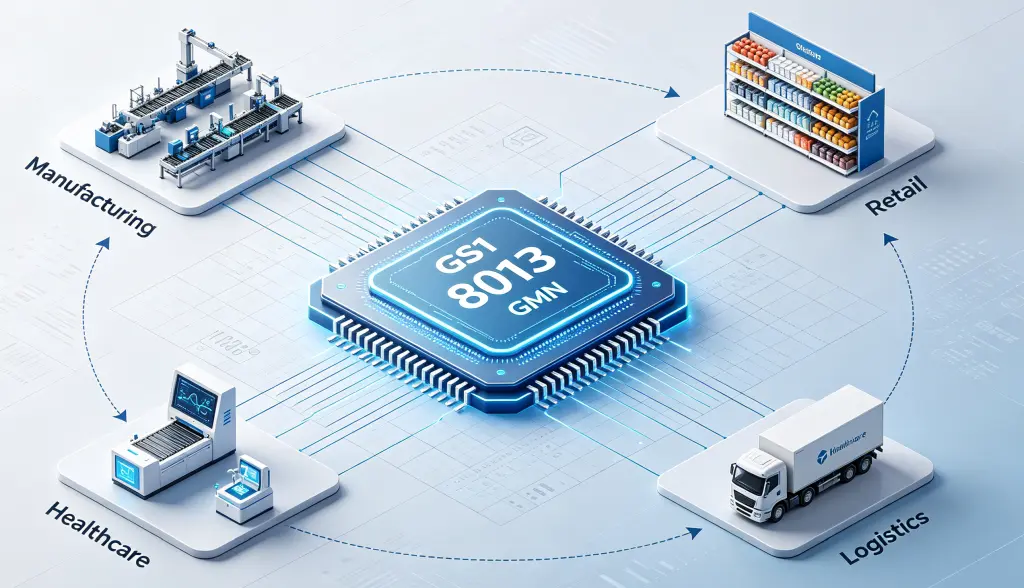
Within the GS1 global identification system, the Global Trade Item Number (GTIN) solves the identity recognition problem for individual items and trade units. However, for cross-enterprise unified identification and full-lifecycle management at the product model level, a dedicated standardized coding framework is required. GS1 Application Identifier (AI) 8013, corresponding to the Global Model Number (GMN), is the core standard in the GS1 system designed specifically for product model-level identification. Based on authoritative information from the official GS1 Standards Reference Library, this article provides a comprehensive professional interpretation of AI 8013 across six dimensions: definition specifications, functional positioning, industry use cases, implementation value, technical mechanisms, and development trends.
I. Official Definition and Encoding Technical Specifications
1.1 Official Definition
Per the official GS1 standard definition, GS1 AI 8013 is formally named Global Model Number (GMN). It is an application identifier within the GS1 system for the globally unique identification of product models, providing a unified model-level identity anchor for products of the same model with different configurations and packaging specifications.
1.2 Encoding Structure and Format
AI 8013 follows the general GS1 Application Identifier encoding rules, with a format of N4 + X..25. The complete code consists of two segments:
- Prefix segment: A fixed 4-digit numeric code
8013, the exclusive application identifier assigned by GS1 to mark the following data segment as a Global Model Number. - Model body segment: A variable-length character string of 1 to 25 characters, the core content of the GMN. It is assigned and managed by enterprises in accordance with GS1 rules to ensure global uniqueness of the model.
For character validation, the GMN body segment strictly matches the regular expression ([!%-?A-Z_a-z\x22]{1,25}). The supported character set includes:
- Uppercase and lowercase English letters (A-Z, a-z), underscores (
_), and double quotation marks ("); - Printable ASCII characters in the range from
!to?(including digits 0–9 and standard symbols); - Chinese characters, full-width symbols and non-standard special characters are not supported, and the total length is strictly limited to 25 characters.
1.3 Core Technical Attributes
Based on official GS1 specifications, the core technical attributes of AI 8013 are as follows:
| Technical Item | Official Specification | Description |
|---|---|---|
| FNC1 separator requirement | Mandatory (Yes) | When used in a GS1 element string, it must be separated from other data segments by the FNC1 character, complying with general GS1 encoding syntax. |
| Mandatory associated identifiers | None | Can be used independently and does not require mandatory binding to other GS1 Application Identifiers. |
| Invalid pairing rules | None | No mutually exclusive identifiers explicitly prohibited from appearing in the same element string. |
| GS1 Digital Link primary key capability | Supported | Can be used as an independent primary key in a GS1 Digital Link URI. |
| GS1 Digital Link attribute capability | Supported | Can be embedded as an additional data attribute in URIs with other primary keys. |
| Dedicated key qualifier | None | No associated GS1 Digital Link key qualifier. |
II. Core Functions and System Positioning
2.1 Globally Unique Identity Anchor for Product Models
The core value of GMN is to provide a globally applicable standardized identity for product models, solving the problems of inconsistent naming, varied abbreviations and divergent coding rules for the same model across enterprises and systems. For example, the same home appliance model may have different internal model codes, distributor numbers and retailer SKU names. The GMN assigned via AI 8013 enables “one model, one code” across the entire supply chain.
2.2 Unified Anchor for Cross-System Data Association
With GMN as the primary key, enterprises can associate all model-level public information including product manuals, technical parameters, firmware versions, compliance certifications, maintenance policies and spare parts lists, eliminating redundant maintenance for each SKU/GTIN. Internal PLM, ERP, WMS and CRM systems can achieve model-dimensional data connectivity through GMN, breaking down information silos.
2.3 Dual-Role Capability in GS1 Digital Link
AI 8013 has a dual positioning in the GS1 Digital Link system, making it one of the few identifiers that support both “independent primary key” and “additional attribute” roles:
- As an independent primary key: It can directly generate a dedicated URI as the unique entry point for a model’s digital homepage, where a single scan accesses all public information for that model.
- As a data attribute: It can be embedded in URIs with other primary keys such as GTIN or SSCC, adding model-dimensional attribute information to trade items and logistics units to adapt to combined “individual item + model” scenarios.
2.4 Complementary Synergy with GTIN
GMN and GTIN form a clear hierarchical complementary relationship, and neither replaces the other:
- GTIN (AI 01): For trade settlement and item-level management, with the granularity of “the smallest saleable trade unit”. Different capacities, packages and configurations of the same model correspond to different GTINs.
- GMN (AI 8013): For full-lifecycle management of product models, with the granularity of “product model”. One GMN can correspond to multiple GTINs of different specifications, carrying model-wide public information.
III. Typical Industry Application Scenarios
3.1 Equipment Manufacturing and Home Appliances: Full-Lifecycle Model Management
For categories such as industrial equipment and household appliances, the same product often has multiple configurations, power ratings and voltage versions, corresponding to a large number of different GTINs. Binding a unified GMN via AI 8013 enables the following:
- R&D and production: Manage BOMs, process routes and technical documents with GMN as the main thread, avoiding redundant maintenance across multiple SKUs.
- After-sales maintenance: Maintenance personnel can scan product barcodes to retrieve repair manuals, general spare parts lists and firmware upgrade packages for the corresponding model via GMN, without matching individual SKUs one by one.
- Recall management: Quickly locate all affected batches and SKUs at the model level, improving recall efficiency and coverage accuracy.
3.2 Medical Devices: Compliance Traceability and Unified Registration Management
The medical device industry has strict regulatory requirements for product registration and compliance traceability. A single registration certificate usually covers different specifications of the same model:
- Bind GMN to medical device registration numbers, product technical requirements, clinical data and other compliance documents. All products of the same model and different specifications share the same set of compliance qualifications, avoiding repeated applications and maintenance.
- Hospitals and distributors can quickly verify product model qualifications through GMN, ensuring compliance in procurement and use.
- Adverse event reporting and recalls can be accurately targeted at the model level, meeting traceability and supervision requirements of drug administration authorities.
3.3 Retail and Consumer Electronics: Consumer Services and Category Operations
In 3C digital and home appliance retail scenarios, consumers pay more attention to the general parameters, reviews and service policies of product models:
- Consumers scan GS1 QR codes on product packaging and jump to a model-specific digital page via GMN to view full specifications, usage tutorials, user reviews and extended warranty services, without distinguishing between specific SKUs.
- Retailers conduct category analysis, sales forecasting and procurement planning at the GMN level, improving the granularity and accuracy of category operations.
- Marketing activities such as price protection and trade-in programs can be implemented with unified rules by model, reducing operational complexity.
3.4 Logistics and After-Sales Supply Chain: Reverse Logistics and Spare Parts Management
In reverse logistics and after-sales spare parts systems, GMN can significantly improve circulation efficiency:
- In return and exchange scenarios, quickly confirm the return and exchange policies and replaceable SKUs corresponding to the product model via GMN, simplifying reverse processes.
- Spare parts warehouses manage general spare parts by GMN, reducing the number of spare part SKUs, optimizing inventory structure and improving spare parts fulfillment rates.
- Third-party logistics service providers can uniformly identify similar products from different brands through GMN, realizing standardized warehousing and transportation operations.
IV. Quantified Value for Enterprise Implementation
4.1 Operational Efficiency Improvement: Process Optimization and Labor Cost Reduction
- Workload for product model matching reduced by over 60%: Eliminates manual cross-departmental and cross-enterprise verification of model names; standardized coding enables automatic system identification.
- After-sales spare parts lookup and matching efficiency improved by 40%: Retrieves general spare parts lists directly with GMN as the index, reducing time spent matching SKUs one by one.
- Product document maintenance costs reduced by 50%: Model-level public information only needs to be maintained once, eliminating redundant uploads of manuals, certification documents and other content for each SKU.
4.2 Data Accuracy Assurance: Eliminating Ambiguity and Reducing Errors
- Model information mismatch rate reduced by 80%: Globally unique coding fundamentally eliminates confusion caused by different names for the same model and same names for different models.
- Cross-system data consistency improved to over 99%: All business systems align data based on the same GMN, avoiding data deviations caused by differences in coding rules.
- Significantly lower compliance declaration error rate: Unified model identification reduces the risk of incorrect or missing model entries in regulatory submissions.
4.3 Enhanced Supply Chain Collaboration: Information Alignment and Faster Response
- Upstream and downstream model information alignment time shortened from days to real-time: Partner enterprises can directly recognize GMN based on common GS1 standards, eliminating the need for customized coding mapping.
- Product recall response speed improved by 50%: Quickly lock all affected batches and circulation scopes by model, shortening crisis handling cycles.
- Cross-enterprise spare parts collaboration efficiency improved by 35%: Brands, service providers and spare parts suppliers collaborate based on the same model code, accelerating the response speed of the spare parts supply chain.
V. Technical Correlations and Data Exchange Mechanisms
5.1 Relationship with Core GS1 Identification Systems
AI 8013 does not exist in isolation; it is deeply compatible with the full GS1 identification system, forming a hierarchical identification network:
- With GTIN (AI 01): A one-to-many hierarchical relationship. One GMN corresponds to multiple GTINs of different specifications; GMN can be embedded as an attribute in GTIN codes and URIs to supplement model-dimensional information.
- With SSCC (AI 00): An attribute dependency relationship. GMN can be embedded in logistics unit codes to identify the product model corresponding to pallet/case goods, facilitating model-level inventory management in warehousing.
- With GLN (AI 414): A scenario combination relationship. GLN identifies the location entity, and GMN identifies the product model. Combined, they can accurately express “a certain model of product at a certain location”, supporting inventory counting, channel management and other scenarios.
5.2 Two Application Modes in GS1 Digital Link
Mode 1: As an independent primary key
Generate an independent GS1 Digital Link URI with GMN as the core. Example format:
https://id.brand.com/8013/MODEL-X200This mode applies to scenarios such as model digital homepages and general information queries. One URI corresponds to one product model, and all products of the same model share the same scan entry.
Mode 2: As an additional data attribute
Embed GMN as an attribute in a URI with GTIN as the primary key. Example format:
https://id.brand.com/01/09506000134352/8013/MODEL-X200This mode applies to item-level scenarios. A single scan retrieves both item trade information and general information of the affiliated model, covering both SKU granularity and model dimension.
5.3 System Compatibility and Data Exchange Specifications
- Barcode carrier compatibility: AI 8013 fully follows GS1 element string syntax and can be embedded in all 2D barcode carriers such as GS1 DataMatrix and GS1 QR Code, and can also be carried by 1D barcodes such as GS1-128.
- Data exchange compatibility: Supports EDI electronic data interchange and GS1 standard data synchronization interfaces, and can be directly integrated into an enterprise’s existing GS1 data system without large-scale infrastructure transformation.
- Unified parsing rules: All GS1-compliant scanning devices and parsing systems can automatically identify AI 8013 without customized development, resulting in a low implementation threshold.
VI. Development Trends and Future Evolution
6.1 Model-Level Identity Foundation for Digital Product Passports
With the advancement of global compliance policies such as the EU Digital Product Passport (DPP), model-dimensional general information such as environmental performance, carbon footprint and recycling rules will become standard compliance requirements. GMN will serve as the core identifier for model-level digital product passports, carrying model-wide compliance data and forming a two-tier DPP architecture of “model general information + item-specific information” together with item-level GTIN identifiers.
6.2 Standardized Identification Entry for IoT Devices
In industrial IoT and consumer smart device scenarios, devices of the same model share the same firmware, protocols and cloud service configurations. GMN will become the standardized model anchor for smart device network access, OTA updates and remote operation and maintenance, enabling a layered IoT governance system of “model-level unified management + item-level status monitoring” and reducing the complexity of device management.
6.3 Model-Level Supply Chain Intelligence Powered by AI and Big Data
With the deepening application of AI in the supply chain, model-dimensional data analysis will become the core granularity for demand forecasting, inventory optimization and spare parts planning. Standardized model data based on GMN enables more accurate sales forecasting, failure prediction and spare parts demand models, driving the supply chain to upgrade from SKU-level refinement to model-level intelligence.
6.4 Standard Identifier for Global Regulatory Compliance
As global regulatory requirements for product safety, traceability and environmental protection continue to escalate, the demand for standardized identification of product models — one of the core regulatory dimensions — will continue to rise. As a globally universal model identification standard, AI 8013 will gradually become a standard element for cross-border trade and compliance declarations, helping enterprises meet regulatory requirements in multiple regions.
Closing
GS1 AI 8013 (Global Model Number, GMN) is a key standard extending the GS1 identification system from “item-level trade” to “full-lifecycle management”, filling the gap of globally unified identification at the product model dimension. For industries such as manufacturing, retail, healthcare and logistics, implementing the AI 8013 standard not only improves current operational efficiency, data quality and supply chain collaboration capabilities, but also lays a standardized foundation for future scenarios such as digital product passports, IoT management and intelligent supply chains — making it critical identification infrastructure for enterprises to build global competitiveness.