Within the GS1 global identification system, while the widely known GTIN (Global Trade Item Number) is used for physical goods identification, GS1 has also established a dedicated Global Service Relation Number (GSRN) framework for service supply chain relationship management. As the core identifier for service provider relationships within the GSRN system, GS1 Application Identifier (AI) 8017 serves as the standardized foundation for cross-enterprise service relationship interoperability and end-to-end service traceability. Based on official GS1 standard references, this article provides a comprehensive analysis of AI 8017 across dimensions including definition, functions, use cases, and technical details.
I. Official Definition and Encoding Technical Specifications
1. Core Definition
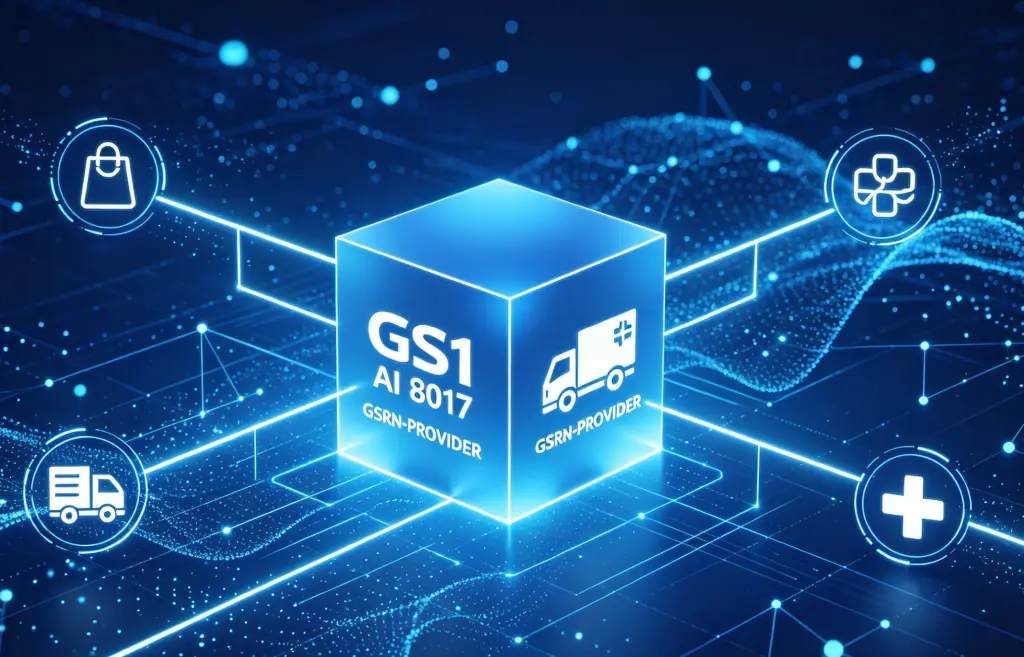
Per the official GS1 standard definition, GS1 AI 8017 corresponds to GSRN – PROVIDER (Global Service Relation Number – Provider). Its core function is to identify the service relationship between an organization offering services and the provider delivering those services, assigning a globally unique digital identity to each service partnership.
2. Encoding Structure
AI 8017 follows the general GS1 Application Identifier encoding rules, with a format of N4 + N18:
- Prefix segment: A 4-digit fixed application identifier
8017, which marks the following data segment as a service provider GSRN; - Data segment: An 18-digit numeric code, the main body of the GSRN, issued via the GS1 global allocation system to ensure global uniqueness;
- Validation rule: The data segment strictly matches the regular expression
\d{18}, supporting only 18 numeric digits with no letters, symbols or special characters.
3. Foundational Technical Specifications
Based on official GS1 standards, the core technical attributes of AI 8017 are as follows:
- FNC1 separator requirement: Mandatory. When used in a GS1 element string, it must be separated from other data segments by the FNC1 character, fully complying with GS1 general encoding syntax;
- Invalid pairing rule: It cannot be paired with AI 8018 (GSRN-RECIPIENT) within the same element string, as the two are mutually exclusive, independent primary key identifiers;
- GS1 Digital Link attributes: It has a dual role: it can be used independently as a primary key in a GS1 Digital Link URI, and can also be embedded as an additional data attribute in URIs built on other primary keys;
- Dedicated qualifier: Its associated key qualifier is GS1 AI 8019, used to supplement extended attributes such as service type and service level.
II. Core Functions and Technical Features
1. Globally Unique Identity Anchor for Service Relationships
AI 8017 assigns a globally unique code to each “service principal – service provider” partnership, independent of differences in internal enterprise coding rules. This fundamentally eliminates issues such as service relationship confusion, reconciliation mismatches and permission misjudgments caused by inconsistent enterprise abbreviations or custom numbering.
2. Standardized Interoperability Across Systems and Enterprises
As a globally universal GS1 standard, GSRN can be directly recognized by all GS1-compliant business systems, scanning devices and EDI data exchange platforms. There is no need for partner enterprises to separately develop custom coding mapping rules, which greatly reduces integration costs and communication barriers for cross-enterprise service cooperation.
3. Traceability Carrier for the Full Service Lifecycle
With the AI 8017 code as the primary key, enterprises can associate end-to-end data including service contracts, fulfillment work orders, settlement documents and after-sales records. This enables full lifecycle traceability of services from contracting and delivery to settlement and termination, providing a unified data anchor for service quality control and compliance audits.
4. Native Compatibility with GS1 Digital Link Capabilities
AI 8017 can directly serve as the primary key of a GS1 Digital Link URI, converting offline service relationships into scannable online digital identities. A single scan can retrieve service provider qualifications, service scope and fulfillment records, realizing “one code for all queries and all uses” for service relationships.
III. Typical Industry Application Scenarios
1. Retail: Third-Party Service Outsourcing Management
Retail brands often outsource services such as in-store merchandising, equipment maintenance, on-site installation and after-sales repair to third-party providers. By assigning a unique GSRN via AI 8017 to each brand-provider partnership, store staff can scan barcodes on provider badges or work orders to quickly verify authorization, service scope and validity, preventing unauthorized personnel from entering premises to perform work. At the same time, all service work orders are uniformly linked to the GSRN, enabling unified quality control and automated reconciliation across multiple service providers.
2. Logistics: Third-Party Logistics (3PL) Service Collaboration
When shippers partner with 3PL providers for warehousing, transportation and last-mile delivery, AI 8017 can assign a dedicated GSRN to each logistics service project. All waybills, warehouse receipts and handover documents are linked to this code, enabling automatic verification of service permissions and operation scope during cross-enterprise cargo handover. During settlement, service fees are aggregated directly by GSRN, drastically reducing manual document verification workload and lowering reconciliation error rates.
3. Healthcare: Regulated Service Outsourcing Governance
When hospitals and medical institutions outsource services such as clinical laboratory testing, equipment maintenance and facility operations, AI 8017 can identify compliant partnerships with third-party service organizations. Test samples and maintenance work orders are bound to the corresponding GSRN, and the system automatically verifies the qualification status of service providers to meet the strict regulatory requirements of the healthcare industry. The full service process is also traceable, providing a complete data trail for medical compliance audits.
4. Commercial Real Estate & Facility Management: Unified Multi-Provider Governance
Commercial complexes and industrial parks typically work with multiple service providers for property management, cleaning, security and engineering maintenance. By assigning a unique GSRN via AI 8017 to each provider’s service contract, all inspection, repair, work order dispatch and settlement processes use the GSRN as a unified identifier. This solves the problems of disparate coding systems and decentralized management across providers, improving facility operational efficiency.
IV. Core Value for Enterprise Implementation
1. Improved Cross-Enterprise Collaboration Efficiency
A unified service relationship identifier eliminates coding silos between enterprises. Service onboarding, document circulation and fee settlement no longer require manual matching and mapping, significantly improving cross-enterprise collaboration efficiency and greatly reducing communication and manual reconciliation costs.
2. Guaranteed Service Data Accuracy
Globally unique coding rules fundamentally eliminate duplicate naming and mismatching of service relationships. The accuracy of service fulfillment, settlement and audit data is greatly improved, reducing financial losses and partnership disputes caused by inconsistent data.
3. Improved Supply Chain Standardization Systems
AI 8017 fills the identification gap in the service supply chain within the GS1 system, complementing GTIN for physical goods and SSCC for logistics units. It helps enterprises build a fully standardized supply chain system covering both physical products and service partnerships.
4. Strengthened Compliance and Risk Control Capabilities
Full-process service records based on a unique GSRN enable rapid compliance audits and issue tracing. This is particularly valuable for highly regulated industries such as healthcare, finance and public services, effectively reducing compliance risks associated with service outsourcing.
V. Related Standards and Data Exchange Mechanisms
1. Relationship with the GSRN Family of Standards
The GS1 GSRN service relationship system includes three core Application Identifiers, each with clear and distinct roles:
- AI 8017 (GSRN-PROVIDER): Service relationship identifier centered on the service provider, applicable to scenarios led by the service delivery party;
- AI 8018 (GSRN-RECIPIENT): Service relationship identifier centered on the service recipient, applicable to scenarios led by the service contracting party;
- AI 8019 (GSRN Qualifier): Supporting qualifier for both 8017 and 8018, used to supplement extended attributes such as service type and level.
Importantly, AI 8017 and AI 8018 are mutually exclusive and cannot appear in the same GS1 element string. Both are primary key-level identifiers that can be used independently.
2. Integration with GS1 Digital Link
AI 8017 has a dual role in the GS1 Digital Link system:
- As a primary key: It can form an independent URI (example format:
https://id.brand.com/8017/123456789012345675), uniquely corresponding to a service relationship and supporting direct access to a service digital homepage via scan; - As a data attribute: It can be embedded in URIs with primary keys such as GTIN or SSCC, to indicate the service provider associated with a given product or logistics unit, adapting to combined “physical product + supporting service” scenarios.
3. Data Exchange Compatibility
AI 8017 fully follows GS1 general element string syntax and is compatible with all GS1-standard scanning devices, barcode printing systems and EDI platforms. It can be directly integrated into an enterprise’s existing GS1 data system without large-scale infrastructure overhauls, resulting in a low implementation threshold.
VI. Development Trends and Application Prospects
1. Core Carrier for Service Supply Chain Standardization
As the global industrial division of labor becomes more refined and the share of service outsourcing continues to rise, the demand for standardization in service supply chains is growing increasingly prominent. The GSRN system, represented by AI 8017, will become the “common language” of service supply chains, driving service partnerships from enterprise-customized rules to globally unified standards.
2. Identity Foundation for Digital Service Passports
Following the EU Digital Product Passport (DPP), digital passports for services will also emerge as a new compliance direction. AI 8017 will serve as the unique identifier for service digital passports, carrying full datasets including service qualifications, fulfillment records, sustainability attributes and compliance certificates to enable trusted, digital management of the entire service lifecycle.
3. 2D Barcode Adoption Drives Scenario Implementation
With the advancement of the Sunrise 2027 initiative, 2D barcodes will be widely adopted across retail, logistics and other industries. AI 8017 can be directly embedded in GS1 QR codes and DataMatrix symbols, enabling rapid service identity verification and information retrieval via scan, driving digital upgrading across more offline service scenarios.
4. Cross-Industry Service Ecosystem Interoperability
Relying on the globally unified GS1 system, GSRN will break down industry-specific service barriers and enable interoperability of service relationships across sectors. For example, for a single home appliance, the service relationships of different providers across the entire journey — from factory logistics and on-site installation to after-sales maintenance — can be connected through the GSRN system, delivering an integrated service experience for consumers.
Closing
GS1 AI 8017 (GSRN-PROVIDER) is a key standard extending the GS1 identification system from physical goods to the service domain, providing a unified, trusted digital identity for service partnerships worldwide. For enterprises advancing supply chain digitization and standardized service outsourcing, implementing the AI 8017 standard not only improves current collaboration efficiency and data accuracy, but also lays a standardized foundation for the future digital upgrading of service ecosystems — making it critical infrastructure for building global competitiveness.