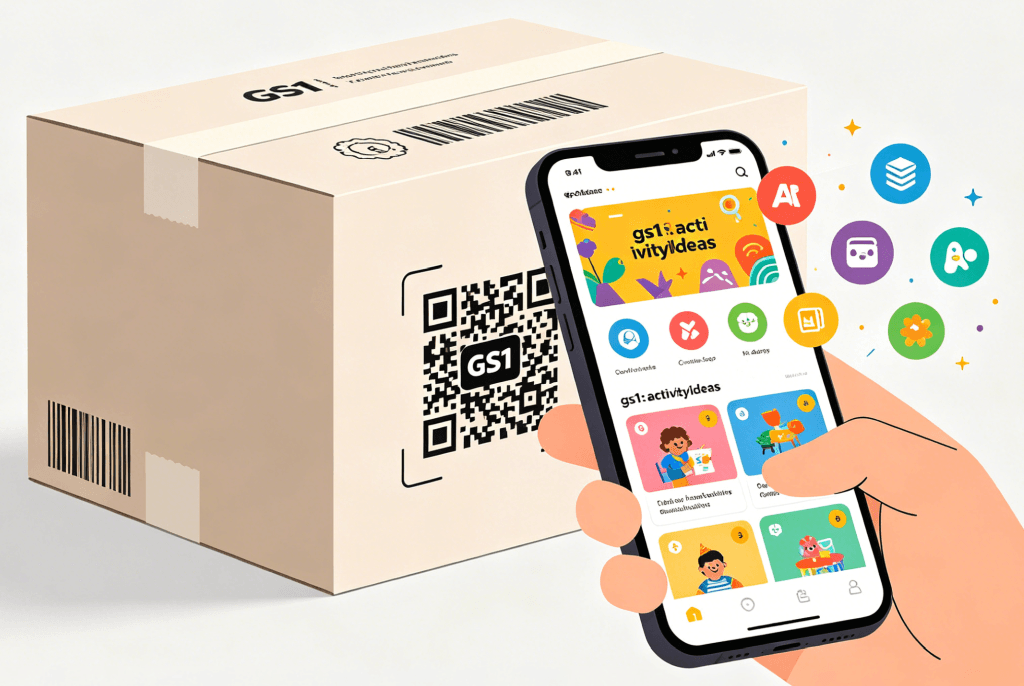
1. What is gs1:handledBy?
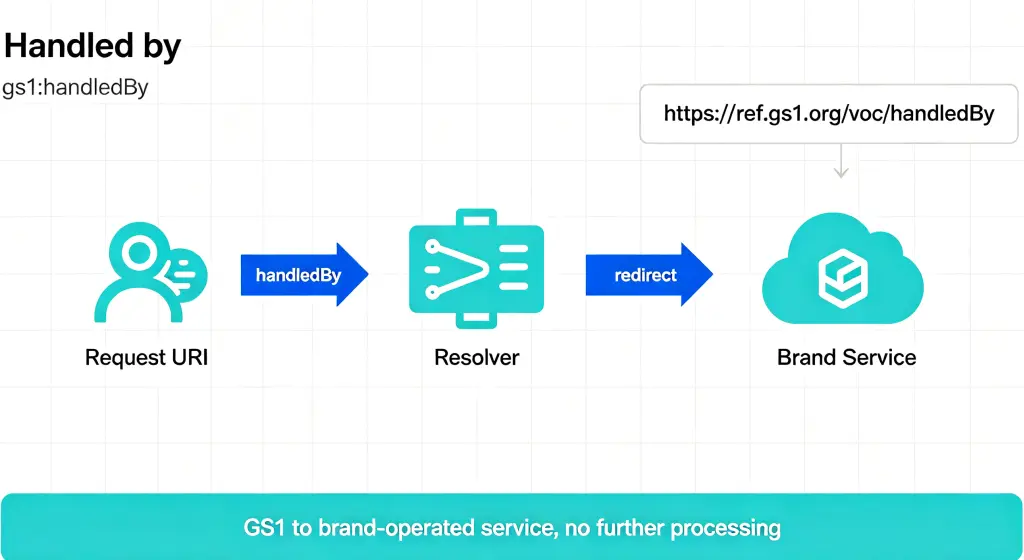
gs1:handledBy is a link type in the GS1 Digital Link standard. According to the official GS1 definition, it is used “when a resolver redirects all request URIs matching a specific pattern directly, without further processing,” for example, redirecting from the GS1 resolver to a brand’s own service.
In the GS1 Digital Link architecture, the Resolver plays the role of a “router” — it receives requests generated by user scans and then directs users to the correct information page (such as product detail pages, instructions, videos, etc.) based on predefined rules. The role of gs1:handledBy is to mark a “handoff” relationship: telling the system, “I’m not handling this request — another resolver takes full responsibility.”
Difference from Regular Link Types
Most link types in GS1 Digital Link (such as gs1:pip for product information pages, gs1:video for video links, etc.) are “content-type” — they point to specific information content. After receiving a request, the resolver redirects the user to the corresponding content page based on request parameters (e.g., linkType=gs1:pip).
gs1:handledBy, however, is a “routing-type” link type — it doesn’t point to any specific content, but rather to another resolver. Its logic is: “All subsequent processing of this GS1 Digital Link URI is the responsibility of the target resolver.”
User scans → GS1 Global Resolver (id.gs1.org) → Matches gs1:handledBy rule →
HTTP redirect to brand's own resolver → Brand resolver returns specific content based on request parameters
Standard Reference
gs1:handledBy is detailed in Section 7.7.1 “Pattern-Based Redirects” of the GS1 Digital Link Standard Version 1.1. The standard requires: when a resolver performs a redirect based on the Global Company Prefix and does no further processing, it must use the gs1:handledBy link type to label that redirect.
2. Why Use It
2.1 Enabling “Global Resolution + Brand Autonomy”
One of the core ideas of GS1 Digital Link is “global unified resolution, brand-driven distribution.” The GS1-operated global resolver (e.g., id.gs1.org) is responsible for resolving GS1 identifiers (such as GTINs) into accessible URIs, but what content is actually returned — product detail pages, marketing pages, instructions, or videos — should be decided by the brand itself.
gs1:handledBy is the key mechanism that makes this idea work. Brands can configure gs1:handledBy rules in the GS1 global resolver, taking over all GS1 Digital Link requests that belong to their own company prefix, and implementing fully autonomous content distribution control on their own resolver.
2.2 Achieving “Zero-Maintenance” Long-Term Stability
If a brand directly points a GS1 Digital Link to a specific marketing page (e.g., https://brand.com/summer-sale), once the campaign ends or the URL changes, all printed QR codes become invalid — and the QR codes on packaging cannot be modified.
With gs1:handledBy, brands keep final request processing rights on their own resolver. The GS1 global resolver does one thing: hand the request to the brand’s resolver. As for what content the brand resolver returns — a product page, a promo page, or a video — the brand can adjust it at any time on their own resolver, without changing the QR code on the packaging. Here, gs1:handledBy achieves the long-term stability of “code stays the same, content changes.”
2.3 Reducing Load on the GS1 Global Resolver
As GS1 Digital Link adoption grows, the request volume the global resolver needs to handle will grow exponentially. gs1:handledBy allows brands to divert the vast majority of request traffic to their own resolvers, so the GS1 global resolver only needs to perform a lightweight “routing lookup” operation. This keeps the global resolver running stably and also gives brands more autonomous control.
2.4 Supporting Multi-Level, Multi-Scenario Complex Distribution
Large brands often have complex business structures — different product lines, different markets, different languages, different user roles (consumers vs. professionals) all need to access completely different content. gs1:handledBy allows brands to build multi-level complex distribution logic on their own resolver, instead of cramming all those complex rules into the GS1 global resolver.
3. Typical Use Cases
Use Case 1: Brand Takes Over Its Own Product Traffic from the GS1 Global Resolver
A global consumer brand “Cloud Brew” has its own company prefix and brand resolver resolver.cloudbrew.com. The brand configures gs1:handledBy rules in the GS1 global resolver id.gs1.org: all GS1 Digital Link requests starting with that company prefix are redirected to resolver.cloudbrew.com.
When a consumer scans the QR code on product packaging:
- The request first arrives at
id.gs1.org/01/06933960552835 - The GS1 global resolver matches the
gs1:handledByrule and returns an HTTP 307 Temporary Redirect toresolver.cloudbrew.com/01/06933960552835 - The brand resolver returns the most appropriate content based on request parameters (GTIN, language, user device, etc.) — which could be a product detail page, a promotional page, or a usage video
The brand can adjust distribution strategies on its own resolver at any time, without coordinating with GS1 or modifying any printed QR codes.
Use Case 2: Third-Party Service Provider Offers Resolution Services to Brands
Not every brand has the capability to build its own resolver. A third-party service provider named “SmartLink Tech” specializes in providing GS1 Digital Link resolution services for small and medium brands. Multiple brands sign up with SmartLink Tech and configure gs1:handledBy rules in the GS1 global resolver, redirecting all requests to SmartLink Tech’s resolver.
SmartLink Tech’s resolver provides a unified content management backend for different brands, allowing brands to upload product information, marketing content, instructions, and more on their own. Small and medium brands don’t need to invest technical resources to build their own resolver — they get the full “global unified resolution entry + brand-driven content management” solution.
Use Case 3: Batch Rule Configuration Based on Company Prefix
A large enterprise group owns multiple brands and thousands of product SKUs. If each GTIN were configured with an individual resolution rule, the workload would be enormous and difficult to maintain.
With gs1:handledBy, the enterprise can configure a single rule based on the global company prefix: all GS1 Digital Links starting with that prefix (regardless of GTIN) are uniformly redirected to the enterprise’s own resolver. On their own resolver, the enterprise can then implement fine-grained item-level content distribution based on specific GTINs, batch numbers, serial numbers, and other parameters. This two-tier architecture of “prefix-level takeover + item-level distribution” greatly simplifies the configuration complexity of the GS1 global resolver.
Use Case 4: Rapid Switching for Regional or Time-Limited Campaigns
A brand has different marketing campaigns in different markets (China, Europe, North America). With gs1:handledBy, after taking requests to their own resolver, the brand can dynamically return content for different markets based on the request’s IP geolocation, user language preference, and other parameters.
Similarly, during the “618” shopping festival, the brand can redirect all scan requests to a promotional page, and switch back to the regular product page after the event ends — all without modifying packaging or QR codes.
4. Complete Usage Example
Configuration Example (in the GS1 Global Resolver)
Below is an illustration of how a brand configures a gs1:handledBy rule in the GS1 global resolver:
{
  "companyPrefix": "0693396",
  "handledBy": {
    "linktype": "gs1:handledBy",
    "target": "https://resolver.cloudbrew.com"
  }
}
Configuration Notes:
| Field | Description |
|---|---|
companyPrefix | The brand’s GS1 company prefix (globally unique identifier) |
linktype | Link type, always gs1:handledBy |
target | The URL of the target resolver; all matching requests will be redirected to this address |
HTTP Response Header Example
According to the GS1 Digital Link standard, when a resolver performs a gs1:handledBy redirect, it should include a Link header to label the redirect type:
HTTP/1.1 307 Temporary Redirect
Location: https://resolver.cloudbrew.com/01/06933960552835
Link: <https://ref.gs1.org/voc/handledBy>; rel="gs1:handledBy"
Response Header Notes:
| Field | Description |
|---|---|
307 Temporary Redirect | Temporary redirect, indicating subsequent requests should still go to the original URI |
Location | The specific URL of the target resolver |
Link | Labels the redirect’s link type as gs1:handledBy |
Complete User Scanning Flow
- Scan: The user scans the GS1 Digital Link QR code on product packaging, and the request arrives at the GS1 global resolver (e.g.,
id.gs1.org) - Rule Matching: The GS1 global resolver matches the
gs1:handledByrule configured for that brand based on the GTIN in the request - Redirect: The resolver returns an HTTP 307 Temporary Redirect, forwarding the request to the brand’s own resolver
- Brand Resolution: The brand’s own resolver receives the request and returns the most suitable content page based on parameters such as GTIN, language, and device type
- Content Delivery: The user sees the brand’s product information page, video, or interactive experience on their phone
Key Benefits
- Global unified entry point: All scan requests first arrive at the GS1 global resolver, ensuring global uniqueness and resolvability of identifiers
- Full brand autonomy: Content distribution strategy is fully controlled by the brand on its own resolver, without relying on GS1
- Zero maintenance cost: Once printed, the QR code is valid permanently; content changes only require adjustments on the own resolver
- Flexible and scalable: Supports batch rule configuration based on company prefix, as well as fine-grained item-level distribution
- Standard compliant: Fully conforms to Section 7.7.1 of the GS1 Digital Link Standard Version 1.1
Summary
gs1:handledBy is a link type in the GS1 Digital Link system that is easily overlooked but important. It doesn’t point to any specific content, yet it determines where all content ultimately ends up. It doesn’t directly serve consumers, but it is the mechanism by which brands achieve the core GS1 Digital Link concept of “global unified identification + brand-driven distribution.”
For brands looking to deploy GS1 Digital Link at scale, understanding and correctly using gs1:handledBy is the first step toward content autonomy and long-term operational stability while ensuring global compliance. It allows brands to confidently say: “Once the QR code is printed, the content is always in my hands.”