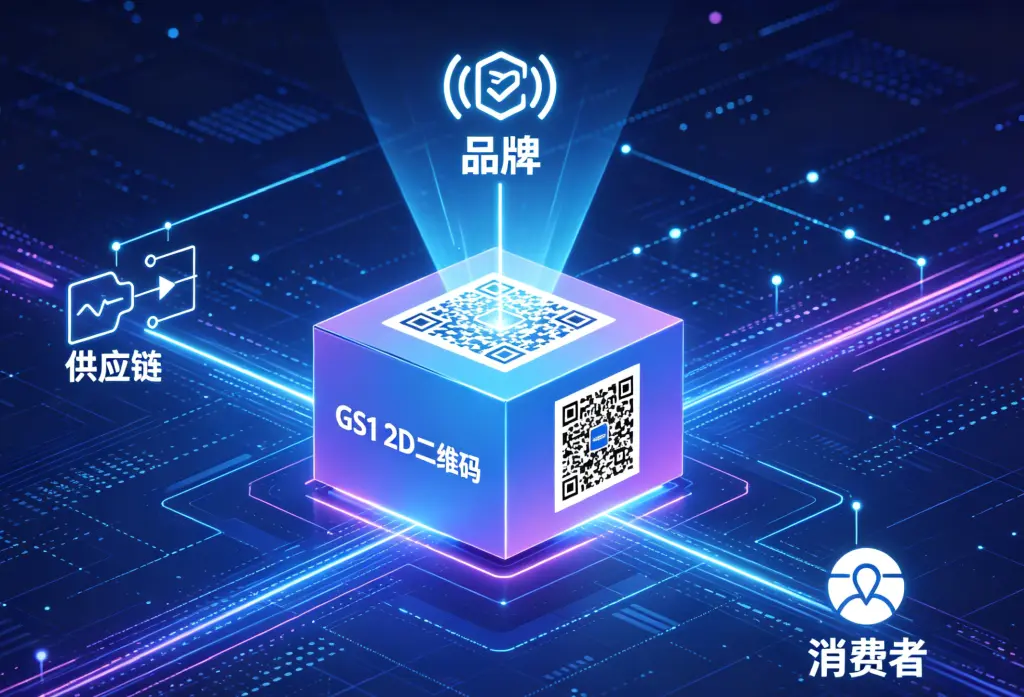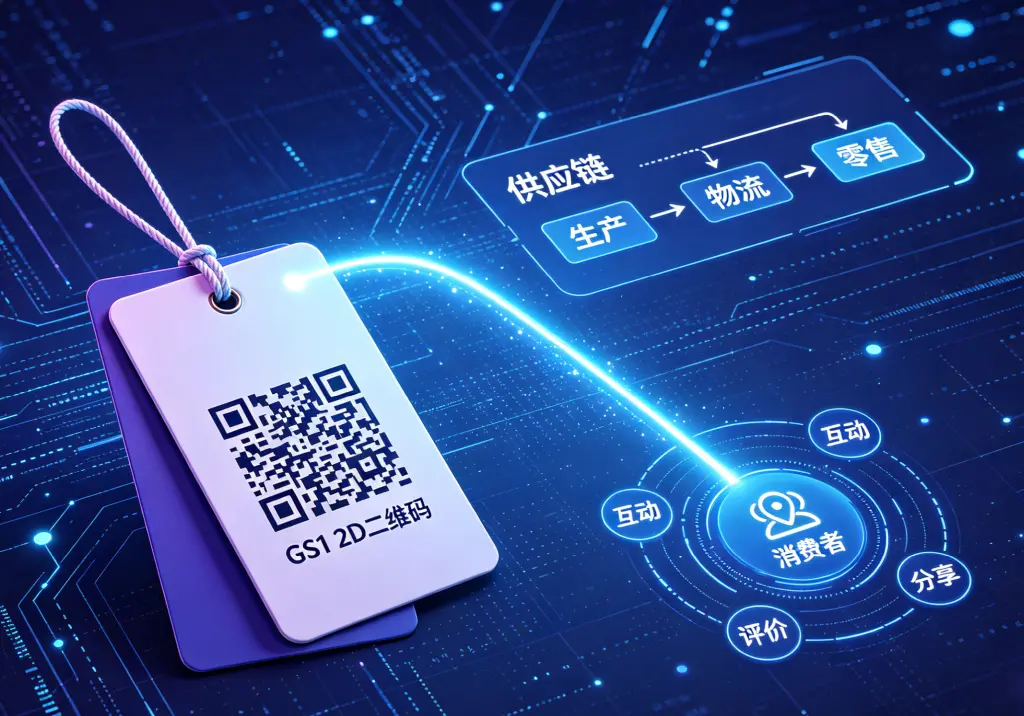
GS1 Digital Link is not merely a “QR code with a link” — it is a standardized URI protocol built on the GS1 global identification system, serving as the core infrastructure connecting physical goods to the digital world in retail. Centered on GTIN (Global Trade Item Number), it upgrades traditional 1D barcodes into a “one item, one code” gateway that carries unlimited digital content. It supports all data carriers including GS1 QR codes, DataMatrix codes, RFID tags and NFC chips, enabling “encode once, use globally, reuse across all scenarios”.
In the retail industry, GS1 Digital Link reshapes industry value across three dimensions: supply chain operations, consumer experience and compliance management. It breaks down system silos across upstream and downstream partners through unified identification, improving inventory and traceability efficiency; provides transparent, personalized shopping experiences for consumers via standardized digital entry points; and supports enterprises’ cross-border expansion and compliance requirements through a globally recognized regulatory framework. Handheld scanners, fixed retail scanners, mobile data terminals and consumer smartphones together form the full-scenario acquisition system for GS1 Digital Link, covering all retail processes including checkout, inventory management, warehousing and consumer engagement.
I. Supply Chain & Operational Efficiency: From Extensive Management to Refined Collaboration
1. Accurate Inventory Management and Cross-System Data Interoperability
Core Pain Points: Traditional retail relies on manual stocktaking and multi-system data integration, resulting in inventory accuracy generally below 90%, frequent out-of-stock and overstock issues. Inconsistent coding standards across brands and supply chain segments lead to fragmented data and low collaboration efficiency.
GS1 Solution:
GS1 Digital Link uses globally unique GTINs to enable “one code across the entire supply chain”. From factory production, warehousing and logistics to in-store shelving, scan data from all links is synchronized in real time to enterprise ERP and WMS systems, automatically updating inventory ledgers. It also supports standardized data exchange across enterprises and systems, allowing brands, distributors and retailers to share inventory and logistics information without additional conversion.
Outcomes:
- Inventory accuracy improved to over 98%, manual stocktaking costs reduced by 60%
- Out-of-stock rates decreased by an average of 30%, slow-moving inventory reduced by 25%
- Supply chain response speed increased by 40%, order fulfillment cycles shortened
2. Granular Batch Tracking and Targeted Recall Management
Core Pain Points: Traditional recalls rely on manual review of paper records, often requiring full-category recalls that cause massive product waste and consumer panic. Recall cycles take days or even weeks, failing to contain safety risks in a timely manner.
GS1 Solution:
GS1 Digital Link supports embedding granular attributes such as batch number (10), expiration date (17) and serial number (21) in the code. A single scan retrieves the full product lifecycle information. In the event of a quality issue, enterprises can quickly locate affected production batches, distribution ranges and retail stores via the traceability system, isolating only problematic products without recalling all items on sale.
Outcomes:
- Recall scope narrowed from “full category” to “specific batches”, product waste reduced by over 80%
- Recall cycles shortened from days to hours, significantly reducing safety risks and brand damage
- Automated compliance traceability reports simplify regulatory verification processes
3. Centralized and Unified Product Data Management
Core Pain Points: Enterprises maintain multiple sets of product materials and packaging designs for e-commerce, offline stores and cross-border platforms, leading to high management costs, inconsistent information and delayed updates, which result in consumer complaints and compliance risks.
GS1 Solution:
All product information is stored centrally in the cloud and served through a single GS1 Digital Link. Enterprises only need to update data once in the backend, and scanned content across all channels is synchronized in real time. It also supports customized displays by language, region, channel type (B2B/B2C) and user role — for example, consumers see product details, retailers see purchase prices and inventory, and regulators see compliance certifications.
Outcomes:
- Product material maintenance costs reduced by 70%, eliminating cross-channel information inconsistencies
- Content updates without reprinting packaging, shortening packaging iteration cycles from 3 months to 1 day
- Automatic adaptation to global multi-language and multi-regulatory requirements, significantly reducing cross-border operational costs
II. Consumer Experience: From Passive Shopping to Active Engagement
1. Instant Access to Full-Dimensional Digital Content
Core Pain Points: Traditional 1D barcodes only carry GTIN numbers and cannot display extended information such as ingredients, allergens, instructions or nutritional parameters. Limited packaging space cannot accommodate multimedia content like videos or 3D models, restricting consumer experiences.
GS1 Solution:
Consumers scan the GS1 QR code on product packaging with their mobile phones to directly access the brand’s official digital content page, obtaining all formats of information including text, images, videos and audio. For example: food products can display ingredient lists, nutrition facts, allergen warnings and cooking tutorials; home appliances can show installation videos, user manuals and after-sales service points; cosmetics can present ingredient efficacy, skin type suitability and user reviews.
Outcomes:
- Significantly improved product transparency and enhanced consumer trust
- After-sales inquiries reduced by 40%, lowering customer service costs
- Real-time content updates without reprinting packaging, enabling faster response to market changes
2. One-Click Product Authenticity Verification
Core Pain Points: High-value categories such as beauty, maternal and infant products, luxury goods and pharmaceuticals have long faced counterfeiting issues. Traditional anti-counterfeiting labels are easy to replicate, making it difficult for consumers to distinguish authenticity. Brands cannot track the circulation channels and scale of counterfeit goods, resulting in low anti-counterfeiting efficiency.
GS1 Solution:
Each product is assigned a unique and non-replicable GS1 Digital Link, combined with encryption technology and blockchain evidence storage. Consumers can instantly verify product authenticity with a single scan. The system automatically records scan time, location and device information, allowing brands to monitor abnormal scan behavior via the backend and accurately locate counterfeit sources.
Outcomes:
- Risk of counterfeit products entering the market reduced by over 60%
- Significantly improved consumer sense of security and protected brand reputation
- Established a closed-loop system of “scan to verify – trace genuine products – after-sales rights protection”
3. Immersive In-Store Interaction and Omnichannel Marketing
Core Pain Points: Offline stores struggle to provide personalized services and push targeted promotional information like online e-commerce platforms. Consumers’ offline shopping experiences are disconnected from online membership systems, leading to fragmented omnichannel experiences and low user loyalty.
GS1 Solution:
GS1 Digital Link serves as a digital gateway for offline traffic: consumers can scan codes to receive exclusive coupons, points and membership benefits, and participate in AR interactive games and lucky draws. Brands can build user profiles based on scan data to achieve “thousand people, thousand faces” personalized marketing. For example: scanning milk powder QR codes to receive parenting courses, scanning snack QR codes to participate in “collect cards for gifts” activities, and scanning home appliance QR codes to bind memberships for extended warranty services.
Outcomes:
- In-store scan conversion rates increased by 2-3 times, promotional event participation improved by 50%
- Integrated online and offline membership systems, user repurchase rates increased by 25%
- Established direct connections between brands and consumers, reducing reliance on third-party platforms
III. Compliance and Globalization: Standardized Passport for Enterprise Overseas Expansion
GS1 standards are the common business language adopted by over 150 countries and regions worldwide. GS1 Digital Link inherently possesses the characteristics of global interoperability, domain neutrality and standardized semantics, making it the core foundation for retail enterprises’ compliant operations and global expansion:
- Meet National Regulatory Requirements: Supports major global regulations including the EU Digital Product Passport Regulation, China’s Food Safety Law, and the US FDA Traceability Requirements, automatically generating product data and traceability reports required for compliance.
- Seamless Cross-Border Retail: The same GS1 code is recognized in any country worldwide, eliminating the need for recoding for different markets and significantly reducing cross-border operational costs.
- Simplified Supply Chain Compliance: Upstream and downstream enterprises automatically complete compliance declarations for customs clearance, commodity inspection and logistics through standardized GS1 data exchange, reducing manual intervention and errors.
Future Outlook: New Possibilities for GS1 Digital Link in Retail
With the development of AI, AR, digital twin and other technologies, GS1 Digital Link will evolve from an “information gateway” to an “intelligent interaction hub”:
- AI Empowerment: Combined with large language models, provide consumers with intelligent shopping guides, personalized recommendations and automatic Q&A services.
- AR/VR Integration: Scan products to experience virtual try-ons and contextual displays, creating immersive shopping experiences.
- Digital Twins: Build digital twins for each product, enabling full lifecycle digital management from production, circulation and consumption to recycling.
- Metaverse Retail: Realize unified identification of physical and virtual goods, breaking down the retail boundary between the real world and the metaverse.
GS1 Digital Link is redefining the concept of “goods” in retail — future products will no longer be just physical entities on shelves, but digital assets carrying data, services and experiences, and GS1 standards are the global common language connecting all of this.